Chapter 18 Part II: PDA Transducers
Topics
What is a PDA transducer
PDA transducer for converting infix notation to postfix
notation
A scheme for producing postfix from infix (no parens)
The PDA machine
Adding parentheses to our language
What
is a PDA transducer?
-
Ch. 8 discusses adding "output" to a FA to create a FA transducer
-
we can do the same thing with PDA’s
-
creating a pushdown (or PDA) transducer
We add to our PDA
-
a PRINT box
-
which can follow any READ or POP
-
and will print whatever was read or popped
PDA
transducer for converting infix notation to postfix notation
Infix notation:
-
conventional notation
-
uses "order of operations" rules for evaluation
-
for 2 + 3*5 , "*" must be done first
-
rules are called operator precedence or operator hierarchy
or operator priority rules
-
parentheses are used to override precedences: (2 + 3)*5
Postfix notation:
-
operands in same order, but no parentheses
-
operators "follow" operands: 1 + 3 Þ 1
3 +
-
2 + 3*5 = 2 3 5 * +
-
(2 + 3)*5 = 2 3 + 5 *
A
scheme for producing postfix from infix (no parens)
-
Operators cannot be printed until after the operands are seen: e.g. a +
b Þ ab+ . So we will save operators when
we read them, and print them later. We will save them on the stack
-
Think about a + b * c * d + e + f .
The red * would have been saved on the
top of the stack until after the c is read.
It can be printed at that point, regardless of what operator comes before
or after, because * has higher precedence that +. We would end up
printing the subexpression bc* (which is correct).
-
Think about: a + b * c * d + e
+ f .
The red + would have been saved on the
top of the stack until after the b is read. It cannot be printed at
that point, because * has higher precedence than +. We will have to:
-
push the * on top of the +
-
print the + when another + (or the end of the string) is seen
The
PDA machine
Here is a PDA that implements the above idea for
-
three operands: a, b, c
-
two operators: +, *
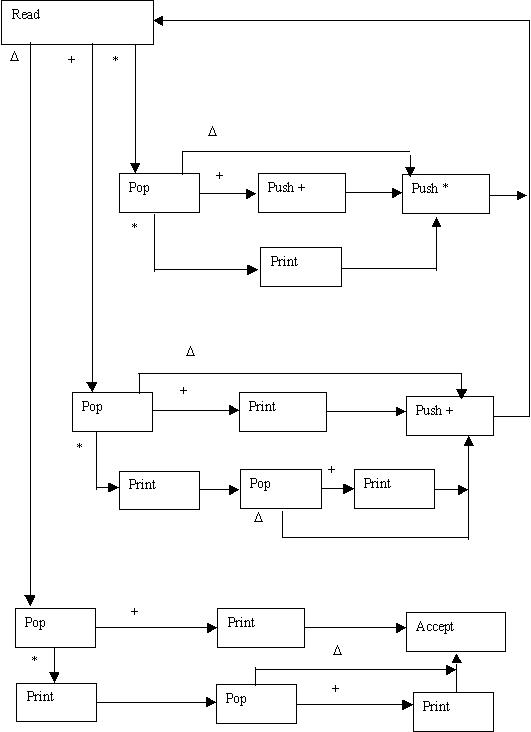
Let’s follow the workings of this machine for some sample input (the
stack is shown after reading an operator; the top of the stack is to the
right):
| input |
|
a |
+ |
b |
* |
c |
D |
|
|
|
|
| stack |
D |
|
+ |
|
+* |
|
D |
|
|
|
|
| print |
|
a |
|
b |
|
c |
*+ |
|
|
|
|
a+b*c Þ abc*+
| input |
|
a |
* |
b |
+ |
c |
D |
|
|
|
|
| stack |
D |
|
* |
|
+ |
|
D |
|
|
|
|
| print |
|
a |
|
b |
* |
c |
+ |
|
|
|
|
a*b+c Þ ab*c+
| input |
|
a |
+ |
b |
* |
c |
* |
d |
+ |
e |
D |
| stack |
D |
|
+ |
|
+* |
|
+* |
|
+ |
|
D |
| print |
|
a |
|
b |
|
c |
* |
d |
*+ |
e |
+ |
a+b*c*d+e Þ abc*d*+e+
Adding
parentheses to our language
Here is the scheme:
-
read a left paren Þ push it onto the stack
-
read a right paren Þ proceed as we would
have for end of string. Pop the left paren at the top of the stack (reject
if none there)
The complete machine (including parens) is given on p. 427 of our book.