Chapter
14: Pushdown Automata
Topics
The pushdown automaton (PDA)
Regular languages are accepted by PDA's
Example PDA
The
pushdown automaton (PDA)
We invent a new machine:
-
the pushdown automaton (PDA)
-
constructed by modifying a FA as follows:
-
add an arbitrary number of blank characters (called D
"delta") to the end of each input
-
add a push-down (LIFO) stack, initially containing a arbitrary
number of D ’s
-
all states will be exactly one of the following six types:
-
start state: no incoming transitions. This state will transition
immediately without reading any input.
-
read state: reads a new character from the input, and transitions
based on what was read. These states correspond to the ordinary states
of an FA.
-
accept state: special states, like the final states of a FA, but
have no out-going transitions.
-
reject state: special states that have no out-going transitions.
-
push x state: pushes a character x onto the push-down stack, then
transitions according to the one out-going transition.
-
pop state: pops a character from the stack, and then transitions
based on that character.
Notes:
-
the same label may appear on more than one outgoing transition (a PDA may
be non-deterministic)
-
similarly, the start state may transition to more than one state
-
there are no l-transitions
-
the machine may reach an accept state, in which case, the machine
halts and input string is accepted
-
the machine may reach a reject state, in which case, the machine
halts and the input string is rejected
-
there may be no transition specified for the character produced
by a pop or read state; in such a case, the machine halts
and the input string is rejected
-
a PDA may accept a string without reading the whole string
-
the vocabulary of characters that may appear on the stack may or may
not overlap the vocabulary of characters that may appear in an input
string
-
on my PDA diagrams, I will designate states: S = start, A = accept,
R = read, RJ = reject, P a = push a, Pop = pop
-
the language defined by a PDA consists of those strings that it
accepts
Regular
languages are accepted by PDA's
We only need to show that any FA can be upgraded to a PDA:
-
remove l-transitions
-
make each state a read state
-
add a start state with a transition to the FA’s start state
-
add a D -transition from each final state to
an accept state
-
there will, of course, be no push or pop states
Example
PDA
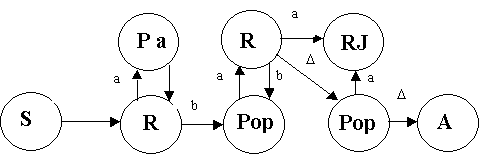
Trace of our PDA's behavior on the input string aabb:
| action |
input |
pushdown
stack (top at left) |
action |
input |
pushdown
stack (top at left) |
| Start |
aabbD |
D |
Pop (a) |
bD |
aD |
| Read (a) |
abbD |
D |
Read (b) |
D |
aD |
| Push a |
abbD |
aD |
Pop (a) |
D |
D |
| Read (a) |
bbD |
aD |
Read (D) |
|
|
| Push a |
bbD |
aaD |
Pop (D ) |
|
|
| Read (b) |
bD |
aaD |
Accept |
|
|
Based on this, can you tell what language this machine accepts?