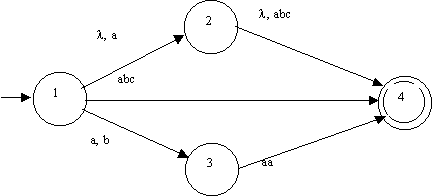
Transition graph (TG): a generalization of a FA
FA:
(1) set of states, one of which is a start state, one or more
of which are final states
(2) alphabet of input letters
(3) set of transitions, which can be represented as a function f(S,x)
which, for some (state, letter) pairs (S, x) defines a new state
Snew = f(S, x)
TG:
(1) can have more than 1 start state
(2) the same
(3) is different in the following way:
How does this machine work as a recognition device?
Question: What do we mean by acceptance, then?
Answer: If any legal sequence of states ends in a final
state with the input string consumed, the string is accepted. Otherwise
it is rejected.
(1) is "abc" accepted by the above machine?
(2) in how many ways?
Generalized Transition Graph
A transition graph where the edge labels are regular expressions
(not just strings).