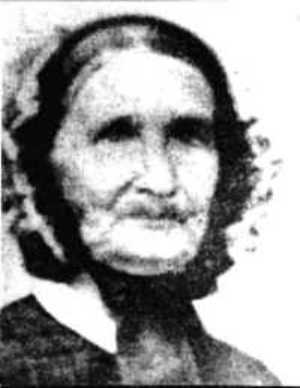
PERMELIA DARROW
| Birth | 15 December 1805 | Bridgewater, Susquehanna, Pennsylvania | ||||||
| Baptism | 13 December 1833 | |||||||
| Marriage | 27 April 1823 | Bridgewater, Susquehanna, PA | Cornelius Peter Lott | |||||
| Endowment | 20 September 1843 | |||||||
| Sealed to Parents | 07 Febrary 1930 | |||||||
| Death | 06 January 1882 | Lehi, Utah County, Utah | ||||||
| Buried | Salt Lake City, Utah | |||||||
| Children (Mother Permelia Darrow) | Parents | ||||||
| 1. Malissa Lott | 09 January 1824 | Tunkhannock, Lucerne, PA | -- Joseph Darrow | ||||
| 2. John Smiley or Lott | 23 March 1826 | Springville, Susquehanna, PA | Permelia Darrow-- | | | |||
| 3. Mary Elizabeth Lott | 09 March 1827 | , Susquehanna, PA | -- Mary Ward | ||||
| 4. Almira Henrietta Lott | 15 December 1829 | Bridgewater, Susquehanna, PA | |||||
| 5. Permelia Jane Lott | 02 October 1832 | Bridgewater, Susquehanna, PA | |||||
| 6. Lucinda Alzina Lott | 04 March 1834 | Tunkhannock, Lucerne, PA | |||||
| 7. Harriett Amanda Lott | 30 March 1836 | Tunkhannock, Lucerne, PA | |||||
| 8. Joseph Darrow Lott | 18 February 1839 | Kirtland, Lake, Ohio | |||||
| 9. Peter Lyman Lott | 02 November 1842 | Pittsfield, Pike, Illinois | |||||
| 10. Cornelius Carlos Lott | 30 September 1844 | Nauvoo, Hancock, Illinois | |||||
| 11. Benjamin Smith Lott | 16 November 1848 | Salt Lake City, Salt Lake, Utah |
(From Descendants of Cornelius Peter Lott by Rhea L. Vance, 1972)
Permelia Darrow, daughter of Joseph Darrow and Mary Ward Darrow, was born October 15, 1805 in Bridgewater, Susquehannah County, Pennsylvania.
She counted among her ancestors such characters of revolutionary fame as General Ward 1727-1800 and Captain Darrow. This was in the land of the Quakers where William Penn sought to establish a free state, founded upon the principal of the universal brotherhood of man.
At this time the district schools were much improved in the country and there were High Schools in many of their larger cities.
Permelia was a capable student seizing every opportunity for learning given at home and at schools of other places. She became a school teacher, and in spite of having to ride horseback to and from school each day, a distance of twenty miles, her school was a decided success. Her quiet pleasing manners with her daily public services made for her many friends, among the parents of the school. From the younger class her companionship was always sought. It is but natural that suitors should be treading the door step of the Darrow home and such is the case; for on April 27, 1823, she was married at Bridgewater, Susquehannah county, Pennsylvania to Cornelius Peter Lott, son of Pieter Lott and Mary Jane Smiley Lott.
Cornelius was a farmer, a tiller of the soil, so as the wife of -a farmer, Permelia always found much to do, cooking, washing, ironing, sewing and helping with the small chores on fhe farm. Then too, in 1843, a family started coming along to bless their home.
Comelius tried hard to make a good living for his young family, but was forced to move many times, where ever he could find employment.
Time passed rapidly on, and in 1837 the Lott family were introduced to the Gospel of Jesus Christ of Latter-Day-Saints. They knew this was what they had been searching for. Their life together must have been wholesome and happy for they both accepted the truth together and joined the Church in its infancy.
They gained a strong testimony that never left them.
Wishing to obey council and to be with the body of the Church they moved to Kirtland, Ohio. Being the only members of either the Darrow or Lott family to accept the Gospel, they abandoned all and cast their lot with the persecuted saints.
The terrific National Panic of 1837 was reaping vengeance, hatred, and contention among the people. When the saints were driven from Kirtland and Missouri, the Lott family settled Pike County, Illinois until 1842. Here another son, Peter Lyman Lott was born on November 2, 1842.
In 1842 Cornelius P. Lott became Superintendent of the Joseph Smith farm, located three miles from the city of Nauvoo. The farm consisted of one-half section of Praire land, with an eight room dwelling ·on it. Permelia became the landlady of this beautiful dwelling .
Permelia was a good mother, teaching her daughters the art of home making, and teaching all of her children the importance of education. They were taught to study and learn all they could about everything.
Cornelius and Permelia Lott became friendly with the Prophet Joseph Smith and his wife, and visited often with them. Their oldest daughter, Melissa, spent much time in the home of- the Prophet visiting and helping his wife. On September 20, 1843,.Melissa was married and sealed to the Prophet Joseph Smith for time and all eternity.
One day the Prophet came to the farm and said, "They are after me", meaning the mob was hunting for him and he asked Permelia to help him. She was making her bed. She took the feather tick off, opened the straw tick in the center and pushed the straw to
either side, making an opening for Joseph to crawl into the place between the straw. He did so, and she replaced the feather tick, made up her bed and when the mob searched the house they found no trace of the Prophet.
Their journey with the saints were filled with days of sorrow and days of joy. They had many visits with the Prophet when he taught them the Gospel and their souls were full of peace toward all men.
Permelia sustained her husband in all that he was called to do. She cared for her family while her husband filled a mission to Kentucky. She worked by his side on the farm. She gave her consent when he took another wife. Although this marriage did not last too long, she stood by him, as this was a commandment and they were ready and willing to obey council.
When the first company of saints started west, Cornelius and Permelia Lott were with them, but at Mount Pisgah they were detained for the years of 1846-1847 to help assist the thousands of saints on the westward move.
ln Heber C. Kimball's company in 1848 the Lott family arrived in Salt Lake City September 23, 1848. Here Cornelius built a home for his family. The master of the art of buildings must have been very busy as they were so many houses of the same kind. Rough
and unhewn logs-with the openings~between the timbers daubed with chinking and mud. Jouel Whide describes them:
| Of logs we built our houses, |
| Of shakes we made the doors, |
| Of sod we built the chimneys, |
| Dirt we had for floors. |
There were more than the coming December winds demanding a hurry-up job, for the shadow of the stork had been seen perched upon the dashboard upon two occasions while crossing the plains and now, November 16, 1848 their eleventh child, Benjamin Smith Lott, was born. Just one month and twenty-three days after their arrival in the valley.
To this family, this newly erected structure of two rooms, supplemented with wagon boxes was more than a house to live in, it was a mansion, a place to call home. The same hands that tidied the eight room dwelling where the Prophet sat, talked and visited, now swept with a sage brush broom, the dirt floor of their new cabin.
The same children who ran to meet the Prophet, walked and talked with him in the ba'rn-yard; and when he failed to catch his high spirited cavalry mount, Almira placed a rope around the horses neck and handed it to the distinguished master of the unruly animal. These children now, were entertaining their sweethearts and making plans for their marriages.
Mary Elizabeth was the first of Permelia's five daughters to marry. In November 1848, she was married to Abraham Losee, a convert to the church from Canada. He had driven a team to the valley for Bishop Whitney, arriving just nineteen days after the arrival of Mary Elizabeth. Their courtship dates back to Navoo, on the Smith farm where Abraham worked for Cornelius.
About four months later Ira Jones Willes married Melissa Lott Smith, the widow of the prophet.
A terrible and unexpected blow came to the Lott family, when on July 6, 1850, Cornelius Peter Lott father of this pioneer family of Permelia Darrow Lott, passed away. He was buried in the Salt Lake City cemetery.
By opening of spring of 1851, it became very clear that the absence of a father required new arrangements. Also the new members of the family urged the need of tilling the soil. Mary Elizabeth and her husband were now located upon their allotted twenty acres, located in Utah Valley. These were very reasonable causes for settling the Lott caravan once more in moving towards the south.
In the meadows a quarter of a mile north of the Lake, where there was plenty of clear cold spring water, the Lott settlement had its beginning. They had a log house with a dirt roof. Her children told of the long nights, when coyotes howled in the yard and kept them awake.
The first five years in Utah, Permelia Lott experienced the marriage of her five daughters. Had she personally made the choice of these sons-in-law, she could have done no better. They proved to be men of vision, full of enterprise and became the leaders of men and the fathers of typical Mormon families. Permelia often said that she just followed along with her children. They seemed to be her support and sustain her when trials came.
With this great mother, who had spent approximately fifteen years of her life as an active member of the church. These years were hard years. When the saints left Ohio, driven from Missouri and finally expelled from Illinois. Living in covered wagons and camping by the way side, from Nauvoo to finally settling in Lehi, had met with great endurance and fortitude. She was the mother of eleven children. Three of whom failed to endure the hardships and were buried in lonely graves along the plains. There remained with her three sons, John Smiley, age 26, Peter Lyman, age nine and Benjamin Smith, age 3 years. A quiet peaceful rest from the strenuous active, shifting life of the past many months, in the little log cabin on the grass lands near the lake, were the days of sweet repose.
This did not last long however. The Indians nearby were showing up and the Walker War had commenced at Provo. From headquarters came orders for the scattered houses to centralize. Among the many cabins that gathered at the fort, Permelia Lott, and her sons-in-
law were there placed end to end in the south part of the Lehi fort, At this time the fort wall was in the making and the 16 original city blocks, with 128 city lots had been surveyed. At the close of a year and a half of Indian war these fort houses made their final move to city lots. This was the fourth move for some of them.
That Permelia was the heart of this distinguished family is noticeable as they clustered around her cabin in the grass lands, and in the fort their houses were end to end, and in the Lehi City survey in the southwest corner of the plat, they were neighbors around the house of the woman they loved.
Permelia's home was built of adobe with two rooms downstairs and two rooms upstairs, on the corner of what is now 2nd South and 3rd West. What joy it must have been to have a home of her own where she could have some fruit and vegetables and above all some flowers. She had apple trees, currant bushes and raspberry bushes, and a beautiful flower garden,
She was unassuming in her quiet ways, and all who knew her loved her. Never out demonstrating, but always present in times and places where help was necessary.
She was ready for her well earned reward when she passed away in January 1882 at the age of 77 years. She died as she had lived, faithful to her trust. Her children lived well and held the faith she had taught them as their greatest possession.
She was buried in the Salt Lake City cemetary by the side of her husband.
08/31/99