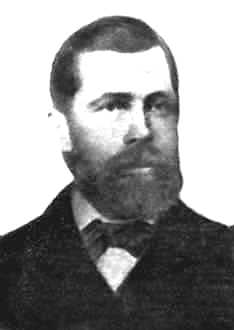
FREDRICK JULIUS CHRISTIANSEN
| Birth | 25 December 1826 | Hjorring, Hjorring, Denmark | ||||||
| Christened | 26 December 1826 | |||||||
| Baptism | 05 July 1853 | |||||||
| Marriage | 13 January 1856 | Aboard Ship - The Atlantic Ocean | Kirstine Marie Andersen | |||||
| (Other Marriages) | 25 January 1868 | Elsie Margaret Larsen | ||||||
| Kirsten Maria Jensen | ||||||||
| Endowment | 21 November 1859 | |||||||
| Sealed to Parents | 30 October 1895 | |||||||
| Death | 16 March 1920 | Mayfield, Sanpete County, Utah | ||||||
| Buried | Mayfield, Sanpete County, Utah |
| Children | Parents | ||||||||||||
| 1. Johanne Maria Christiansen | 29 September 1857 | ||||||||||||
| 2. Fredrick Julius Christiansen | 07 August 1859 | -- Christian Fredericksen | |||||||||||
| 3. Joseph Julius Christiansen | 10 May 1861 | Fredrick Julius Christiansen-- | | | ||||||||||
| 4. Karen Christiansen | 27 January 1863 | -- Maren Christendatter | |||||||||||
| 5. Marie Christiansen | 06 May 1866 | ||||||||||||
| 6. Son Christiansen | 23 May 1868 | ||||||||||||
| 7. Lorenzo Christiansen | |||||||||||||
| 8. Mary Christiansen | 28 June 1869 | ||||||||||||
| 9. Hyrum Julius Christiansen | 01 May 1871 | ||||||||||||
| 10. Elizabeth Christiansen | 03 May 1873 | ||||||||||||
| 11. Brigham Julius Christiansen | 27 March 1876 | ||||||||||||
| 12. Erastus Julius Christiansen | 17 February 1878 | ||||||||||||
| 13. Orson Julius Christiansen | 14 December 1879 | ||||||||||||
| 14. John Julius Christiansen | 28 August 1882 |
Compiled in 1993 by Rae Lou W. Olsen from an autobiography by Fredrick Julius Christiansen, a paper written by Sheryl Lee Voorhees in 1981, the minutes of the Mayfield Ward Relief Society - 1882 to 1900 and the memories of Orpha C. Whitlock and Hazel C. Peterson.
The heritage passed from one generation to another can influence many lives. Kirstine Marie Andersen and Fredrick Julius Christiansen were Danish converts to the Latter Day Saint Church in the mid-nineteenth century. The many experiences they had and the way they lived has left a rich heritage for their posterity.
Fredrick Julius was born on Christmas Day in 1836 in the city of Hjorring, Denmark to Maren Christensen and Christian Fredrickson. His middle name "Julius" means Christmas. When he was five and a half years old his family moved one fourth mile out of the city to Voen. Two years later they moved to Taars, one and a half miles east of the city. Fredrick Julius helped his family and took care of the few cows and sheep the family owned. He went to school from the time he was five years old until he was fourteen.
Life in Denmark was very good at the time Fredrick was a child. The houses were well built and well furnished and cleanliness was important to the people. When he was fourteen years old he worked with his father for three and one half years learning to make spinning wheels. After mastering this trade he hired out to a carpenter and learned the carpenter trade. For a few years he made spinning wheels in the winter and worked as a carpenter in the summer.
In Denmark every able bodied man had to serve in the Danish Army. Fredrick Julius was twenty three years old when he was called to duty in 1849. He didn't have to go in the army as early as usual because the poor people had to go first. At this time there was war with Germany. After being in one engagement he was sent to Copenhagen for exercise (training.) He was there from May 20, 1849 until July 2, 1849. Then he was sent to Fyen where he was in the Second Franstennings Jogereoyn Company Number 255. He was in Fyen only three weeks, then Fredericia another three weeks. His company then marched to Copenhagen and was there until Christmas, 1849. Then they marched to Odense and back to Fyen for five months and on to Middlefort for one month. He was in the historic battle of Isted, Schlesvig. He said they met the enemy on the twenty fourth of July and on the twenty-fifth he was wounded in the leg. He tells how "the bullet hit the bone, glanced off and back out of my leg and I picked it up from the ground." He packed the wound with ashes and kept right on marching with his company. (It's possible he received a small pension from the Danish government in later life because of this injury.)
After the enemy was driven back the company marched to the city of Schlesvig and then to Danevirke. They stayed in Danevirke until February 5, 1851. The company then marched to Sandoderborn on the Island of Ols and Fredrick Julius was mustered out of the service. He returned home and worked for J. A. Overson building houses in the country.
The Latter Day Saint missionary efforts were just beginning in Denmark at this time. Fredrick Julius' employer had talked with the missionaries and had told him about the conversation. Both Mr. Overson and Fredrick Julius believed what the missionaries had to say. This was in the summer of 1852. At Christmas time Fredrick Julius began to study pamphlets about the Latter Day Saint Church, but his father was against the doctrine, so he decided to drop contact with the missionaries and to have nothing to do with this church. He was troubled about this decision all winter, however, and he prayed often to be blessed with the power to do what was right. In April, while he and other carpenters were building houses, a missionary came at lunch time. Three of the workers, including Fredrick Julius, went to a meeting the next day, Sunday. He attended meetings regularly from that time on and was baptized on June 4, 1853, by Peter Christian Jensen.
Many of the newly converted Danish members were soon doing missionary work among their own people. Fredrick Julius was sent on a mission with Niels Jensen Simonsen to Binsler in November 1853. He was ordained a teacher at a conference in Steenfroin on December 15, 1853. Here he labored with P. Otteson for a time and then with Brother Gristaf until April 1854.
On May 2, 1854 Fredrick Julius married Johanna Marie Larsen and they moved to a one room apartment. Conference was held on August 13, 1854 and Fredrick Julius was appointed to labor on a mission with Jens Christian Jensen. These two men, together with the President of the branch visited the Saints and Fredrick Julius also served as Branch clerk. He was ordained an Elder on January 31, 1855 and continued working for the church. Tragedy struck that same year, as Fredrick Julius' wife, Johanna, died June 27, 1855, "having been sick for six months, having worked too hard and lifted too much."
At this time Fredrick Julius decided to leave Denmark and go to the Salt Lake Valley. He left his home in Taars, Hjorring County November 25, 1855 and went to Copenhagen. Here he and two others were detained for three days. They needed to get permission to leave the country because they were still in the army even though they were not on active duty. Later he went to Kiel on a mail steamer and joined the company of Canute Peterson, Captain. They went by train to Gluckstadt and then to Grimsby, England. From there they went to Liverpool by steamer and railroad. They arrived at Liverpool and bearded the ship "John J. Boyd" on December 5, 1855. The weather was stormy and the ship was held in port for a week, so they didn't sail until Wednesday, December 12. Fredrick Julius records there were four hundred thirty Scandinavians, fifty one British and forty-one Italians on board. (Another source reports five hundred twelve saints - Scandinavians, British and Italians sailed on the "John J. Boyd.") A note of interest is that seventeen percent of the passengers on board were artisans - carpenters, and related craftsmen like cabinet-makers, coopers, wheelwrights joiners, turners and carriage makers. Fredrick Julius would fit this group.
The weather was stormy most of the voyage. The sails were sometimes lowered because the wind blew so hard they couldn't be controlled. Even with bad weather the saints fared well They often sang and put their trust in the Lord for their safety. Later the captain of the ship was very disagreeable, and forbade the passengers to sing. The sailors were beaten with a long black whips. On January 11, 1856 a ship nearby was destroyed by the wind. Thirty of the seamen were rescued by the "John J. Boyd", but some were whipped so much by the first mate they could hardly walk when they arrived in New York Port.
Fredrick Julius was married to Kirstine Marie Andersen on board ship on January 13, 1856. We don't know if they knew each other before leaving Denmark or if they met during the voyage. It's possible they were acquainted, as they both spent time in the same area. Kirstine Marie was seventeen years old at the time of her marriage. She was born in Hallund, Hjorring, Denmark on October 15, 1838 to Marianne Nielsen (Jespersen), and Andrew (Anders) Andersen Uensen). She was baptized February 4, 1854. Her parents and several brothers were on board ship with her.
The "John J. Boyd" reached New York on February 16, 1856, after being at sea for sixty seven days. From New York the ship went to Castle Garden for a week. This was a compulsory landing place set up by New York State to help the immigrants. At Castle Garden there were facilities for changing money, buying inland passage tickets, forwarding baggage, obtaining meals and medical attention, receiving news from friends and sending messages to them, and even registering at an employment agency.
After leaving Castle Garden on February 22, Fredrick Julius and his wife traveled by railroad through Cleveland, Toledo, Chicago and on to A]ton, Missouri, where a branch of the church had been organized. They stayed there from March 1, 1856 until May 21, 1856. It had been a hard winter and Fredrick Julius found no work the first month. The second month there was some work. Many of the converts became ill because of the different climate and food. Fredrick Julius' knees and ankle joints became so stiff he could hardly walk. During May he was able to find work with a carpenter and earned money for rent and provisions. On May 21, 1856 they left Alton for Florence, Nebraska. Kirstine Marie took sick that day with chills and fever and was ill for three weeks. It took ten days to reach Florence and they stayed there until June 27, 1856. While in Florence, Fredrick Julius worked with a carpenter in both Florence and Omaha, just six miles away. They started the long tedious journey of one thousand miles on June 27, 1856.
Fredrick Julius had been able to pay his way across the ocean and to the take off point for crossing the plains. To cross the plains he drove a team of two yolk of oxen for Neils Bengstrom and Kirstine cooked and washed for him. In addition they paid Bergstrom one hundred dollars besides their labor so he would take them to the Salt Lake Valley. All went well with them on their journey. There were several stampedes where the oxen ran with the wagons. The first time was caused by buffalo running through the wagon train which resulted in the death of one young man.
While traveling by the Platte River they had to cross to the other side to gather wood to take with them as there would be nothing for kindling for the next two hundred miles. As Fredrick Julius crossed he was swept under and nearly drowned. On August 13th they arrived at Fort Laramie and on the 15th of September crossed the Bear River.
One can imagine the joy and relief of Fredrick Julius and Kirstine Marie when they reached Salt Lake City on September 20, 1856. They stayed in Salt Lake until October Ilth and then went to Brigham City. They stayed with Jens Christian Steenboren and worked for him for eight days. He wouldn't pay them anything but did give them room and board. On November 21, 1856 they took out their endowments in the Endowment House in Salt Lake City and were sealed together. Fredrick Julius' first wife, Johanna Marie was also sealed to him. The first winter in Brigham City Fredrick Julius made cooper ware (barrels) which was in great demand. He worked with Olson and Erick Cast making furniture for a few weeks.
In the spring of 1857, in Brigham City, Fredrick Julius was given a city lot and he built their first home. It was a dugout with rock walls. They moved in June 1, 1857. During this summer he made cooper ware and worked some of the time for Lorenzo Snow. Their first child, Johanna Marie, was born on September 29, 1~57. He then obtained another lot from Lorenzo Snow and built an adobe house with two small rooms. They moved into it on October 10, 1857. He sold the first lot and dugout for a cow.
It was at this time that Johnston's army came to Utah. Fredrick Julius tells about it this way :
"That fall, winter and summer there was a good deal of trouble among the people on account of the United States Army coming on to Utah to destroy the Mormons. The young men were called to go and meet them in Echo Canyon and others to stay and guard the town. Then there was a company called from Brigham City. I volunteered to go but was excused if I would let my coat go. I had a good overcoat that went and I stayed home because I had started to make spinning wheels and there was a great need for them, for folks were much destitute for clothes and there was nothing to be bought.
"I had to stand guard occasionally. One night Jens Keller and myself had to go about one mile northeast of town to stand guard and see if any would come in from the north. It started to snow and we could not see anything so we laid down in the snow. We had a couple of quilts along. In the morning we got up. There was about a foot of snow on top of us so we had it pretty warm and comfortable .
"I worked that winter making spinning wheels and I with Anders Peterson Busager worked together making cooper ware and spinning wheels. "
In the spring of 1858, orders were received to move south. Kirstine Marie left for Salt Lake City on April 6th. Fredrick Julius stayed to stand guard, to help make flour sacks, to fix wagons and to set fire to the town if the army came. He had word from his wife that his cow was lost so he was released from duty to hunt for the cow. Three days later he arrived in Salt Lake City and stayed there until May 4th. (He didn't tell if they found the cow.)
Fredrick Julius, Kirstine Marie and their baby next went to Spanish Fork. There was no work so they came to Ephraim with Peter Jensen. They arrived in Ephraim, a four year old settlement, on May 2·2, 1858 and stayed for some time with an old friend, Soren Jensen.
The people were in poor circumstances hecause the grasshoppers had eaten almost everything for the last several years. The people had to sell everything they could to get food. Spinning wheels were in great demand in Ephraim and Manti, so there was plenty of work for Fredrick Julius. He also made cooper ware part of the time.
Fredrick Julius was active in the affairs of Ephraim. He helped make roads and ditches and helped build school houses and church buildings. Construction had started on the Manti Temple and he helped with it. He also donated to the St. George Temple. Since Ephraim was a new settlement there was plenty of work. In addition to making spinning wheels, he built houses and made furniture. He was active in the church and taught the Elders Quorum until April 13, 1861 when he was ordained a seventy by Niels Benson.
The family lived in the fort for a while and then Fredrick built a house on a city lot in the fourth ward where they lived the remainder of time they were in Ephraim. He also labored as a teacher in the fourth ward.
Kirstine Marie gave birth to their first son, Fredrick Julius, on August 7, 1859. Joseph Julius arrived on May 10, 1861. Maren was born on January 27, 1863 and died the same day. Andrew Christian was born May 18, 1864.
It was during this time that Fredrick Julius "yielded obedience to the higher law of marriage" and took Kirstine Marie Jensen as a plural wife on July 16, 1864. Her husband, Soren Jensen had apostatized, and left her and their seven fully grown children. Soren Jensen had been a friend of Fredrick Julius and one would wonder if he took Kirstine, an older woman, as a plural wife to take care of her after she was left alone. No children were born to this marriage ,
Kirstine Marie gave birth to a daughter Marie on May 6, 1866. She died at age one and a half.
On January 25, 1868, Fredrick Julius took Elsie Margrete Larsen as his fourth wife. Kirstine Marie, the mother of all of his children to this date didn't accompany them to the Endowment House for the ceremony. She felt sad when they went to get married.
The housing arrangement of Fredrick Julius' families is not known while they lived in Ephraim.
Fredrick Julius had a great interest in the work of Salvation for the Dead. In October of 1872 he and Kirstine Marie were baptized in the Endowment House in Salt Lake City for some of their dead ancestors on two different days. Another day their daughter Johanna accompanied them and they were baptized for more.
During the next ten years while living in Ephraim, Kirstine Marie had six more children. An unnamed baby boy was born and died on May 23, 1868. Mary arrived June 28, 1869, Hyrum Julius on May 1, 1871, Elizabeth came May 3, 1873, Brigham Julius March 27, 1876 and Erastus Julius on February 17, 1878.
Three children were born to Fredrick Julius and Elsie Margrete in Ephraim. Ephraim Erastus arrived on October 14, 1870. He died at the age ten. Julia Ann was born December 23, 1872 and Christina on March 8, 1875.
In 1877 Fredrick Julius bought a farm on Twelve Mile Creek and became one of the early settlers of Mayfield. Part of his family moved to Mayfield that year and the rest in 1878. From the birth dates of some of the children one would think he moved his fourth wife Elsie's family to Mayfield first. Their fourth child, James Albert was born May 31, 1878 in Mayfield. Three more daughters were born to Elsie - Ephraimina on September 1, 1880, Ella on October 17, 1883, and Caroline on October 23, 1886. Ephraimina died in 1889.
Kirstine Marie's last two children were born in Mayfield. Orson Julius arrived December 14, 1879 and John Julius on August 28, 1882. She was a very busy mother taking care of her children. Overaperiod of twenty five years she gave birth to fourteen children, eleven of them living to adulthood. The sons were tall and handsome and the daughters were attractive.
Each of Fredrick Julius' wives had their own home, all within a block of each other. It is not known how Fredrick Julius divided his time between his families, but he did take turns with all of them. Only one instance where conflict may have occurred is remembered by a granddaughter. When one of the fourth wife's daughters was getting married, the fourth wife borrowed all the cream she could from the second wife. Someone saw plenty of cream in the fourth wife's cellar and inquired why she had borrowed cream from the second wife. The reply was that she would use her own cream for herself.
When Fredrick Julius was fifty-six years old he was called to go to Denmark on a mission, This call came on April 1, 1883. He left Salt Lake City April 11 and arrived in Copenhagen May 2, 1883. One would wonder what hardship this would put on a family and especially a polygamous familywith more than one household to support. His last child with his second wife was nine months oId when he left. A daughter was born to his fourth wife after he reached Denmark. Eight children were under ten years of age. One would assume the older children in the family had quite a bit of responsibility.
The first place Fredrick Julius was assigned to labor was in the Aalborg Conference. Then he traveled in the Hjorring Branch until October 15, 1884. There weren't many baptisms on this mission. In his autobiography he said, "The people were so prejudiced. There were so many different denominations and they believed one was as good as another. " His parents had died, but he made contact with other members of his family. However none showed any interest in the gospel. He comments about not having the best of health, because the climate was different than he was used to in Utah. He arrived home November 12, 1884.
Fredrick Julius was almost sixty-two years old when he was sent to the Utah Penitentiary for practicing polygamy. This is how he describes the experience:
"In the summer of 1888 I was looked after by Marshall Rasmus Clausen. He wanted to take care of me because I was married too much. I was arrested and had to meet in Provo in the District Court on the 29th of September, 1888. I was then sentenced to go to the pen for four months and pay fifty dollars and it cost forty-five dollars. I got into the pen on the 9th of October and out of it on the 20th of January 1889. That was for polygamy. I had another charge against me for adultery for which I had to give a bond for five hundred dollars while I was in the pen. I had to meet in court again on the 5th of February 1889, but that charge was dismissed because there was no evidence. There was at that time one hundred and eighty-eight brethren in the pen. I was at liberty again in 1889."
Fredrick Julius spent Christmas and his sixty-second birthday, December 25th, in prison. He had thirteen unmarried children at home at this time.
The children liked to visit in the home of Kirstine Jensen, the third wife. As she had no young children at home she enjoyed entertaining them. She died on October 15, 1892.
As soon as Fredrick Julius moved to Mayfield he was busy in the church and the community. He was a school trustee and held different positions in the church. The first Sunday School was held in his home. He was a teacher for many years and first assistant to the Sunday School Superintendent. On February 16, 1885 he was set apart as one of the Presidents of the 65th Quorum of Seventy. On October 28, 1894 he was ordained a High Priest by Henry Beal.
He states "At that time the First Council of Seventy asked the older men of the Seventies to go to the High Priest Quorum and let the younger men take their places."
From the minutes of the Mayfield Ward Relief Society we know that Kirstine Marie was an active member. She bore her testimony many times, gave opening and closing prayers, supported the gathering of Sunday Eggs for the Relief Society Hall and helped to gather wheat. She was listed as a teacher in the First Ward and had a turn for at least one year of keeping the sacrament service trays clean. Following are a few excerpts from the minutes:
June 26, 1882 Sister Julius felt well for the society and hoped it would prosper.
May 3, 1883 Opening prayer by Sister Julius. She gave a report of her ward.
July 28, 1883 Sister Julius willing to pay Sunday eggs and monthly eggs and help the needy and poor. (Everyone) should do all they could to gather means for the Relief Society Hall.
May 1, 1884 Sister K. M. Julius felt well in the gospel. Said her desire was to serve the Lord. Spoke of some of the signs of the coming of the Son of God. Said we were indeed a blessed people and if we are humble and prayerful the Lord will hear our prayers. She knew this was the true gospel of Christ. Exhorted all to cease back biting and fault finding, speak ill of no one, to be united, for in unity there is strength. The Lord will take care of his own. Had no ill feelings toward anyone. Desired to do all the good she could.
May 30, 1885 Sister Julius felt the remarks of the sisters had been good.
October 3, 1885 Sister Julius would help gather wheat.
February 27, 1886 Sister Julius felt to go ahead to do her duty. Sisters in her ward generally felt well.
February 3, 1887 Sister Julius said the sisters had a great work to perform. Great and good and wise men generally had good mothers. We should remember our prayers.
January 1, 1891 Kirstine M. Julius bore her testimony.
1894 Kirstine M. Julius became a member of the World Fair Club.
February 4, 1897 Pres. M. Olsen called for a vote of thanks from the sisters for Kirstine M. Christiansen for attending the sacrament service for this past year.
October 12, 1899 Benediction by Sister Julius.
Fredrick Julius did ordinance work for the first time in the Manti Temple on July 12, 1889. He went several times a year until 1912. From 1912 to 1916 he was at the temple for endowment work and baptisms every day the temple was open during the months from April till November. He accomplished two hundred sixty-nine endowments and some baptisms.
Elsie Margrete died on September 21st 1907. The log house she and her family lived in (located at 90 South 100 West) is still standing - one of the few original log homes remaining in Mayfield. However no one has lived in it since 1928 when son Albert moved out of the log home into the new home built just south of it.
For the last thirteen years of their lives Fredrick Julius could devote all of his time to Kirstine Marie. They lived in the two story adobe home he had built for her and her family.
A one story frame room was attached to the south. (The building located at 111 South Main has been remodeled and is a lovely home today. See picture section.)
Fredrick Julius had his carpenter and furniture shop by this home. It was located some distance to the east of the house. The front faced south and the back was against the sidewalk. The fireplace was on the west side and a large work bench ran from east to west in the front part of the shop. The north wall had shelves and places for tools and supplies. The wheel that turned the lathe was at the east of the work bench. He made his own glue and paint. The many articles he constructed included chairs, tables, cabinets, washstands, coffins and kitchen utensils. He helped build almost every home in Mayfield erected during his working years. His grandchildren enjoyed watching him work in his shop. He was patient with all of them. The older children turned the handle of the lathe as he made all sorts of wooden toys - including eggs, windmills and ball bats. He made stilts which the boys practiced using until they could really go fast through the mud. One granddaughter enjoyed a doll buggy he had made for her which was big enough for her to give her baby brother a ride. One great grandson is the proud possessor of his pocket watch and a great granddaughter has one of his tables.
Fredrick Julius enjoyed entertaining his grandchildren with shadow pictures made with his hands. There were all kinds of animals - ducks, geese, doves that would fly and peck each other. His grandchildren enjoyed riding in his fringed surrey pulled by handsome horses. In his later years he spent much time in the tithing office. He was secretary and took care of the fast offerings and Sunday eggs.
Daughter Elizabeth and her husband Chris lived with Kirstine Marie and Fredrick Julius to help take care of them in their later years. Kirstine Marie was not well and spent much time rocking in her chair by the fire. Fredrick Julius ends his story this way:
"On the 25th of December 1916 I am 90 years old. I have at that time twenty-one children, fourteen living and seven dead - one hundred and six grandchildren, eighty-four living and twenty-two dead - seventy great grandchildren, fifty-eight living and twelve dead."
Fredrick Julius was ninety-four years old when he passed away on March 16, 1920 in Mayfield, Utah. Kirstine Marie died two months later on May 22, 1920. What a heritage these two have passed on to their posterity. With the ever-changing world we live in, we can look to the standards and ideals set by this couple and become a better person because of the examples passed from one generation to the next.
Note: In the quotes from Fredrick Julius Christiansen's autobiography and in his travels with the army names are spelled as he wrote them.
05/13/99