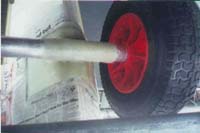
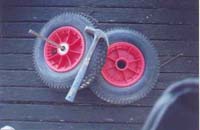
 The wheels are plastic rimmed builders wheel barrow wheels and come in widths from 4 to 8 inches. They can be purchased from hardware or stores that sell engineering supplies. First we need to knock out the bearings and this leaves a hole with almost a 2 inch dia but a slight taper towards the centre. |
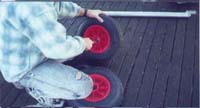 This taper needs to be removed with a rasp or 40 grit sand�paper so a 2 inch dia axle can be fitted and the wheels move freely on the axle. |
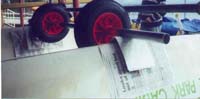 These beach wheels are being made for some small 12 ft Surfcats we use for kids training boats at our sailing club. As the boats a re small we are only using 4 inch wide wheels. We turn the hulls upside down and use them as a mould to make the cradles for the beach wheels. |
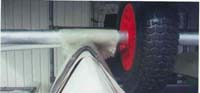 The hulls are protected from the resin with some newspaper and a inch layer of rubberised foam which becomes the padding the hulls sit on when the cradles are made. |
|
Over the rubberised foam we have layed up several layers of 450gram chop strand mat the a layer of 1/8 inch core mat and several more layers of 450 gram CSM. This layup is wet out with polyester resin and the quantity of resin required is 2.5 to 3 times the weight of the material to be wet out. |
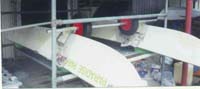 The beach wheels are nearly finished they just need the cradles to be trimmed and painted and some locating collars of 2 inch plastic pipe pop rivetted to the axle to�keep the wheels� next to the cradles� when the boats are being wheeled around. |
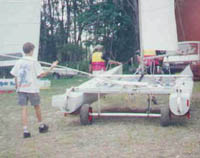
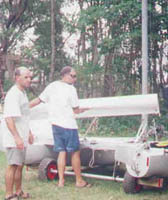 I have also see cradles made from aluminium. Seems like quite a simple process to shape the Aluminium to the hull make up supports to hold the shape and pop rivet them to the axle.