
Getting there:
You can either take an expensive tour for about 240 Pesos, or a private taxi for 750 Pesos. The best option however is to go yourself with public transport. You can best take a metro to "Autobuses del Norte". The metro system is very efficient. From there you go to gate nr. 8 and buy your ticket for the bus. It takes about an hour, and the bus drops you right at the entrance of the site. Admittance is 25 pesos.
 Next to the temple there is the Palacio Quemado (burned palace) containing a Chac Mol (god of the rain) statue. On the right of the pyramide you find the ballcourt - the heads of the loosing team were put up on the place in front of it.
Taxco - the silver city
160 km south of Mexico City lies Taxco. It was the biggest silver producing city of Mexico (so-called "capital of silver in the world"). It became famous by William Spratling, an US-American professor who started producing very valuable jewellery (Spratling Silver) as a silversmith. The house and fabric of Spratling are a museum about silver production today.
Many silver and jewellery shops are still located around the zocalo. The San Sebastian y Santa Prisca (constructed in 1758) is an increadible beautifull church with 12 altars. It is a must to visit.
Other things to visit are the Casa Humboldt (in honor of the German scientist Alexander von Humboldt), Casa Borda (the founder of the silvermine in the 8. century) and la mina de plata outside of the city (showing the conditions in the silvermines at that time).
Puebla - the city of 100 churches and Cholula (August 1999)
Puebla (130 km East of Mexico) is the 4th largest city of Mexico with 2 million inhabitants. Puebla is famous for its churches and its special mole poblano. The cathedral was built from 1585 until 1649. From its tower one can see the volcanoes Popocatepetl (smoking mountain) and Iztaccihuatl (white woman). The other most important churches are Iglesia Santo Domingo (1535) with an incredible baroque ornament decoration and Iglesia San Francisco.
When entering Puebla, you see the largest factory of Volkswagen in the world. The avenues leading into the city are loaded with shops from Bosch, Conti and other car suppliers. In the middle of it, I saw the German consulate of Puebla.
Next to Puebla lies Cholula, a village with the Tanapa pyramid, the second largest pyramid of the world. A bit strange is that a church was built on top of the pyramid. One can walk through a subterranean passage below the pyramid.
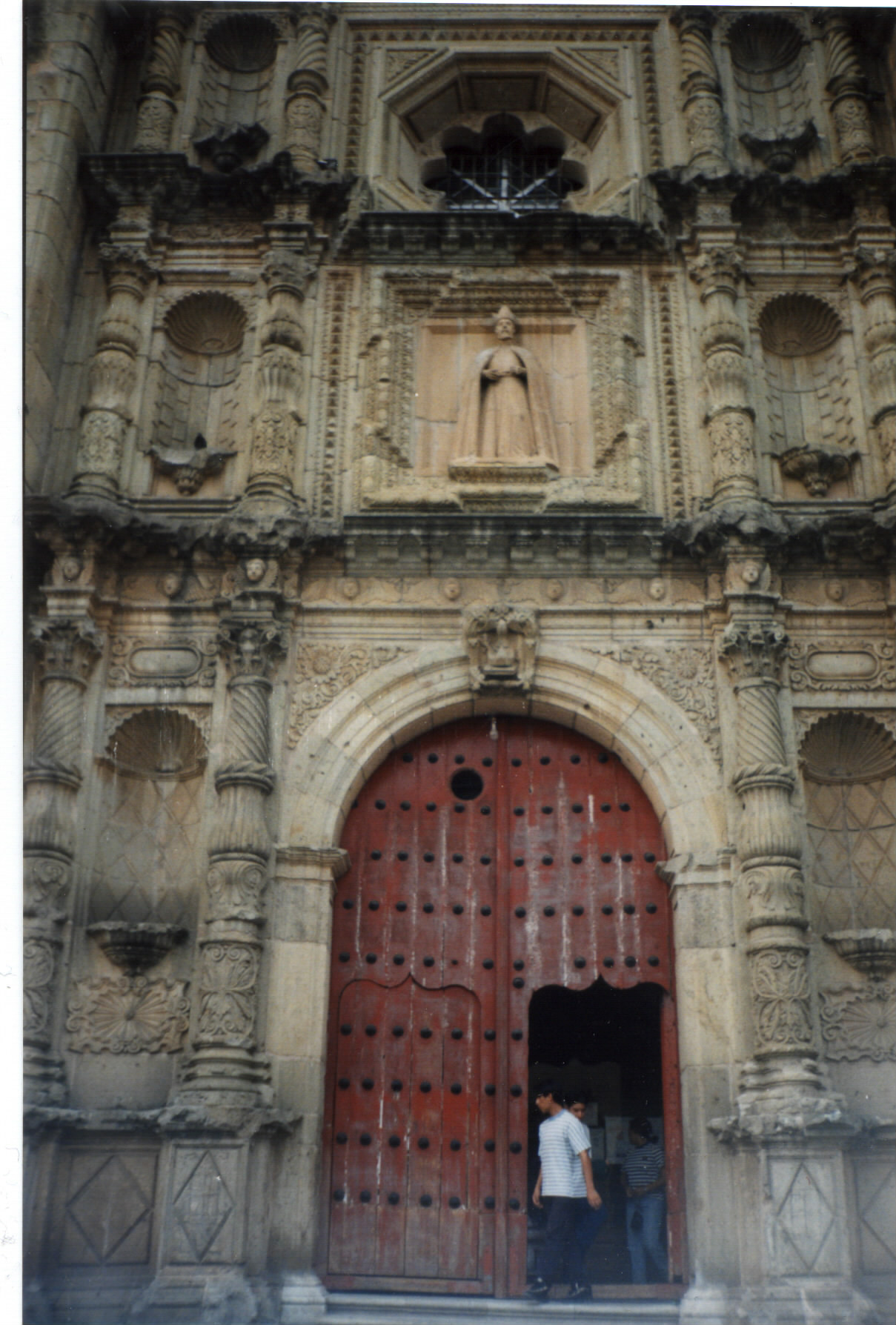
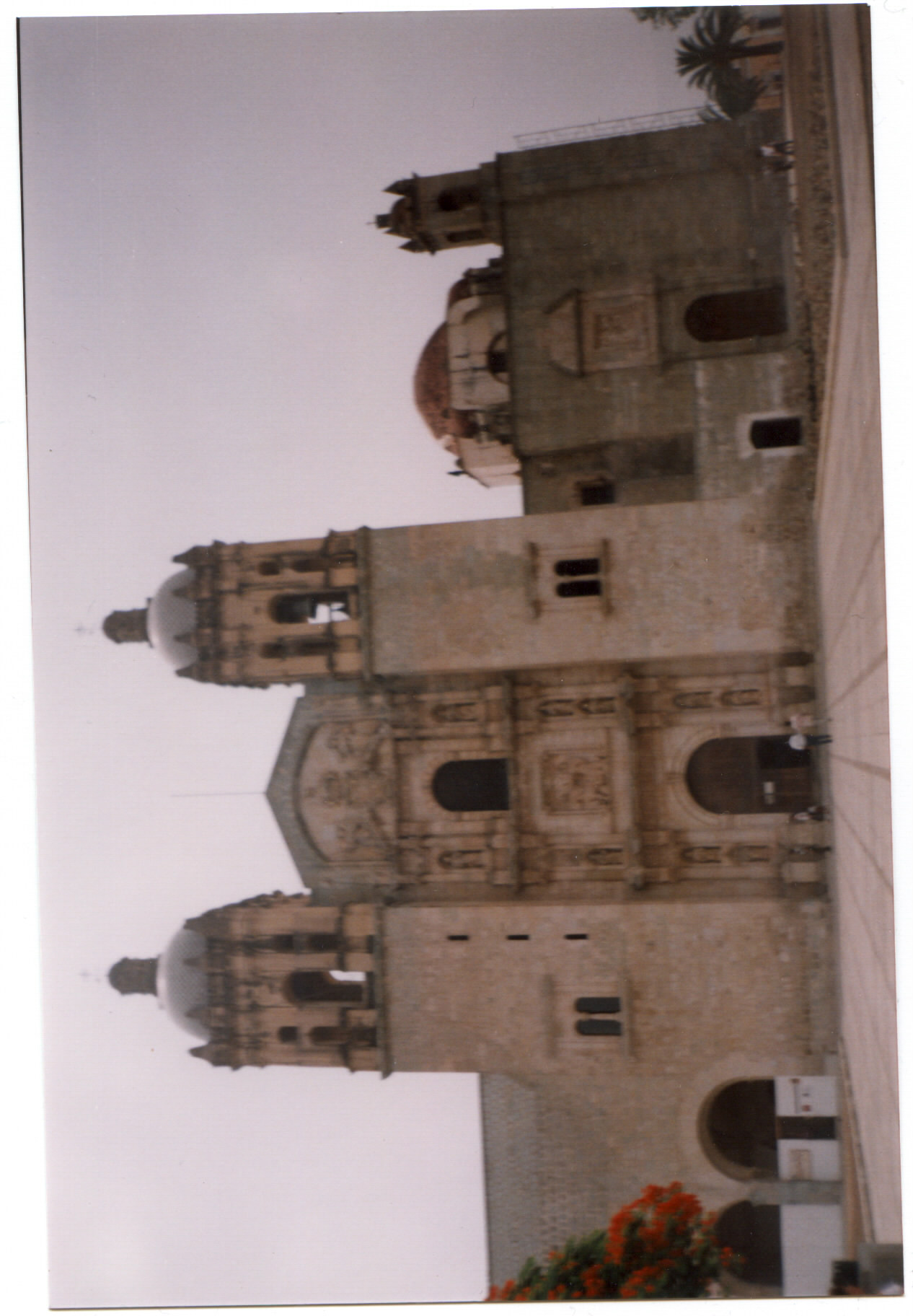
 The reason why you most likely went to Oaxaca is not the city itself, but the archeological site of Monte Alban. You can catch a bus from the hotel Meson del Angel. Monte Alban (white mountain) is the mountain village archeological city of the pre-Colombian Zapotecs. During the busride from Oaxaca to Monte Alban, one sees how the Zapotecs are living today - in small huts at mountain of Monte Alban.
Villa Hermosa (Tabasco) - open air park of the Olmecs (September 1999)
Because I had vacations during the holidays of Mexican independence, I visited Villa Hermosa (Tabasco) and Paleque (Chiapas).
Villa Hermosa is the capital of Tabasco. First, I watched the parades of schoolchildren. All were marching with their school uniforms, having a huge Mexican flag in their hands. In the other street, I watched a parade with and men and women on horses dressed in western cowboy like style. Finally, in the street next to the river, I watched a parade of police and military.
The biggest attraction is the Parque Museo de La Venta. This is an extraordinary open air museum. It is superb walking through the forest, seeing the huge heads of the Olmecs (They are over two meter high and the biggest is said to weight 24 t - they do not have any Mayan style, but rather look African). Furthermore, the park has a small lake with different kind of fished (unfortunately also including mosquitoes). I relaxed under palm trees just enjoying the beautifull surroundings.
The other important site to visit is the Museo Regionale de Antropologia. It contains a wide exposition of the Olmecs in the Tabasco region and the Maya in Mexico including copies of the frescos in Palenque and Bonampak.
Palenque
From Villa Hermosa, I went by bus to Palenque. On both sides of the road were palm trees, jungle with huge ceiba trees (the ceiba tree meant to the Mayas the tree of life). When entering the state Chiapas, we were not controlled by the military, but saw some military shelters. Along the street, I saw some huts and donkey - civilization seemed to be far.
When I got of the bus in Palenque, it seemed like 35 degrees humid weather. First, I did not find around, but ask some Norwegians and French people who are telling me which hotel to take. Just take a pasero the 7 km to the ruins. It is cheap.
If you have a Mexican student ID, you can enter the site without paying. First, I went to the Templo de la Calavera (temple of the skull) and the Templo de las Inscripciones (temple of the inscriptions). Then, I went into the jungle. Suddenly, I see the Templo del Jaguar. Though one can go inside, I did not manage because I did not have a flash light wit me. In the jungle, one can walk 7 km on top of the mountain, but a guide is needed for that.
In the middle of the archological zone, the palace has many courtyards and stucco relief. On the other side of the river, one can visit the Grupo de la Cruz including a variety of temples. Behind this complex, one finds an obeservatorio in the jungle, which you can not see from outside. Crossin the Arroyo Otolum (otolum stream), you can see the Complejo Murcielagos (bat complex), the Motiepa waterfall with the jungle setting. Altogether, Palenque is - until now - my favorite site in Mexico!!
The other day, I went to the cascades of Misol Ha and Aqua Azul. The Misol Ha waterfall (20km south of Palenque) plummets nearly 35km into a small lake. Within the jungle surroundings, it is increadibly beautifull. The Aqua Azul cascade are composed of many small waterfalls. It is very refreshing and you can make a little walk around the indian villages.
The central highlands - Road of Independence
(September 1999)
Queretaro
250 km Northwest of Mexico lies Queretaro. In Queretaro, the independence movement began in 1810. The city is very clean, has many trees and has many historical colonial buildings. Many houses are made of red sand stone. At the zocalo, the Monumento de la Corregidora (monument of the mayor`s wife) is honoring Josefa Ortiz de Dominguez who told the conspirators of the independent movement that their plot had been discovered by the Spaniards. Around the main plaza, many restaurants and churches are located. The Iglesia San Francisco and the Museo Regional (mostly exhibiting the independence movement and the french domination) at that place should be visited.
Another place to visit is the Palacio de Bellas Artes and the Convento San Augustin (monestry St. August). In this monestry, the emperor Maximilian was put in jail in 1867 before he was executed. In the west of the city Cerro de las Campenas with a monument for Benito Juares (the democratic elected president fighting again Maximilian) and Maximilian (where he was shot) is located. This monument is on top of a hill from where is a beautifull view.
Guanajuato (October 2001)
The capital of the state Guanajuato is located 90 northwest of San Miguel de Allende. The city is famous for silver mines, buidings in a colonial and classical style and the subterranea.
When coming to Guanajuato, you enter the city through the subterranea, a street going beneath the city for one or two kilometers(it had been a river before, which was dried out).
Since the 17. century, silver mining was done in this region. The mine of Valencia was the sign of the silver mining. One should definetaly visit the Valencia mine (5 km north of Guanajuato) and its adjunctant monastry.
Driving along the panoramica (panorama street) is recommanded because the great view over the city is really great. You can see the houses and churches of the city at best from the Pipila memorial (memorial for one of the heros of the independence) on the panoramica.
The fortress "Alhondiga de Granaditas" is today used as the "Museo del Estado" for the heros of the independence movement. During the independence war, it was used as a prison for the insurentes (independence fighters). It is said that the heads of Hidalgo and Allende were publicly placed there.
Another interesting museum is the "Museo de las Momias" showing more than 100 well preserved momies.
Other sites to visit are the center of the city with the "Jardin de la Union", a place surrounded by classical buidings, theater and churches. Next to it lies a museum about Diego Rivera, who was born here.San Miguel de Allende (October 2001)
San Miguel de Allende is a colonial city 650 km from Mexico City. The city is famous for Allende, one of the insurentes (fighters for independence during the war of independence) together with Hidalgo.
Museo Historico de San Miguel
La Parroquia de San Miguel
Templo de San Francisco
Hotel: We stayed in the hotel Quinta Lorento which was quite a fair value.
Restaurants: The Posada Carmina in a nice inner garden is a good restaurant for breakfast. We did not enjoy the Rincon Espanol for dining too much, because the food was not the best. Better go to La Grotta near the center. The serve large pizzas for a good price.
Dolores Hidalgo (October 2001)
The town Dolores Hidalgo (40 km northwest of Allende) was named in honor of the catholic priest Hidalgo rung the bell of this church in 1811 for showing the pain the people had with the Spanish occupation. By this, he started the Mexican independance movement, but the war of independence lasted until 1821.
The most important site to visit is of course "La Parroquia de Nuestra Senora de Dolores Hidalgo", the church that bells were rung by Hidalgo. Other than being an historic event it is not really interesting.
Outside of the church are vendors of ice-cream "Nieve de sabores" on the main plaza outside of the church providing traditional mexican flavors like mole or different kind of chile. Though I did not have any problem with ice-cream, you should be cautious about it because it might hurt your stomach.
The other site to visit in Dolores Hidalgo is the "Museo de la Independencia Nacional". Here, you will find a small but interesting collection of paintures about the independent movement starting in Dolores Hidalgo. Another museum to visit is the "Museo Casa de Hidalgo" which had been the private home of Hidalgo.
The Pacific Coast
Acapulco 1-3 October 1999
The name is just a symbol for sun and beach. I am personally not a big fan of beaches, but still I can give you some advises about the city.
We went to Acapulco for one weekend.
Taking the early bus at 7:30, the landscape during the journey was very beautifull contaiing hills with tropical trees and catuses.
When arriving to Acapulco, I was shocked at first when I saw small cabins shabby roads and people in rags just at the side of our highway. But then, we came to a tunnel and at the other side was the bay full of nice hotels and tourists. The tourists are mostly protected from the locals. You only see them as vendors and - of course - as servants in the hotels who only receive the minimum wages. The only rich peolple are the owners of hotels or the construction enterprises.