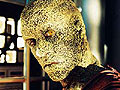
Date: Unknown (4 months, 2 weeks, 6 days after "Broken Bow")
When Enterprise narrowly escapes destruction at the hands of a volatile plasma storm, Archer is shocked to learn that his Suliban nemesis Silik is responsible for their survival. That shock is soon superceded when he discovers that a member of his own crew is a time traveller from the 31st century, and is trying to apprehend Silik to gain information about the factions involved in the Temporal Cold War.
Summary
Crewman Daniels brings Archer his breakfast, noting that the ship has changed course. Archer explains that they have detected a number of ships inside a spectacular stellar nursery. Upon arrival, Archer hails a transport vessel. Its captain says that he's in the neighbourhood for a job: he's transporting religious pilgrims from a number of different species to witness the "Great Plume of Agasoria", a hydrogen flare which his passengers hold to be a sacred event. Archer invites the pilgrims aboard, giving them a tour of the ship with includes Engineering. Breaking away from Tucker's lecture on the warp reactor, one of the pilgrims pops open a hatch on the side of the engine and disconnects a conduit inside.
Archer is with Phlox and the pilgrims in sickbay when a plasma storm begins to buffet the ship. Although Mayweather tries to navigate around it, charged plasma strikes Enterprise in a direct hit to the warp manifold. A cascade effect begins, rippling through the engines, building towards a core breach - until it reaches the conduit which the pilgrim removed, stopping the cascade and preventing the ship's destruction. Tucker questions his staff as to who disconnected the component, but no-one claims responsibility.
As Archer contemplates who could have been responsible, he is approached by Daniels, who claims that the Suliban whom Archer fought on the helix, Silik ("Broken Bow") is responsible for saving the ship. In Daniels' quarters, he tells Archer that he is a time traveller from approximately 900 years in the future, who has been assigned to apprehend Silik in the hope of gaining more information about the person or persons giving him his orders in the Temporal Cold War. He shows Archer his portable "temporal observatory", noting that after time travel was made possible, laws were drawn up - the so-called "Temporal Accord" - that races with the technology to travel through time were bound by. Archer correctly surmises that some factions have failed to act by the Accord, and that that is the basis for the Cold War. Daniels says that his superiors believe that the 22nd century is a front in the war, but that he needs to capture Silik to find out more. Archer agrees to modify Enterprise's internal sensors to try and locate the Suliban, despite his misgivings about trapping a man who saved his ship from being obliterated.
Phlox returns from spending the night with the alien pilgrims on the transport ship, bringing some of them back with him to observe the Great Plume from Enterprise's mess hall. When Archer returns to his quarters, Porthos won't stop barking. Curious, the captain's gaze tracks the room ... to fall on a pilgrim's hood. He reaches for the comm, but is stopped in his tracks by Silik's voice. The Suliban materialises and claims responsibility for saving the Enterprise from the cascade effect. He asks who is looking for him; in response to Archer's denial of all knowledge, he says that he's detected tachyon radiation aboard ship, and nothing Starfleet has emits tachyons. Archer remains tight-lipped ... until T'Pol contacts him over the comm, telling him that Daniels is eager to begin. Silik stuns Archer and leaves the captain's quarters.
In Engineering, Daniels brings the new sensors online, and they instantly detect that Silik is somewhere on his very deck. Quickly, he has Engineering evacuated, but Tucker and T'Pol hang back near the entrance. Daniels turns to see Silik levelling his weapon at him. "Did they tell you the 22nd century would be your final resting place?" the Suliban sneers, before firing his weapon. Daniels initially temporally dislocates before a second shot causes him to fly apart. Silik disappears again as Tucker summons Phlox to the captain's quarters to revive the unconscious CO. Furious at his own incapacitation and Daniels' death, Archer has Reed begin a search for Silik and orders Tucker to try and use Daniels' sensors to find the intruder. Although neither heads nor tails can be made of the scans, someone sends an encrypted message via the comm system. Using some sort of phasing device which Daniels earlier used to walk through a bulkhead, Archer catches up with Silik, who has taken Daniels' temporal observatory device. Realising that it could tip the war in favour of whoever is giving Silik his orders, Archer attacks the Suliban. The fight ends up in the main loading bay, where Silik camouflages and opens the main doors, opening the bay to space. Air rushes from the bay, Archer barely managing to keep a grip; Silik leaps through, falling from Enterprise to an incoming Suliban ship. Archer manages to repressurise the bay, and orders T'Pol not to pursue Silik as he takes his vessel to warp.
Later, an exhausted Archer orders Daniels' quarters sealed off, as protection against whatever futuristic devices may still be contained within.
Review
I was looking forward to this one. The Temporal Cold War (TCW) storyline is an example of the sort of television I really enjoy: respectful of continuity yet still primarily episodic, satisfying in terms of foreshadowing, overriding arcs which weave together many different plot threads. It's for these reasons that I loved early X-Files and think that Deep Space Nine is the best of the Trek series. It's also the reason that I thought Babylon 5 became far too self-involved (although, from what I've heard, it works well in syndication). I've speculated on the potential for the marriage of the Vulcan/Andor storyline with that of the TCW previously on these webpages; this episode only adds fuel to the fire as far as the rumour mill is concerned. What does Daniels mean when he says that he's "more or less" human? Is there more than one way to "define" Earth? If there is ... what the hell does it look like in 3050? Why does Daniels "refract" and "explode" when he dies - is it because he was only "more or less" human, or was he somehow out of phase with the 22nd century? And then there's the favourite question of fans since the pilot: who is Evil Future Guy?
These questions riddle the episode; they're never far from the back of the viewer's mind. They form its backbone, and for the most part that's a damn solid spine. But they also form my only major quibble with this instalment. Although Silik's quite right that it's possible Daniels is lying to Archer, I found it highly unlikely. One, Daniels was (more or less) human. Two, Silik is working for an Evil Future Guy who took out his eyes because he failed in a mission. Three, Silik is a sneering, evil, conniving old bugger who's tried to kill Archer once already. (Did you see the smug look of victory on his face when he vapourised Daniels? No-one that nasty can be good.) Characters' motivations have to be kept hazy in this sort of morally ambiguous situation, otherwise the audience sides with one faction from the off and our prejudices are set. Mine are already set against Silik and his faction (another interesting term, implying that more than two groups are competing for supremacy); in that sense, this episode has failed. The bias needs redressing.
Although that point is crucial to the long-term arc, it's not too much of a problem yet - and it certainly doesn't detract from the fact that "Cold Front" is one of Enterprise's best episodes yet, if not the best. I certainly enjoyed it more than "Strange New World", preferred its theme to that of "Fortunate Son", felt that it (to put it politely) urinated all over "Unexpected" and that its premise was far more original (in Star Trek terms at least) than that of "Civilisation". One of the highlights for me was the clock that the pilgrims gave Archer, reminiscent of the Saltah'na clock given to Sisko in "Dramatis Personae". In fact, the pilgrims were a very interesting menagerie of aliens indeed, and it was perfectly in keeping with what we've learned of Phlox's character that he should be the one to spend time with them and learn their religious practices. The offer to him to lead the invocation at the moment of the Great Plume was inspired - a real opportunitu for John Billingsley to convey the Denobulan's love of new cultures and civilisations, and for us as viewers to explore them with him. It's probably the one incident that's most in keeping with the original Roddenberryian ethos of Star Trek that Enterprise has come up with so far. One might, however, wish to argue that seeing another underhand conman transport ship captain in Fraddock might give those who claim that the show is inherently racist and humanocentric some ammunition.
After all the stick that I've given Tucker in the past few weeks, this episode he's a delight. He has two particularly standout scenes. The first is his lecture to the pilgrims, wherein he unconsciously equates a deep spiritualism with a technological ignorance, and is surprised to find that one of the aliens is a warp field theorist. His assumption also lends Silik his opportunity to sneak away from the group and commit his Samaritan mission. The second good scene is that with Daniels in Engineering, where his boyish enthusiasm for meeting someone from the 31st century and his playing with the crewman's futuristic toys really chimed with my own feelings about the time traveller. For the first time here, I actually felt the crew's excitement at discovering something new. The planet in "Strange New World"; the Akaali in "Civilisation"; the stellar nursery here - all things that we've seen before, in one way or another. Daniels is an unknown, a truly fresh plot device. I feel as if I've gotten to know Tucker a little better after this episode. Now let's just hope that he doesn't make some American-centred, blinkered comment in the next couple of weeks and he may permanently win me over.
Other brief character observations: T'Pol performs a role this week which rings true, the sceptical doubter to Tucker's full-on acceptance of Daniels' story. Although Archer's point that if the TCW exists they have no choice but to believe Daniels is correct, it still makes sense that there would be some doubt in some quarters, not least from a Vulcan whose Science Directorate has conclusion that there's no evidence for either the existence of time travel or the possibility of same. Otherwise, she has a fairly quiet episode. Returning to Phlox for a moment, his Garak impersonation makes a quick return in the mess hall, not least in his curious facial expressions, when he's probing Archer about the pilgrims. Archer himself has a fairly strong episode - I particularly like dthe way that the initial handshake between the captain and Prah Mantoos was played (it reminded me of the handshake at the close of First Contact) - but I couldn't understand why he didn't order pursuit of Silik come the closing minutes. (I know, they ran out of time.) Capturing Silik was Daniels' main mission; I would have thought that Archer would have wanted more information about the war as well, especially considering that he'd just risked his life to stop the Suliban escaping with the temporal observatory device.
All in all, this is an excellently plotted, executed and directed episode. It belongs up there with "The Andorian Incident" as one of the best of the season so far, in terms of developing storylines and fulfilling the series' promise and premise. I have just one final issue to raise: that of Archer's religion, or lack thereof. Gene Roddenberry always maintained that religion had no place on the bridge of the Enterprise, but here we learn that Buddhism and Christianity at least exist in 2151, as well as the fact that Vulcans have religious ceremonies, after a fashion. The contradictions in humans not having any religious belief except constructive atheism and the Vulcans having a spiritual centre based on logic were evident as far back as The Motion Picture; here, though, they take on a new signifiance when Archer answers the question as to his religious faith with the typical fudge of "I try to keep an open mind." Whether this is a diplomatic version of "I'm beyond your backward psychological dependence on supreme beings, you primitives" or an honest, rather than glib, response is an interesting question. Is Archer in it purely for the love of scientific endeabour? Does he find religion a little backward? The only time that Star Trek tried to tackle religion (Star Trek V), it failed horribly. But perhaps Enterprise may yet return to the question of what God would need with a starship. |