1939
Boston-born Sculptor Korczak Ziolkowski
wins first prize for sculpture at the New York World's Fair with his marble
portrait, "Paderewski: Study of an Immortal," prompting Lakota Indian Chiefs
to invite him to carve Crazy Horse in the Black Hills of S. Dak. That summer
he works briefly as assistant to Gutzon Borglum carving Mt. Rushmore Memorial
in the Black Hills.
1940
Korczak visits the Pine Ridge Indian
Reservation in S. Dak. to meet Chief Henry Standing Bear. Learns much about
Crazy Horse and makes clay model (with right arm outstretched).
1941-42
Korczak sculpts 13-1/2-foot Noah
Webster Statue as gift to West Hartford, Conn. Ruth Ross is among student
volunteers helping with the Noah Webster. The sculptor studies extensively
about Crazy Horse and the Native American.
1943-45
Korczak volunteers, at age 34, for
service in WWII (lands on Omaha Beach; suffers wounds later). At war's
end, the sculptor decides to accept the Indians' invitation and turns down
government commission to create war memorials in Europe.
1946
The Indians insist Crazy Horse be
carved in their sacred Black Hills, and Standing Bear and Korczak locate
the 600-foot monolith the sculptor names Thunderhead Mountain. He uses
his own money to buy privately-owned land nearby. From stone off the Noah
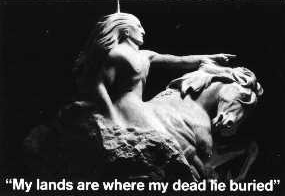
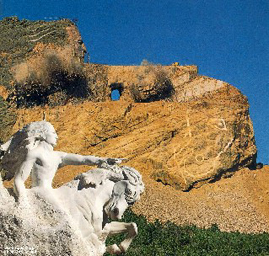
Webster Statue, Korczak sculpts the Tennessee marble Crazy Horse 1/300th
scale model (left arm outstretched).
1947
Korczak arrives at Crazy Horse May
3rd. He is 38. Lives in a tent while building log studio-home. Decides
to carve the entire 600-foot mt. in the round rather than just the top
100 feet, as originally planned.
1948
Memorial is dedicated June 3rd with
first blast on the mountain. Special guests include five of the nine survivors
of Battle of Little Big Horn. Korczak promises that Crazy Horse will be
a nonprofit educational and cultural humanitarian project financed by the
interested public and not with government tax money; he pledges never to
take a salary at Crazy Horse. Korczak single-jacks four holes for the first
blast, which takes off only 10 tons. He falls, suffering his first injury
on the mountain. Crazy Horse Memorial Foundation formed Aug. 16th. Sculptor
continues "pioneering"-building roads, sinking a well, creating a first
lake, "finishing" the studio-home. That winter he builds 741-step staircase
to mt. top (elevation: 6,740 feet above sea level). Volunteer Ruth Ross
helps build staircase.
1949
97,000 tons blasted off (horizontal
cut under horse's mane) as work begins on mt. Sculptor works alone with
one small jackhammer powered by a gas compressor (the old Buda) at bottom
of mt. Connecting pipeline runs 2,040 feet up and across mountain. Early
mt. work is done under special use permit; then under a mining claim. Korczak
has $174 left to his name. Continues improving studio-home for public.
IRS makes Crazy Horse Memorial Foundation tax exempt on Nov. 28th.
1950
Works second summer on mt. (mane
cut). Thanksgiving Day, marries Ruth Ross. First admission fee 50 cents
per adult (after 1949 contributions averaged five cents per person visiting
studio-home); sculptor establishes policy there will be no admission charge
for Native Americans, military personnel in uniform, Boy Scouts and Girl
Scouts in uniform or Custer County residents. Builds 32-foot addition to
viewing veranda.
1951
Korczak paints outline of Crazy Horse
on mt. Six-foot wide lines take 176 gallons of paint. Korczak and Ruth
begin drafting three books of comprehensive plans and measurements for
the mt. carving. During winter, from Crazy Horse granite Korczak carves
3,000-lb. "Wild Bill" Hickok statue as gift for Deadwood, S. Dak.
1952
Starts cut for Indian's 90-foot profile.
"The bucket" aerial cable car (run by antique Chevy engine) working to
haul equipment and tools to top of horse's head. Electric compressor now
at base of mt. In winter Korczak carves 1/24th scale model of Crazy Horse's
head from a 48-inch-diameter pine tree; also carves 1/1,200th Crazy Horse
scale model (5inch miniature) from lemon wood.
1953-55
Sculptor continues work in front
of Indian's face, blasting down to below nose. Korczak suffers a back injury
when a cable snaps. Purchases first bulldozer. Sculptor turns down $10
million in potential federal funding. Crazy Horse Memorial Foundation acquires
the mt. and 328 acres around it in a land exchange with federal government.
Korczak builds modern milking parlor for Holstein dairy farm. Minnesota
students present architectural model of the future of Crazy Horse. Admission
to 75 cents per adult. From Crazy Horse granite, Korczak carves nearly
seven-ton Sitting Bull Memorial.
1956
630,000 tons removed to date (down
to Indian's chin). Korczak works all winter on first road up back of mt.
to top. Moves Buda compressor to top (shorter airline gives more power).
Now able to use wagon drill as well as jackhammer and jackleg.
1957-58
300,000 tons cleared from above arm.
Constructs Avenue of the Chiefs (gravel) direct from Highway 16-385 port
of entry to studio-home. (First rocky trail in was nicknamed "oil pan alley.")
Builds and begins operating lumber mill.
1959-60
395,000 tons cleared from arm (1,325,000
tons to date). Sculptor has first "cat" working on top (much more rapid
progress clearing arm). Danger increases. Korczak breaks right wrist and
thumb.
1961-62
475,000 tons removed from above arm.
Korczak again turns down $10 million in potential federal funding, Builds
Sun Room, workshop, roof over visitor viewing porch, large garage and machine
shop. Drills new well for studio home. Sculptor gives his mahogany portrait
of Chief Standing Bear to President John F. Kennedy. Crazy Horse School
opens, Korczak's first spinal operation (two lower discs removed).
1963
200,000 tons removed (2,000,000 to
date). Finishes clearing above Indian's arm. Starts new road downward across
horse's mane (to clear in front of tunnel to come later). Builds Theater
#1.
1964-65
350,000 tons removed from horse's
mane area. Builds four-story, 26ton scaffold on tracks in front of Crazy
Horse's face. In winter Korczak creates 16-ton (1/34th scale) plaster model
of Crazy Horse. Finishes writing poem to be carved in three-foot letters
on mt. Drills 377-foot deep well. Modernizes public restrooms. Admission
fee to $1 for those over 15. Korczak's second spinal operation (a third
disc removed).
1966-67
450,000 tons removed from mane area
and in front of Indian's chest (2,800,000 to date). Electricity to top
of mt. and first electric compressor taken all the way up. Charles A. Morss
Bridge built. Entrance, road and visitor parking lot blacktopped. Builds
octagonal dining room. Korczak's third spinal operation (fourth and fifth
discs removed).
1968
75,000 tons removed as tunneling
into mt. Begins for what will be the start of the opening under the Indian's
outstretched arm. Korczak has slight heart attack. U.S. Post Office opens
at Crazy Horse April 1st with Ruth as Postmistress (for $1 a year). Charles
Eder Indian collection and Ebell Egyptian (King "Tut") furnishings given
to Crazy Horse.
1969-70
325,000 tons removed (3,200,000 to
date). Tunnel under arm to day-light through the mt. Korczak purchases
D-9 "Cat" (Zeus) and acquires new compressor, air trac, huge "Cat" drill-compressor,
Eight of Korczak's marble works of sculpture vandalized at entrance to
studio-home. Sculptor receives honorary Doctorate from Fairfield University,
Conn, Korczak has massive heart attack,
1971
200,000 tons removed. Korczak enlarges
tunnel and begins removing right end of 600-foot mt. in front of horse's
head. Project is out of debt for first time. In winter Korczak begins his
tomb about 500 yards from the base of the mountain.
1972
200,000 tons removed. Very dangerous
bulldozing at top of horse's head. In winter sculptor and sons build Indian
museum, new restrooms, additional water system, new well and drain field.
Admission to $4 a car-load.
1973
200,000 tons removed. First 3 years
work at top and in front of horse's head begins to change the silhouette
of mt. against horizon. Museum dedicated May 30th. Korczak has worsening
diabetes and arthritis.
1974
300,000 tons removed (4.100,000 to
date). Work continues in front of horse's head. New road built on back
of mt. Chief Luther Standing Bear and Sunflower Indian collections given
to museum. Sculptor receives Trustee Award from National Western Heritage
and Cowboy Hall of Fame. IRS reaffirms Crazy Horse Memorial tax exempt
status.
1975
500,000 tons removed, blasting to
about halfway down in front of horse's head. "Flying Cat Incident (bulldozer
cartwheels 250 feet down the mt.). Korczak bulldozes with right foot in
a cast after operation to remove a large spur and repair separated Achilles
tendon. He builds 80-foot-long, 24-ton boom, hoist and metal platform/work
cage for future work on horse's head.
1976
500,000 tons removed (5,100,000 to
date). Reader's Digest U.S. bicentennial books ranks Crazy Horse "One of
the seven wonders of the modern world." Expansion of visitor complex continues.
1977
600,000 tons removed. Heaviest blasting
of the project. 100th anniversary of Crazy Horse's death Sept. 6th, Korczak's
69th birthday, Crazy Horse Centennial Blast Largest of the project) removes
40,000 tons at one time. 30th anniversary of Korczak's arrival at Crazy
Horse May 3rd.
1978
500,000 tons removed (6,200,000 to
date) June 3rd is 30th anniversary of dedication of the mt. Korczak celebrates
his 70th birthday blasting and bulldozing--as usual. Korczak and Ruth launch
Crazy Horse Memorial Indian Scholarship program as a "good faith gesture"
toward the Memorial's long-range educational goals. Korczak's tomb nears
completion.
1979
300,000 tons removed (6,500,00 to
date). First cut into mt. toward horse's nose. Two new roads up back of
mt. Fortieth anniversary of Standing Bear's invitation to Korczak to carve
the mt. Two collections donated to Indian Museum. Concord Stagecoach (circa.
1856) acquired, Tashunka Witco Nature and Historical Hiking Trail mapped
out (as a Boy Scout Eagle project).
1980
250,000 tons removed (6,750,000 to
date). Further cutting into mt. toward horse's nose. Second D-9 Cat (Jupiter)
acquired. Two new roads on back of mt. One week after his 72nd birthday
in September Korczak has fourth back operation to remove a sixth consecutive
disk, but he works on the mt. through the rare open winter. Also, he builds
first phase of the Crazy Horse Village, sinks well #14 (206 ft,), designs
new wing for Indian Museum, Designs and begins building 50-foot Nature
Gates, hand cuts steel letters for the legend on the door of his tomb:
KORCZAK-Storyteller in Stone--May His Remains Be Left Unknown. Tomb is
consecrated on an April morning by Father William O'Conneil. Christopherson
oil portrait of Korczak is unveiled. Logging operation resumed. Admission
fee to $5 a CAR-load. Korczak and Ruth celebrate their 30th wedding anniversary.
1981
450,000 tons removed (7,200,000 to
date). Seventh million ton removed on May 3rd, the 34th anniversary of
Korczak's arrival in the Black Hills. First road downward across scarf
of mt. completed to under the horse's nose. Also, a new road on back of
mt, Sculptor roughs-out horse's left eye and constructs 20-foot steel template
for work on the eye. Visitation tops one million for first time. Korczak
receives honorary doctorate from Black Hills State College for his humanitarian
concept for Crazy Horse Memorial. Design for Chief Crazy Horse 13cent regular-issue
U. S. postage stamp unveiled at Crazy Horse Sept. 6th, Korczak's 73rd birthday
Black Hills Nature Gates set in place. Two major wells deepened (including
original 1947 well). Logging and post operation continue.
1982
200,000 tons removed (7,400,000 to
date) as work in front of horse's head continues. First Day of Issue Ceremony
Jan. 15th in Indian Museum for Crazy Horse stamp, part of the Great Americans
Series. CRAZY HORSE and KORCZAK· The Story of an Epic Mountain Carving
by Robb DeWall published May 3rd, commemorating the 35th anniversary of
Korczak's 1947 arrival in the Black Hills to begin the nonprofit, Crazy
Horse humanitarian project. On July 24th Korczak under goes quadruple heart
bypass operation. He spends his 74th birthday on September 6th supervising
his sons and daughters painting a new outline of the horse's head on the
mt. Second land exchange with federal government approved. 500 Order of
the Arrow Boy Scouts camp around mt.
October 20, 1982
Korczak dies unexpectedly at the
age of 74. His wife, Ruth, and all 10 of their sons and daughters are with
him as he is laid to rest in the tomb he and his sons built near the mt.
He leaves with Ruth scale models and the three books of comprehensive plans
and measurements they prepared for the mt. carving, and she and their large
family express their dedication and determination to carry on his Crazy
Horse dream according to his detailed plans. Tributes arrive from throughout
the nation and many foreign countries. Korczak is eulogized as a man of
"legends, dreams, visions and greatness," and Indian representatives proclaim
that "two races of people have lost a great man."
1983
Korczak's Crazy Horse dream continues.
Mrs. Ziolkowski assumes supervision of all activities on the mt. and off.
200,000 tons removed (7,600,000 to date) as over-all blocking out continues.
Outline on mt, expanded. Pope John Paul II accepts a bronze of Crazy Horse
1/1,200th scale model mounted on granite from the mt. Legislature designates
May 3rd annually as Korczak Day in S. D. Construction includes tripling
size of parking lot, adding Theater #2, enlarging viewing verandah, and
sinking well #15. A $60,000 check is left in contribution box.
1984
200,000 tons removed (7,800,000 to
date). Comprehensive measurement on mt. in the round underway. Indian Museum
tripled in size. Grass Roots Club launched. Crazy Horse U.S. stamp issue
tops one BILLION. Viewing verandah greatly expanded. Laughing Water Restaurant,
Arrowhead Lake built. Wells #17 and #18 drilled.
1985
Total rock removed reaches approximately
8,000,000 tons to date as comprehensive measurement and blocking-out continue
on mt. carving. New 1,000 ft.-long road on mt. Construction begins on rock
building at visitor complex. Five hundred Boy Scouts camp around mt.
1986
First annual Volksmarch up the mt.
carving where new explosives engineering techniques are being used for
areas nearer finish surface. Ahrlin Collection and the Harris Jewelry Collection
donated to Indian Museum. Long-range program launched to cast Korczak's
sculpture in bronze to benefit Crazy Horse. Visitor complex improvements
include main lobby remodeling. Ruth Ziolkowski is 60 on June 26th.
1987
Measurement on Crazy Horse's head
and face begins after board of directors of the Crazy Horse Memorial Foundation
in October endorses Mrs. Ziolkowski's recommendation to shift priority
on the mt. carving from the 22-story horse's head to Crazy Horse's nine-story
face. May 3rd is 40th anniversary of Korczak's arrival in the Black Hills
to accept Indians' invitation to carve Crazy Horse. Gifts to Indian Museum
include Harris Navajo rug collection donated to Indian Museum. Two collections
(5,000 volumes) donated to Crazy Horse Library. 1Oth anniversary of Scholarship
Program. Plaster cast of Korczak's seven-ton "Sitting Bull Memorial" joins
permanent collection at Crazy Horse.
1988
Blocking-out Crazy Horse's face begins,
starting to remove the protective rock left by Korczak. Comprehensive measurement
continues on the head and face. Weathered "Slow Man at Work" scaffold in
front of face removed. Major new mt. road built. June 3rd S. D. Gov. George
S. Mickelson and Ruth Ziolkowski set off Memorial's 40th anniversary blast;
when he was seven years old, he had helped his father, Gov. George T. Mickelson,
set off the first blast on Crazy Horse. US WEST Foundation pledges $50,000
over five years to Scholarship Program. First computer for development
of computer assisted design (CAD) program to augment measurement on the
mt. donated by Apple Computer, Inc.
1989
First detail work on the mountain
begins at the top of Crazy Horse's forehead as the face continues to be
blocked out three-dimensionally Pointing system in use for the first time.
A 3,400-degree, super-sonic torch goes into use as a cutting and "finishing"
tool. Lightning-caused fire July 29th destroys both electric compressors,
compressor building and mt. equipment. Work continues with portable compressors.
Eight lighting firms donate the first phase of a floodlight system for
the mt., and publisher Malcolm Forbes on Aug. 11th officially illuminates
the mt. for the first time. First night blast Sept. 6th. Rose collection
donated to Indian Museum. Crazy Horse Library nears completion. Wells #19,
#20, #21 drilled.
1990
Crazy Horse's forehead "rough finished"
and right eye "opens." Detail work on Crazy Horse's face continues through
first (1989-90) of a series of "open" winters. Eyebrows blocked-out, and
work progresses roughing-out the nose. Two new electric compressors acquired
for the mt., housed in new block building. Memorial hosts S.D.'s first
Native American Day Oct. 8th, and Korczak and Ruth Ziolkowski receive Reconciliation
Awards for their life-long dedication to the Crazy Horse Memorial humanitarian
project. Modest increases during the last decade bring admission to $10
a carload.
1991
Crazy Horse "opens" both eyes on
the Black Hills, and Crazy Horse's profile from forehead to chin is blocked
out against the sky for the first time, About 17' of rock removed from
in front of the chin and along about one-half the 263-foot length of the
out-stretched arm. The mt. is blessed in four spiritual ceremonies by Lakota,
Minataree and Shawnee leaders. A pipe believed used by Crazy Horse is donated
to the Memorial. Lloyd Duggins of Mauckport, Indiana (who never visited
Crazy Horse) bequeaths some $230,000, the largest gift to date to the Memorial.
The final three light banks around the mt. are installed. First annual
Crazy Horse Stampede (All-Indian Rodeo) and "A Gift from Mother Earth"
arts and crafts festival. Steve and Molly Dancey Collection of historical
photographs acquired. Ruth Ziolkowski is 65 on June 26th. For carrying
on Korczak's Crazy Horse dream she is awarded an honorary doctorate from
S.D. School of Mines & Technology.
1992
Crazy Horse's nose is two-thirds
out in space; Ruth Ziolkowski makes a "conservative but realistic" projection
that the face of Crazy Horse will be finished by the year 2000. Detail
work begins on the right eyelid; thinning the face continues in cheek and
jaw areas. Progress speeded by a third consecutive "open" winter (1991-92).
Year-long project to remove 17' of rock from above the arm is completed
(with a 2,000-ton blast on Ruth's 66th birthday). Major new road up mt.
Memorial observes the 150th anniversary of the 1842 (?) birth of Crazy
Horse and the 10th anniversary of the death of Korczak, Benefit concert
Oct. 20th by tenor White Eagle and pianist David Strickland commemorates
the dual anniversaries. Parking lot expanded.
1993
Crazy Horse's eyelids are carved,
the eyebrows are shaped, most of last rock beneath the nose is removed,
and the first rough cut is made for the lips. Rock removal also continues
from Crazy Horse's chest, the horse's mane and along the out-stretched
arm. Fourth consecutive mild winter (1992-93). First maintenance shop built
on mt. S. D. Gov. Walter Dale Miller sets off June 3rd blast marking 45th
anniversary of dedication of the Memorial. Scholarship program observes
15th anniversary ($133,550 distributed to 864 Native American students
mostly from the nine S. D. reservations). US WEST Foundation donates $50,000
for planned Native American Educational and Cultural Center (rock building).
Multi-phase water improvement project continues. Admission is $15 a carload.
At White House President Bill Clinton accepts bronzes of Korczak's "John
E Kennedy" and "Crazy Horse" 1/1,200th scale model.
1994
Both nose lobes defined and tip of
nose rounded; upper half of both cheeks cut and "polished;" eyebrows carved.
Mild winter 1993-94. Fiberglass cast of Crazy Horse 1/34th scale model
created to facilitate computer imaging programs for mt. measuring. Six
original oil paintings by Frank McCarthy and many prints gifted to the
Memorial by Tom and Jean Doherty of Connecticut and their family. Authorized
by the S. D. legislature, a larger-than-life size bronze of Korczak's "Fighting
Stallions" is unveiled April 19th on state capitol grounds in Pierre, S.
D. as a memorial to eight air crash victims including Gov. George S. Mickelson.
1995
Crazy Horse's face is two-thirds
finished; face completion date is advanced two years to June 3, 1998, the
Memorial's 50th anniversary. Nose and cheek bone areas completed during
another mild winter (1994-95); work progresses downward on face. Roof built
on Native American Educational and Cultural Center. 10th anniversary Volksmarch
draws 10,511 hikers. 150,000-gallon reservoir built. Admission remains
$15 a carload.
1996
Crazy Horse's mouth is blocked out
(after two years of work on the lips); much of the left cheek is cut and
smoothed to the jaw line. Native American Educational and Cultural Center
dedicated on Native American Day Oct. 14th, Joe Day Collection bequeathed
to Indian Museum. Edward Curtis print collection donated by Bill Turner.
First college extension course offered at the Memorial. 50th anniversary
of Standing Bear and Korczak picking out the mt. Blasting supervisor (1987-1996)
Paul Muehl dies after a long illness. Ruth Ziolkowski's 70th birthday includes
a 70-fireball tribute on the mt. Larger-than-life-size "Fighting Stallions"
bronze donated to Memorial.
1997
50th anniversary of Korczak's May
3, 1947 arrival in the Black Hills to accept the Indians' invitation to
carve Crazy Horse Memorial. Ongoing detail work on Crazy Horse's head and
face and continued rock removal from other areas of the mt, carving in
the round. Continued growth of the educational and cultural aspects of
the Memorial. At a Vatican audience Pope John Paul II accepts a bronze
of Korczak's "Paderewski: Study of an Immortal."
1998
Dedication of the face of Crazy Horse
(just the face portion of the colossal mt. carving) on June 3, 1998, the
50th anniversary of the first blast on the mt. and the June 3, 1948 dedication
of Crazy Horse Memorial. (Due to uncertainties of weather and financing
it is not possible to predict when the over-all mt. carving might be completed
in the round.)
1999
Blasting begins to create a series
of horizontal benches (access roads) to the 219 foot horse's head; newly
acquired heavy equipment speeds drilling. 60th anniversary of Standing
Bear's invitation to Korczak to carve Crazy Horse. U.S. President Bill
Clinton visits July 6th. Ground breaking for the new 40,000 sq. ft. Orientation
and Communications Center and New Lakota Wing for the Indian Museum of
North America. Phase One of Avenue of the Chiefs widening completed (including
removal of entrance bridge).
2000
Rock removal begins at top of horse's
head and first bench completed around top of head. Orientation Center and
Lakota Wing dedicated June 7th. Phase Two of Avenue of the Chiefs widening
completed (including parking lot). Scholarship Program cumulative total
tops $300,000. 50th anniversary of marriage of Korczak and Ruth Ziolkowski.
Seven of their sons and daughters continue working with their mother continuing
the project. U.S. Senate unanimously recommends creation of a U.S. commemorative
stamp honoring Korczak and Crazy Horse Memorial for issuance Oct. 20, 2002,
the 20th anniversary of the sculptor's death.
2001
Progress continues on the network
of access roads around the horse's head. Completion work underway on lower
level of Orientation and Communications Center (to be used for educational
purposes and to house the Crazy Horse Research Library). Gifts of artifacts
and art continue for the growing Indian Museum collection.