Université Libre de
Bruxelles
Ecole de Commerce Solvay
3° Cycle en
Marketing & Advertising
« Launching of
Philippine Super Mangoes in Belgium »
« Mémoire de
fin de cycle » présenté en vue de l’obtention du Degree en Marketing
& Advertising
Promoteurs :
M Jean Pitz
Melle Ana Abejuela,
Attaché à l’Agriculture, Ambassade des
Philippines,
Bruxelles, Belgique
M Romy Borillo,
Attaché Commercial, Ambassade des
Philippines,
Bruxelles, Belgique
Decembre 2001
Launching
of Philippine Super Mangoes in Belgium
Table of Contents
Pages
Introduction 1-2
Chapter 1 What is a mango ? 3-7
Chapter 2 Mango World Trade 8-10
Chapter 3 Mango Imports in the European Union 11-13
Chapter 4 The Belgian Mango Trade 14
Chapter 5 Philippine Mango Trade 15-23
Chapter 6 The Belgian Marketplace for Mangoes 24-38
A. The Belgian Consumer
A.1. Belgian awareness of mangoes
A.2. Belgians’ buying habits
B. The Belgian Fruit Retailers
B.1 Supermarkets
B.2. Specialized fruit shops and open
markets
C. The Belgian
Tropical Fruit Importer
Chapter 7 Learning from the Kiwifruit Story 39-44
Chapter 8 Conclusions and Recommendations 45-54
A. Product
B. Positioning
C. Target Clients
D. Price
E. Distribution Points
F. Competition
G. Brand
H. Launching
I. Launching Promotions
Recommendations 55-56
Annexes
Bibliography
Acknowledgements
Introduction
There has
been much claim about the best mango in the world during the last decade when
mango from various origins started to be actively marketed around the world.
This claim has come from the sources rather than from the consumers, who
despite an increasing presence of mangoes in the marketplace, know very little
of this fruit otherwise referred to as the « peach of the
tropics. »
After all
these years, the question of the best mango remains unanswered especially in
Europe, which did not yet see all of the world’s mango varieties. The waiting
is finally over. The super mango is on its way to the European market and this
time, it’s not coming from Africa nor Central America nor the Middle East but
from the Philippine Islands where the best mangoes of the world come from.
But what is
a super mango ? A super mango is the Carabao variety, growing in different
islands of the Philippines. You harvest it green and wait for it to turn golden
yellow to be sure that it is ready to eat. When eaten ripe, you can easily peel
the smooth, waxy skin off or elegantly slice it into three and scoop the flesh
with a spoon. It’s the kind of mango that is sweet, juicy and melts in your
mouth. It’s a mango you have never tasted before !
The super
mango is a delicate variety – hardly supports bad transport and will almost
never survive a long, hazardous trip. Until now, Philippine fresh mangoes can
only be airfreighted.
It’s a mango
grown in specially-designated orchards, where each tree is adopted by a farmer.
During the initial ripening stage, each mango is wrapped with a paper bag. If
it is a real good harvest year, it could mean 100 mangoes per tree, thus 100
individually-wrapped super mangoes.
A ripe super
mango emanates a sweet fragrance, reminding you of tropical summer breezes
which sweep across warm, blue seas. No other mango has ever looked like this –
bright yellow as the blazing afternoon sun, smooth to the tongue, and leaves a
persistent craving for a next one. These are the images that only Philippine
super mangoes can evoke.
This study
will tackle the challenge of bringing Philippine super mangoes in the European
marketplace via Belgium and how Philippine super mangoes can challenge existing
varieties in the marketplace. The study will define the kind of consumers,
identify competition, price elasticity, distribution points, and promotions
that will support its launching for the next five years.
To provide a
valid and justified report, the study incorporates the results of a very thorough research and interviews with
Belgian consumers, importers, supermarkets, fruit vendors and authorities in
the fruit industry. A « usage and attitude » survey to check on
consumers’ product awareness, frequency of purchase, profile, criteria and
venue of purchase, as well as price elasticity, was also conducted with 120
respondents. About 60 respondents participated in a question and answer forum
conducted during a taste test in one of the fruit stands in Brussels. This same
fruit stand tested consumer reaction to a test sale of about 6 kilos of
Philippine super mangoes. The test sale coincided the taste test. An unaided perception test on the
Philippines was also implemented. In addition, a visit in London’s Chinatown
provided a market analysis of Philippine
super mangoes’ penetration in the UK.
In summary,
the research provides the following scenario : Priced at a premium,
Philippine super mangoes will be introduced to a niche market in Belgium,
catering to consumers who are ready to pay a higher price for a better product
and who usually buy their fruits and vegetables at fruit vendors. The
Philippine super mango will be launched in May 2002, positioning it as a
« seasonal, differentiated fruit product. » The final target is to get a regular shelf space in the
supermarkets all year round as Philippine mangoes evolve into a mainstream
fruit in the coming years.
Chapter 1 : What is a mango ?
Mangoes (mangifera indica linn) are cousins of pistaschio and cashew,
belonging to the anachardiacea
family. It is believed that mangoes originated from the Myanmar region, where
it was known to have been cultivated 4,000 years ago.[1]
Buddhist monks took mango to Malaya and eastern Asia in the 5th
century B.C. Later in the 18th century, Portuguese explorers would
introduce mango in Brazil. From there,
mango cultivation would reach Florida, USA in 1833 and eventually in Africa and
in other lowland tropical and sub-tropical areas. Today, there are about 83
mango-producing countries in the world.
Mangoes grow in tropical climates that
tolerate a wide range of rainfall, although they need dry weather at the time
the fruits are forming.[2]
It adapts well to high or low altitudes, rich loam, sand or clay. What is
important is good soil to accommodate the expansive root system.
A mango tree makes a handsome landscape
specimen and shade tree.[3]
They stand erect and grow a canopy of almost evergreen leaves. It can grow into
a very large tree, sometimes reaching a height of upto 30 meters. Some trees have long life spans, growing
upto 300 years old and still bearing fruit.
At the stage of inflorescence, some
2000 minute yellowish or reddish flowers may appear – pollinated by thrips,
flies, hoverflies and rarely by honey bees. Not all flowers, however, are
perfect enough to develop into fruits. A mango tree produces an annual yield of
about 100 fruits. A mango fruit matures in 100 to 150 days after flowering.
Mangoes naturally set fruit over several weeks. Harvesting from each tree is
therefore selective and carried out between two and four times over the season.
Mango is a seasonal crop with normally two seasons a year.
Like all fruits, the best tasting ones
are those left on the tree to ripen. Mature fruits ripen in three to eight
days. For commercial shipments, mangoes can be picked when green and firm,
arranged in trays with stem end down and left to ripen at room temperature. To
delay ripening and facilitate shipment, fruit can be stored at cold temperature
no lower than 13°C. Once re-exposed to higher
temperatures after chilling, mangoes may show skin discoloration, surface
putting, uneven flesh ripening and off flavors. High temperatures, on the
other hand, can cause mangoes to shrivel and develop off flavors.[4]
Most mangoes are harvested by hand from
the ground, snapping the fruit from the stem. It can also be picked using a
long pole with a canvas bag attached to a metal ring with a blade at its end or
by using ladders or hydraulic lifts. After ripening, fruit keeps at room
temperature for one week or refrigerated for 2 weeks. This means that a mango’s maximum shelf life is approximately 10
days unless it undergoes a ripening deterrent process.
The most common diseases are
anthracnose and sooty mould, which causes premature drop and fungal infection,
respectively. These are controlled by fungicide. Pests include the leaf cutter
weevil which cuts off tender young leaves and the oriental fruit-fly which
feeds on the soft pulp.
A Mango Fact Sheet of the Horticultural
Sciences Department, Institute of Food and Agricultural Sciences at the
University of Florida, indicates that there are two main types of mango,
namely :
Indian type – has monoembryonic seeds and often
highly colored fruit. Susceptible to anthracnose and internal fruit breakdown.
Indochinese type – has polyembryonic seeds and fruit
often lack attractive coloration. Relatively resistant to anthracnose.
Other fruit fact sources cite two
races :one from India and the other from the Philippines and Southeast
Asia.
There are about 500 varieties of
mangoes worldwide but only a few superior cultivars have actually entered
international markets. Some countries grow common varieties. Selected varieties
in the commercial trade to Europe, the United States, and Asia include[5]:
Florida type : Tommy Atkins,
Haden, Irwin, Zill, Van Dyke, Kent
Brazil : Tommy Atkins
Venezuela : Kent
Israel : Keitt
Haiti : Francisque
North Africa : Amelie
India : Alphonso, Totapuri, Payri
Pakistan : Chausa
Kenya : Ngowe, Apple
Australia : Kensington Pride
Mexico : La Criolla, Haden, Van
Dick, Palmet, Kent, Irwin
Costa Rica : Tommy Atkins, Irwin,
Mora
Thailand : Nan Klarngwun, Nam
Dorkmai, Pimsen Daeng, Rad
Philippines : Manila Super
Spain : Sensation, Tommy Atkins,
Keitt
Taiwan : Irwin
Ivory Coast : red Kent, green
Amelie
Some mangoes are round while others are
oval, kidney-shaped, ovoid-oblong and rarely round. Depending on the variety,
the thin, smooth, leathery skin can be greenish, yellowish or reddish, often
tinged with purple, pink, orange-yellow or red. The flesh is orange or orange-yellow, can be fibrous or fiberless,
supple like peach or crunchy. Most
varieties are smooth, buttery, sweet and fragrant. Certain varieties,
especially wild mangoes, have and aftertaste of turpentine. The flesh clings to
the large, elongated and flat single seed found in the middle of the fruit.
Mangoes are excellent source of vitamin
A and C, which normally vary with variety and maturity of fruits. A 100-gram of
mango contains approximately 69 calories, 20.5 mg of Vitamin C, 14.1 g of
carbohydrates, 2.1 g of protein, and 45.0 mg of potassium.[6]
In trade, a guideline for a 4-kilogram
carton has the following “counts” : (i.e . 6 in a box)[7]
6s :
666 grams
8s :
500 grams
10s :
400 grams
12s :
330 grams
14s :
290 grams
16s :
250 grams
There are also export standards for
mangoes. The United Nations ECE Standard FFV-45 cites that « mangoes
should be intact, firm, fresh in appearance, sound (produce affected by rotting
or deterioration such as to make it unfit for consumption is excluded), clean,
practically free from any visible foreign matter, free from black stains or tails
that extend under the skin, free from marked bruising, practically free from
pests, practically free from damage caused by pests, free from damage caused by
low temperature, free from abnormal external moisture, free of any foreign
smell and taste. »
The UNV/ECE mango standards have also
the following grading system :
Extra Class – superior quality, free of
defects
Class 1 – good quality with slight
defects of shape or of the skin
Class 11 – do not qualify for inclusion
in the higher classes but satisfy the
minimum requirements
Mango can be eaten alone, ripe or
unripe. In some Asian countries, fresh green mango is made into salads to
accompany the main course while fresh yellow mango maybe mixed into a fruit
salad for dessert.
The most important use of mangoes is
fresh consumption and fresh mangoes are traded worldwide. However, the volume
for processed mango products is higher. These include mango-flavored beverages,
mango pulp (puree), and juice, dried, jam and jellies, syrup and other
retail-packed products like pickles and chutney.
Chapter
2 : Mango
World Trade
A February
2001 report of the Food and Agriculture Organization (FAO) of the United
Nations indicated that while « production is expected to have increased for
all varieties of tropical fruits, the biggest increase has been in mango
production. » Global production of mangoes, which accounts for nearly 40%
of world tropical fruit production, was forecasted for 2000 at 23.6 million
tons, an increase of 6% over the 1999 level. More than 75% of world mango
production was in the Far East, 15% in Latin America and the Caribbean, and 9%
in Africa.[8]
|
Mango Production
in ‘000 tonnes |
|
|
|
|
|
|
1995-1997 Average |
1998 |
1999 |
2000 |
|
India |
11833 |
9000 |
10500 |
12000 |
|
China |
2037 |
2127 |
2127 |
2100 |
|
Mexico |
1345 |
1474 |
1450 |
1450 |
Source : FAO, Economic and Social
Department Commodity Notes, Tropical Fruits
(February 2001)
Production volumes for 1998 in Asia
were : India (10 mt), Pakistan (0.9 mt), Indonesia and Thailand (0.6 mt).[9]
Unfortunately, India’s export figures
compared to its production remains minuscule. In 2000, it exported 0.3% while
Mexico and South Africa exported 13.3% and
32.5% of its produce, respectively. Mexico is the world’s largest mango
exporter with the United States as its main market.
Source : FAO
The two main reasons for mango’s
continuing rapid growth trend are : increase in local consumption and
demand in the international markets. Mangoes, which were virtually unknown in
the 1970s, have succeeded to break into the international markets either as
fresh or processed imports. In the early 60s, imports were averaging 5,000 tons
annually. By 1995, mango imports were pegged at 342,000 tons, up in 1999 with
488,000 tons, and is still expected to increase by 53% by the year 2005.
|
Mango Imports in ‘000 tonnes |
|
|
|
|
|
1995-97 Average |
1998 |
1999 |
|
United States |
167 |
197 |
219 |
|
EC |
103 |
131 |
173 |
|
China (Hong Kong SAR) |
37 |
47 |
50 |
Source : FAO, Economic and Social
Department Commodity Notes, Tropical Fruits
(February 2001)
North America was the major market for
mangoes, importing 44% of the world total in 1999, while Europe accounted for
24 % and Japan 2%.
|
Mango Exports in ‘000 tonnes |
|
|
|
|
|
1995-97 Average |
1998 |
1999 |
|
Mexico |
186 |
235 |
220 |
|
Brazil |
20 |
39 |
54 |
|
Pakistan |
20 |
40 |
50 |
Source : FAO, Economic and Social
Department Commodity Notes, Tropical Fruits
(February 2001)
Mexico still takes the lead in world
mango exports in North America, nearly 40% of world exports. The Philippines
and India were also significant exporting countries, approximately 17% of the
world markets. The following table will reveal the top five countries which has
the highest exports :
|
Distribution of world mango production and exports |
|
|
|
|
|
|
|
County |
Total Production
(Mt) |
Total Exported
(Mt) |
|
Bangladesh |
187 000 |
0 |
|
Brazil |
500 000 |
53 765 (10,8%) |
|
Colombia |
99 000 |
945 (1%) |
|
Democratic Republic of Congo |
206 000 |
0 |
|
Dominican Republic |
180 000 |
400 (0,2%) |
|
Egypt |
232 000 |
523 (0,2%) |
|
Haiti |
250 000 |
9100 (3,6%) |
|
India |
15 642 000 |
47 149 (0,3%) |
|
Indonesia |
827 066 |
564 (0,7%) |
|
Madagascar |
204 000 |
0 |
|
Mexico |
1 529 307 |
204 002 (13,3%) |
|
Nigeria |
729 000 |
348 (0,5%) |
|
Pakistan |
937 705 |
37 971 (4,1%) |
|
Peru |
180 000 |
20 026 (11,1%) |
|
Philippines |
781 447 |
35 102 (4,5%) |
|
Sudan |
192 000 |
40 (0,02%) |
|
Tanzania |
190 000 |
0 |
|
Thailand |
1 350 000 |
10 473 (0,7%) |
|
Venezuela |
130 180 |
4583 (3,5%) |
|
South Africa |
38 000 |
12 341 (32,5%) |
|
|
|
|
|
Source : FAO 2000 |
|
|
While international trade in tropical
fruits is still widely dominated by pineapples and avocadoes (in that order),
mangoes are catching up fast. Increased market shares of mangoes and other
minor fruits such as lychees and mangosteen have actually resulted to a 2%
decrease in the avocado share of world trade in 1999.
Chapter
3 : Mango Imports
in the European Union
The European Union (EU) has witnessed
one of the greatest growth in mango imports, posting a 200% increase from
17.161 MTs in 1985 to 52.000 MTs in 1993. Asian producers began to export to
the EU, which proved to be a more favorable market than the US. Several factors
contributed to this market evolution : (1) greater acceptance of different
varieties because of a large demand from Asian immigrant groups ; (2) less
stringent phytosanitary restrictions ; and (3) competitive transportation
costs.[10]
(At that time, India and Pakistan have a bigger disadvantage over Mexico
because of transport costs. Both countries were still then at equal levels on
freight costs with other mango suppliers to the EU).
FAO’s 2001 reports indicated a growing
pattern for mango imports to the EU. An average of 103,000 tons were imported
between the years 1995-1997. Mango imports increased to 131,000 tons in 1998,
and to 173,000 tons in 1999.
The growth pattern is best traced back
in 1993 when mangoes started to be exported to Europe in increased frequency
and volumes. Total imports from non-EU sources reached 45,118 MT for a value of
53 million US$ in 1994.[11]
EU import statistics, however, include significant intra EU-trade. The top four import markets in 1993 were the
Netherlands (18,829 MTs), the United Kingdom (11,517 MTs), France (11,014 MTs)
and Germany (7,662 MTs).[12]
Imports to the Netherlands do not reflect actual consumption because that
country is a major re-exporter, primarily to Germany and Belgium.
The Dutch are the second largest
European mango consumer, following the British. Half of its imports are for
local consumption while the rest are re-distributed to Germany, Austria,
Switzerland and Scandinavia. In 1994, the Netherlands imported 15,461 MT valued
at 17.7 million US$.
Dutch importers played a major role in
the EU’s soaring import volumes. They brought in various mango varieties from
various suppliers and shipped them throughout Europe. One of Europe’s biggest
open fruit markets is Barendrecht, found in the vicinity of Rotterdam.
France is the third largest mango market
in Europe with 18 different suppliers, according to 1994 figures indicated in
the RAP Market Information Bulletin No. 9 of Market Asia. France is followed by
Germany.
According to Belgian fruit importers,
the European market is not homogenous – Scandinavian and German consumers
prefer hard, crunchy mangoes ; the French prefer the tasty, fiberless Kent
variety ; the British like it very sweet ; the Dutch like it
red ; and the Belgians like it more colored, firm but a still a little bit
hard.
Brazil is the largest foreign supplier
to the EU with a 23% share in 1993. Other significant suppliers include the US
(12%), South Africa (8%), Venezuela (7%), Israel (7%), Mexico (7%), Pakistan
(6%), Ivory Coast (6%), and Peru (5%). India and Mali were the only other
countries that supplied more than 1000 MTs in 1993. Pakistan and India are the
only major Asian suppliers and most of their exports are destined to the UK.[13]
The following table shows the 1993
scenario of suppliers and its EU markets.
|
Country |
Season |
Markets |
|
Mexico |
April-September |
US,France, Canada, Japan |
|
US (Puerto Rico/Florida) |
|
Canada, The Netherlands, Japan |
|
Brazil |
October-March |
US,
The Netherlands, France, UK, Portugal |
|
Venezuela |
June-July |
US, UK, Portugal |
|
Peru |
November-March |
US, The Netherlands, UK |
|
Costa Rica |
Febuary-June |
The Netherlands, Germany |
|
Haiti |
|
US, Europe |
|
Ecuador |
|
US, France, Spain and The Netherlands |
|
South Africa |
January-May |
The Netherlands, UK, France |
|
Ivory Coast |
March-July |
France |
|
Mali |
|
France, The Netherlands |
|
Burkinafaso |
|
France, The Netherlands |
|
Gambia |
|
UK |
|
Guinea |
|
France, The Netherlands |
|
Kenya |
|
Europe and other destinations |
|
Israel |
July-November |
France, The Netherlands, UK |
|
India |
April-August |
UK |
|
Pakistan |
June-August |
UK |
|
Spain |
|
Europe |
Today, however, you have other foreign
suppliers such as Burkina faso, Kenya, Israel, Egypt, Ecuador, Thailand, and
Australia. Sourcing out mangoes from different suppliers at different times of
the year, importers have made mangoes available in Europe all year round.
Chapter 4 : The Belgian Mango
Trade
Mangoes found its way to Belgium some
30 years ago via air transport, said Christian de Cannière, President, Union
Nationale des Importateurs, Exportateurs et Grossistes en Fruits, Légumes &
Primeurs. However, sales evolution
occurred some 8-10 years ago after a successful implementation of a procedure
focusing on carbon dioxide to deter the ripening process and to combat
anthracnose, the most important mango disease caused by the fungus colletotrichum gleosporioides. This
disease results in flower blight, fruit rot and leaf spots that could lead to a
lower yield.[14]
The ripening deterrent was a major
breakthrough which permitted shipping mangoes by boat and consequently reduced
the retail price by 50% while considerably increasing consumption.
There are four major Belgian tropical fruit importers housed
at the Centre Européen des Fruits et Légumes in Brussels. These are: Goosens,
Starfruit, Exofi and Tradexo.
There are about 15 country-suppliers for mangoes :
Israel, Sudan Egypt, Brazil, Venezuela, South Africa, Peru, Mali, Ivory Coast,
Burkina Faso, Senegal, Puerto Rico and Mexico. On a very small scale, Thai
mangoes are imported and distributed through the Asian dry goods and fresh food
outlets. There are also irregular arrivals of mangoes from Australia.
De Cannière
revealed that several attempts were made in the past to import Indian and
Pakistani mangoes but with no success. He cites price and color as the main
culprits of this venture’s failure.
Note : No recent statistics of entry
volumes are available. Mr. de Canniere explained that statistics are based on
country of entry (i .e . mangoes shipped via Rotterdam are counted in
as Dutch entries). The Belgian Foreign Trade Office does not have
mango-exclusive statistics neither. Mango forms part of a certain fruit
category that includes guavas and mangosteen.
Chapter
5 : Philippine
Mango Trade
Mangoes were introduced in the
Philippines in the early 15th century by Chinese and Arab traders.
There are many mango varieties grown in
the Philippines. These include carabao, pico, señorita, Indian, duldol,
binoyboy, katchamita, and pahutan. The carabao variety is cultivated mainly for
export. In August 1999, the Philippine Mango Council adopted « Philippine
Super Mango » as the official name of all carabao mango
shipments overseas.
The sizes of exportable Philippine
super mangoes are :
Extra Large 351 grams and up per piece
Large 281
grams to 350 grams
Medium 241
grams to 280 grams
Small 201
grams to 240 grams
Super Small 160 grams to 200 grams
They are individually wrapped in soft
paper and placed in cartons with partitions and a foam padding at the bottom of
the box.
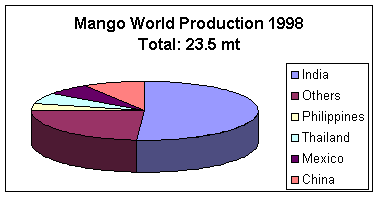
In 1998, the Philippines ranked fifth
among the world’s biggest producers of mangoes. It accounted for 4% of the
global output of 23.4 million tons during the year, after India (51%), China
(9%), Mexico (6%), and Thailand (5.8%).[15]
Production steadily rose from 508,000
tons in 1994 to 987,000 in 1997, dipping 7% in 1998 due to El Niño. Growth
averaged 18.4% from 1994 to 1998. Hectarage devoted to mangoes also rose by 10%
annually during the same period while farm productivity jumped from 7.8 ton/ha
in 1994 to 9.8 ton/ha in 1998.
Mango ranks as the third most important
export fruit crop of the Philippines, next to banana and pineapples. From
1994-1998, export revenues from both fresh and processed mangoes averaged US$50
million annually. Fresh exports, which account for close to 80% of total export
value, increased from 29,100 tons in
1994 to 51,700 tons in 1998. Exports, however, declined to 35,100 tons in 1999.
Major markets for the Philippines then were Japan, Hongkong, and China.[16]
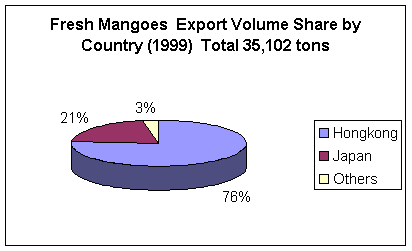
The Philippines dominates the
mango market in Japan. In 1994, the Philippines took the lead with a 72% share
of import volume. Mexico and the United States accounted for 22% and 2%,
respectively ; and the remaining 3% was shared by all other suppliers like
Thailand, Australia and Taiwan.[17]
Source : University of Asia and Pacific
Food and Agribusiness Yearbook « Millennium
Edition »
|
Exports by Country of Destination (1999) |
||
|
Volume in tons, Value in US$ ' 000, FOB |
||
|
|
Volume |
Value |
|
All Countries |
35,102 |
32,34 |
|
Hongkong |
26,691 |
18,914 |
|
Japan |
7,418 |
12,47 |
|
China |
488 |
342 |
|
Singapore |
421 |
450 |
|
Switzerland |
35 |
91 |
|
Others |
49 |
73 |
Processed exports, which consist of
dried, puree, juice, concentrates, edible parts, uncooked, prepared/preserved,
drained and in brine/sulphur water, fluctuated from 1994 to 1999. Dried mangoes
(11% of total value of mango exports in 1999), and puree (6%), dominated exports.
Hongkong is the biggest market for dried mangoes, absorbing 50% of the export
production while the United States gets a 22% share. Much of the mango puree
production is exported to the US and the Netherlands with 29% and 24% ,
respectively.[18]
Further growth is expected with the
opening of new markets such as South Korea, the United States, and Australia
following the successful negotiations for the lifting of their respective bans
on Philippine mangoes. Exports will also get a boost from China’s decision to
reduce tariffs on agricultural imports from the Philippines. Japan will also
reduce its tariff on fresh and dried mangoes from 6% to 3% and will offer a
Generalized System of Preference (GSP) that will allow Philippine mangoes to
enter Japan duty-free under the General Agreement on Tariffs and Trade (GATT).[19]
The year 2001 marked an important
expansion for fresh mango exports with the initial shipments to Australia and
the United States, which ended almost a decade of negotiations to reconsider
the ban on Philippine mangoes. Both countries have approved product testing
results showing no significant pest risk associated with the importation of
mangoes. However, only mangoes grown in the Guimaras Island, the country’s only
pest-free producer of mangoes certified by the US Department of Agriculture,
are accepted in Australia and the US.
Australian quarantine officials
inspected the first shipment of 200 kilos before it was transported to Manila
for vapor heat treatment and airlifted to Australia in May 2001. The initial
shipment was supplied by Lapanday Food Corp. of the Lorenzo Group. Philippine
super mangoes are targeted for exports during Australia’s winter months.
The US shipment followed shortly the
Australian export. The opening of the
US market is significant considering that US imports of mangoes are increasing
at a rate of 10% to 15% a year, according to Market Asia, an online trade
information service. Still considered an « ethnic » food, only a
third of American households have ever purchased the fruit. Mangoes are most
popular in cities with large Hispanic and Asian populations. While Florida
grows mangoes, the main supplier for the US is Mexico with an estimated export
of 108 ,000 tons per year or about 88% of the annual volume of US imports.[20]
Less publicized was the first shipment
of super mangoes to London, United Kingdom. Three Filipino producer-exporter
committed themselves to participate in a market development exercise initiated
by the Philippine Embassy in the UK. Manning Impex, an Asian importer in
London, had had big hesitations on the profitability of having to sell
expensive Philippine mangoes when the London-based consumers are used to buying
Indian mangoes at 150% less.
André Cheong
of Manning Impex accepted this challenge in his part of the globe, bringing in
the first 100 boxes of mangoes in London’s Chinatown in April 2001. Since then,
some 500 kilos of super mangoes are airfreighted to London every 10 days via
Pakistani Airways, Saudi Airlines, Japan Airlines and Air France. The mangoes
are delivered to Cheong’s New Loon Moon Supermarket, which already sells over
50 Philippine dry goods ranging from canned fruit juice to flavor mixes. As
other points of distribution, Cheong chose the two Golden Gate supermarkets,
which specialize in fresh exotic fruits and vegetables and whose clientele are
willing to pay a premium for quality. Also, with the ideal location of the two
Golden Gate shops at the extremities of Chinatown and André’s own in the
middle, they formed a perfect triangle of Philippine mango outlets. About 20-30
cases of mangoes are delivered to Golden Gate. The rest are sold in New Loon
Moon Supermarket and in the Philippine stores. To launch it, André first
proposed mangoes to these stores on a consignment basis and eventually other
incentives like « buy 4, get the 5th one free.» There is also
an agreed price with Golden Gate. « We would like to maintain the same
price even if price fluctuates with the exchange rates. We would rather keep a
reasonable price for a profit for a certain period of time, say six
months. » The price agreement with the producer is based on each harvest
season.
Cesar
Bautista, Philippine Ambassador to the United Kingdom and Ireland, who
initiated this market development exercise, revealed that the top 4 producers
of the Philippine mango association have defined the details of this market
development exercise – assure 500 kgs a week at a certain price which is
sustainable for a year, define quality, size, variety, etc. The retail price of
Philippine mangoes in London in September 2001 was 6.50£ per kilo,
approximately four medium-size mangoes. A case of Philippine mangoes is sold at
25£ while Indian mangoes are tagged at 2.50£ per box. In New Loon Moon, no
Indian mangoes are sold to avoid cannibalizing the sale of Thai and Philippine
mangoes, both of which have no big price difference and have an equal share of
the market. There is, however, a distinctive difference in taste between
Philippine and Thai mangoes.
The initial target for Philippine
mangoes in London are the Asians. « The Europeans have a very superficial
knowledge of mangoes and are willing to buy cheap ones of a variety that they
already know, » Cheong explained. These are the Indian mangoes, the first
mangoes introduced in the UK and are currently sold at 25 pence per piece in
the Asian stores, fruit vendors and even in the multiples or supermarket chains
like Tesco and Sainsbury. Cheong disclosed that the English will never be his
clients, explaining that the English food culture does not favor overspending
on food. « They will spend an average of 15£ for food per week. So, how do
you expect them to spend 6£ for a kilo of mangoes ? »
There are 20 different suppliers to the
UK, most of them occasional. Pakistan exports more than India. These two very
sweet varieties are favored by consumers which still remains relatively
« ethnic. »
The
distribution of Philippine super mangoes in London, though small, is well set-up today. Cheong, however,
foresees an increase in import volume by 50% by the beginning of next year’s
new harvest season (March-April-May). He has already approached three
Oriental/Western stores, which cater to the Arab market, Australians and some
Europeans. These stores are quite receptive and have expressed willingness to try
to market Philippine mangoes. Manning Impex Ltd will also start to introduce
mangoes in the international open markets like in Covent Garden, where traders,
restaurant owners, and high-end retail stores come to buy fresh produce.
Manning Impex Ltd has no intention of approaching the big supermarket chains.
« These companies are so large that they tend to buy direct. They also
have strict quality standards. It’s better for the Philippine mango producers
to introduce themselves directly to the big chains. »
These
multiples, according to Ambassador Bautista, are not yet properly primed. They
did not get information on the difference of mangoes, nor samples, nor
literature nor an assurance that this is a market development exercise
committed by the Philippine counterparts. The importers want to go to the
mainstream and not only to Oriental stores to be profitable. The long-term
prospect is to hit the mainstream but to do this, said Ambassador Bautista, we
should offer some concrete alternatives. He cited the ongoing experiment of a
longer shelf life by using a Korean-made special wrapper to deter the maturity
of mangoes. This may not mean that mangoes need not be airfreighted anymore but
it will allow greater flexibility for distribution if mangoes have a longer
shelf life.
Manning
Impex does not see itself as a supplier for the big supermarket chains due to
its limited size and has no intention of distributing in Continental Europe.
« It’s possible but not feasible. We have to ship a minimum of 3 pallets
(about 400 cases of mangoes) to get a good transport price. Due to high
transport taxes in the UK, it’s still cheaper to haul mangoes from the
Philippines to the UK than to transport mangoes from the UK to France, »
he explained.
The entrance
of Philippine of mangoes in the UK is not new. Two years ago, there was an on
and off importer of Philippine mangoes. But the quality was not good and
packaging was bad. Ambassador Bautista further added that this early venture
failed basically because of flagrant fluctuations in supply and price.
This year’s
shipment in the UK, however, revealed that it is logistically possible to
market Philippine super mangoes in Europe. In the UK, the niche market are the
Asians. Philippine super mangoes are actually “transportable” and could stay in
good quality on the shelf for the next 10 days after arrival. Also, it proved
that despite of relatively high transport costs, there is a still a market for
Philippine super mangoes.
The UK,
however, is not the first European market. 1999 mango export figures show that
Switzerland has imported some 35 tons of mangoes. Yong Faa Imports in Zurich,
one of about five major importers of Philippine super mangoes, has been
importing mangoes from the Philippines during the last 10 years. Yong Faa
Imports is the only importer which has a regular arrival of 300 kilos per week
via Thai Airways. The primary clients for Philippine super mangoes in
Switzerland are the Asians. Medium-size Philippine super mangoes are sold per
kilo at 13 Swiss francs and the closest competitor in the Asian shops are the
Thai varieties.
The Philippine Department of Agriculture has launched a program to expand
market access for Philippine mangoes. Agricultural attachés have been
instructed to aggressively position the product as a potential export
commodity. Aside from these defined marketing efforts from the government,
other measures have been taken to meet global standards. These included the
acceptance of the US Department of Agriculture of two Filipino scientists to participate
in a US research program on extending the shelf life of bananas, tomatoes and
mangoes through enzyme manipulation.
The Philippine government is also
negotiating with the US and other international counterparts to recognize and
list the Philippines as a seed weevil-free country on the International Pest
Map. Further, the government is also financing local research centers which,
among other functions, will pursue germplasm collection and fingerprinting of
mangoes and other fruits.
The special packaging which deters
ripening of mangoes is already at its commercialization stage and awaits
buyers’ feedback on a profitable, commercial scale.
For many
years, the Philippine Embassy in Brussels, which is also the economic mission
to the European Union, has closely observed the trend of mango imports in
Belgium. A major hurdle which have hindered an earlier launching of the super
mango in the Belgian marketplace are the phytosanitary requirements and
pesticide residue standards. Fruit and vegetables imports are randomly checked
to find out if they conform to the legal maximum residue limits. These are
tested on the acceptable pesticides, the amount of residue left on the product,
and the amount of pesticides that is taken up through consumption, either processed
(washed, peeled or cooked) or non-processed (no peeling after purchase as in
the case of apples). While Belgium observes a harmonized EU-wide regulations on
pesticide residues, there are some Belgium-specific maximum pesticide residue
limits on fresh fruits including mangoes, which differ from those imposed by
the harmonized EU regulations. The Philippine Department of Agriculture, in
collaboration with mango exporters, is running several tests to ensure
compliance of Philippine fresh mangoes with the EU standards and those required
uniquely in Belgium. Positive results of this exercise are expected by end of
November 2001.
The other
major constraint for an earlier Belgian launching was freight costs.
Producers-exporters did not explore transport options in the past. Today, there
are several advantageous transport factors such as: more airlines flying the
Philippine-Europe route, more direct flights, and the willingness of these
airline companies to provide volume discounts.
With the
success of London and Switzerland, the
Philippine super mango is ready to try out the rest of the European market with
a market test in Belgium. Considering that Belgium is home to the European
Union, phytosanitary and pesticide residue standards acceptable in this country
are applicable to the rest of Europe. Also, Belgium’s central geographical
location makes it ideal as a base for re-distribution of imported mangoes to
neighboring countries.
Chapter 6 : The Belgian Marketplace for Mangoes
Do Belgians
know mangoes? Yes, they do and most of them would say that mangoes come from
Africa. This information is revealed in a consumers’ product awareness survey
which was implemented in three Delhaize supermarkets in Brussels, Belgium. 120
male and female respondents, between the ages of 25 and 65 years old, gave their answers to a multiple-choice
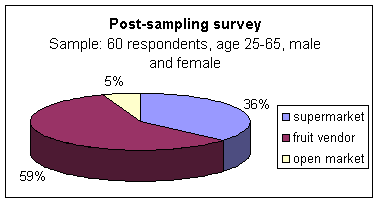
questionnaire. An additional five-question survey was conducted during a
sampling exercise with 60 responents. The results of both surveys provide a
profile of the Belgian fruit consumer, his shopping habits, his price range,
and frequency of purchase, among others.
This chapter
will also provide an overview of the Belgian fruit industry in general with
focus on mango imports based on interviews with the top four Belgian tropical
fruit importers as well as an insight on tropical fruit retailing. Thus, this
chapter will tackle the Belgian consumer, retailer and importer and see how the
Philippine super mango can position itself in their respective group scheme.
A. The Belgian Consumer
According to a study made by Export
Consultant Jonathan Poirier for the Canadian Embassy in Belgium,
« Belgians live in a densely populated country of 331 people per km². The
number of single person households account for 26% of the total 4.2 million
households. On average, household size is 2.5 persons. Single person households
are expected to continue rising with population aging, couples marrying later
in life, rising divorce rates, children leaving home earlier, and an increasing
number of single foreigners employed by multinational organizations. »[21]
The same
study revealed that food expenditure grew by 29% between 1988 and 1995. The
biggest expense was on rents, taxes and water; followed by food ; and
personal toilet/hygiene.
With a history of gastronomic flair and
known as « the culinary country par excellence in Europe, » the
Belgians are quite discerning when it comes to food and generally demands high
quality for a wide variety of products. In general, they shop at local supermarkets
and hypermarkets like GB/Carrefour and Delhaize.
Specialty shops still abound. And most neighborhoods will have more than one bakery, delicatessen, butcher shop and other shops specializing in fresh fruits and vegetables, seafood, wine, cheese and chocolate.
A.1. Belgian
awareness of mangoes
Belgium has
a long love-hate relationship with Africa – from the early years of King
Leopold II’s colonization of Congo to modern-day development aid programs.
Belgium claims that Africa-focused activities have graduated from political
exercises. Instead, a two-way, constructive relationship has emerged. Whatever
name its called, this relationship has undeniably nurtured a Belgo-African
bonding. Africa is no stranger to a Belgian.
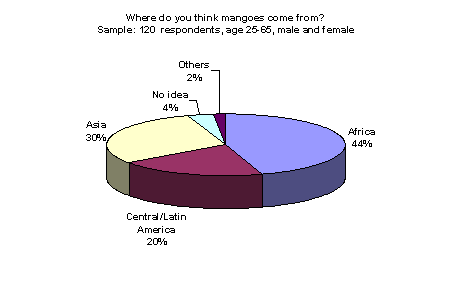
This probably explains why
majority of the Belgians nonchalantly responded « Africa » when asked
in a supermarket survey where mangoes come from.
Many African
countries are indeed sources of mango imports to Belgium. These supplier
countries include Kenya, Rwanda, Ivory Coast, Mali, Burkinafaso, Senegal, and
South Africa. The African sources have also the shortest transport period,
averaging 11 days via sea vessels.
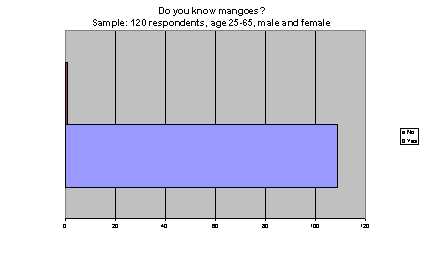
A number of respondents have
indicated that their first taste of mangoes was in Africa. Many of them have
tasted mangoes either at home or at someone else’s home not really knowing
where mangoes came from. In general, a very high percentage of Belgians know
mangoes - an exotic fruit (definitely not homegrown) now available in the
market.
Christian de
Cannière, President, Union Nationale des Importateurs, Exportateurs and
Grossistes en Fruits, Legumes & Primeurs, said that an earlier survey on
consumers revealed that the main criteria for purchase are (1) beauty, (2)
price and (3) taste. The Belgian consumers, he said, are used to richly-colored
mangoes and prefer the reddish or greenish varieties. They are also used to
large mangoes.
While this
statement is true, it must be noted that Belgians have never been exposed to
any other type of mango apart from the ones which are available in the market.
Therefore, it’s difficult to assume that they will not like nor not buy “pale”
colored mangoes such as the golden yellow variety of the Phlippines. A consumer
can only be familiar with a product that is available to him.
Importers
and retailers disclosed that consumers “buy with their eyes.” If Belgian consumers
have no other references for a good quality mango and no possibilites for
tasting, the physical aspect of the product will be the main criterion.
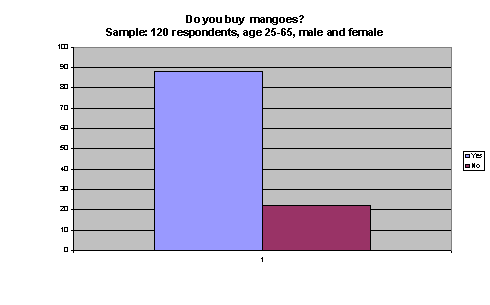
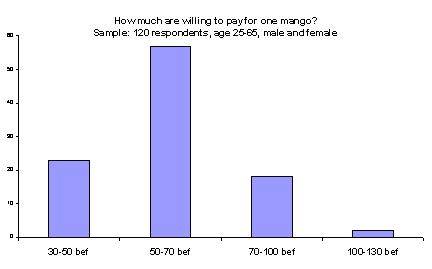
The consumer survey revealed the following
results as criteria of purchase:
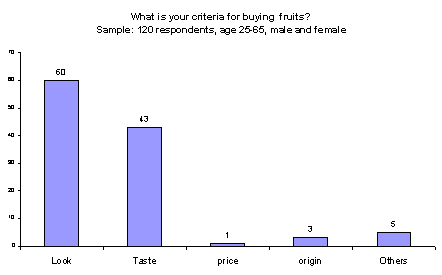
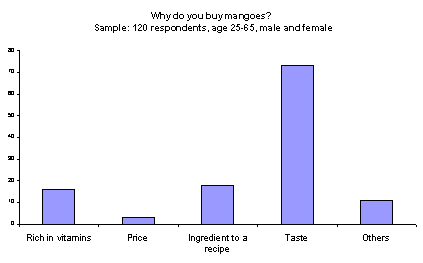
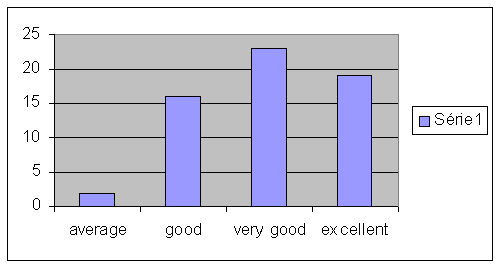
During the sampling exercise,
respondents were asked to describe the taste of Philippine super mangoes. The
results are as follows:
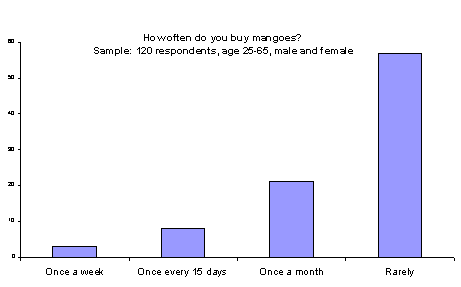
As mangoes are not yet in the
same category as bananas and apples, frequency of purchase is low. Belgians buy
an average of one mango in a period of 3-6 months.
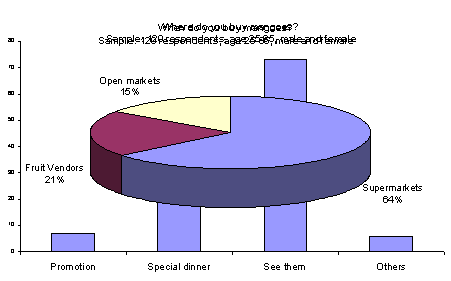
Mangoes are not a « must » in
the grocery list but more of an impulse commodity (when they see them) or a
“different” and “plus” item for special
occasions.
Exotic
fruits are undeniably part of a supermarket’s novelty products program. And
even in Delhaize, which claims to have a policy of non deluxe products, the
range of exotic and special fruits are not necessarily low-priced.
See sample
pricing below :
Another
fruit vendor in Ixelles (also an upmarket commune) said that Mexican mangoes
may be very cheap and affordable but if the taste is bad, nobody will pick it
up. “I throw half of my Mexican mangoes because they remain unsold. I prefer to
have Venezuelan mangoes, for example, because they are very good and even if I
have a small quantity, all the mangoes will all go in a matter of days.”
The manager
of a high-end fruit outlet in Brussels claimed that her clientele are those
searching for “high quality” and rare products. Whether the fruit racks have Senegal mangoes at 118 bef per piece
or the big Australian variety at 299 bef per piece, people pick it up and she
manages to clear out her boxes in no time.
Owners of fruit stands and vendors at
open markets disclosed that they sell more in summer than in winter and sells a
weekly average of 30 boxes (five kilos per box) or 150 kilos of mangoes per week.
C.
The Belgian Tropical Fruit Importer
The four major Belgian tropical fruit importers housed at
the Centre Européen des Fruits et Légumes in Brussels are Goosens, Starfruit,
Exofi and Tradexo.
Goosens is the biggest and oldest; Starfruit is the importer for Delhaize; Tradexo supplies to
wholesalers; Exofi is small but caters to the upmarket outlets.
According to Edwin Callebaut of Tradexo, there are two types of wholesalers, namely: (1) catering
to high-end fruit stalls in the rich communes or areas and to the hotels and
restaurants; (2) catering to fruit stalls in the marginal areas and ambulant
fruit vendors.
Importers
can source out mangoes all year round. About 90% of mango imports to Belgium are transported via fast sea
vessels, which dock at the harbors of the Netherlands. G. Goosens of Goosens et
Fils, one of the oldest Belgian fruit importers, disclosed that the average
period of transport of mangoes is 15 days. It takes 12 days from South Africa,
14 days from Peru, and 18 days from Mexico. He said that except for
« irregular varieties like Australia’s Kensington Pride, »
airfreighted mangoes are almost non-existent. Mangoes brought in by boat for
Exofi, for example, accounts for about 10-12 tons per week and only one ton is
brought in by air.
The only
airfreighted mangoes are from Mali, Senegal, Australia and Thailand.
Importers
consider November to June as peak import months and July to October as the low
season for mango imports. The only logical explanation for this is that during
the European summer months (July-September), there is an abundance of local
fruits such as peaches, abricots, strawberries, cherries, prunes, red currants,
and blueberries at less cost than exotic fruits. Consumers, they said, pay less
attention to exotic fruits when there are more local fruits on sale.
Geert Puttemann of Star Fruit, claimed that Senegal mangoes
are the best to eat while Mexican mangoes are the most commercially viable
because he has shorter transport periods from Mexico and the yellow-red skin is
very attractive to the consumers. In terms of variety, Kent is the best to eat
while Tommy Atkins, though not having good taste, is price-wise.
Callebaut of Tradexo considers Mali mangoes as the
best-tasting but his imports of Malian mangoes are re-distributed outside
Belgium.
De Cannière
revealed that Asian mangoes are better in taste than the other varieties but
importers and distributors will most likely not buy Asian mangoes even if there
is a difference in taste because « to show this difference costs a lot of
money. Also, transport costs are too high. The final price will be too
prohibitive. »
Charles
Roess of Exofi said that Asian mangoes may prove expensive to the local
consumers and are best suited for the niche Asian expatriate community. In the
UK and Switzerland, the target markets of Asian mangoes, Philippine super
mangoes included, are the Asian communities. The major reason is that importers
are Asians who sell these mangoes in their own supermarkets and re-distribute
the rest of the volumes to other Asian stores. The importation structure of
these Asian importers are too limited to cater to the requirements of the
mainstream and therefore their markets have remained relatively ethnic.
Tradexo,
however, has expressed willingness for trial volumes of about 800 to 900 kilos
which he intends to propose to his existing clientele. He agreed that
Philippine super mangoes may be positioned as a “deluxe” product, implementing fruit tasting and
trial selling in certain high-end fruit shops. “Deluxe” or “irregular” products
are not shipped every week but whenever best available or when demand is high.
He also proposed to collaborate with the launching promotions.
He added
that the acceptance of Philippine super mangoes among Belgian importers depends
not only on the quality of the fruit but on the price, margins, packaging,
transport and export services. Fruits must arrive in good quality and
producers-exporters must ensure that all factors assuring “top quality upon
arrival” are well-guarded.
Chapter 7 Learning from the Kiwifruit
Story
One of the
most impressive tropical fruit market breakthroughs is kiwifruit, a wild,
unknown fruit of Chinese origin which was cultivated and commerciaized by New
Zealand. It is a 50-year old struggle to be in the mainstream and finally, the
huge marketing efforts are paying off. Kiwifruit is almost in the daily fruit
bowl along with apples and pears.
Meanwhile, the marketing board continues to re-adapt its strategy
inorder to meet the evolving market scene.
Philippine
super mangoes have a lesson or two to learn from the kiwifruit story, which
until now is one of the best examples of how a rare, tropical, expensive fruit
became one of the world’s important staple in the mainsteam.
History and Background
Kiwifruit is originally called the
Chinese gooseberries, a green, hairy fruit growing wildly on vines. The first Kiwifruit was brought from China
to New Zealand in 1904. The Hayward variety, developed by Hayward Wright in
1924, became the variety grown worldwide today.
Commercial cultivation was first
directed for domestic consumption. In 1952, the first exports of kiwi were delivered
to England and the USA. The name « kiwifruit » was first used in 1959 to identify with
their country.
Almost 50 years later, the kiwifruit
has become one of the world’s important fruit in the mainstream. The secret of
kiwifruit’s success relies mainly on an active, well-organized marketing board,
which is growers-based and is in-charge of running the entire kiwifruit
industry – from production, packaging, research, to the implementation of a
clear marketing strategy.
Every year, some 2000 growers produce
over two billion kiwifruits, which are harvested and shipped to some 70
countries. They are now under the brand Zespri™ and come in four different
types : Zespri™ Green, Zespri™ Green Jumbo, Zespri™ Green Organic, and the
recently-launched Zespri™ Gold Kiwifruit.
Year-round, Zespri™ International has a
30% share but gets 70% of the market during its selling period from May to
December.
New Zealand prides itself in an
environment-friendly program. The Marketing Board makes sure that the product
is not only safe to eat but is grown in conditions that do not harm the
environment. Kiwifruit growers try to use control agents to an absolute
minimum. The Kiwigreen program guarantees there are no harmful residues on the
fruit, meeting the toughest international standards. Recyclable packs has been
developed to meet consumers’ demand for eco-friendly packaging while an ongoing
study is being made for returnable plastic containers.
New Zealand Kiwifruit
Attributes :
produced in a pollution-free environment ; moist and juicy,
refreshing, sweet yet
tangy
Benefits :
easy to digest, doesn’t spoil appetite, keeps you active, keeps you
healthy
Values :
makes me feel good, puts me at my best, makes me feel refreshed,
makes me feel I’m taking
care of myself, makes feel I’m buying a
quality product, fits my
active lifestyle
Personality : exotic (from
overseas), special, fit, fresh
(Source :
Brand Essence Research, February 1992)
The
Marketing Board
Prior to the creation of the New
Zealand Kiwifruit Marketing Board, the New Zealand industry was fragmented,
distributing and marketing its product via several channels.
The New Zealand Kiwifruit Marketing
Board is an unsubsidized, 100% owned by New Zealand kiwifruit growers with
headquarters in Auckland, New Zealand. It has a network of
strategically-positioned offshore marketing offices operating in Europe, Japan,
East Asia, and the Emerging Markets (Americas and South East Asia). The Board
is continually involved in developing strong relationships with international
distributors; in research and development on the new commercial varieties;
improving orchard management and post-harvest techniques; in extensive
international market research; and expanding consumer awareness and demand. The
Board has an annual budget of US$30 million for consumer advertising and
in-store merchandising.
With the new brand, the New Zealand
Kiwifruit Marketing Board has become Zespri ™ International Limited.
Target : to position kiwifruit as
a premium everyday fruit alongside others such as bananas, apples and oranges.
This is a target, which is ongoing since the last 50 years.
Mission : Dedicated to making
kiwifruit as an exciting mainstream fruit that is valued for its unique
nutritional qualities, and to improve New Zealand kiwifruit’s clear leadership
of the industry worldwide.
Branding
Special products are often identified
with only one leader. For example, France for wines, Switzerland for cheese and
New Zealand for kiwifruit.
A few years after the first exports,
New Zealand adopted the name « kiwifruit » to identify its source.
(The word « kiwi » is the name of a round, brown, flightless bird).
As the world market grew, all
kiwifruits became identified with the New Zealand kiwifruit. Thus, the
brand New Zealand.
In 1991, the « New Zealand »
brand was re-launched worldwide as « New Zealand kiwifruit - The
world’s finest. » International market research confirmed that only New
Zealand consistently delivers « the world’s finest » kiwifruit for
which the consumer is prepared to pay a premium.
Consumption of kiwifruit grew and
competition became stiffer. Consumers were eating more kiwifruit but the
marketing board’s target was to have consumers eat more of their
kiwifruit. A re-branding exercise was
required to strongly differentiate New Zealand’s kiwifruit from other
kiwifruit, especially in an environment where the appearance and price of the
product have become the same among competitors. A brand will help create
customer loyalty.
The result of a series of Gallup
« usage and attitude » survey in five different markets and sessions
with marketing consultants was the new brand name « Zespri™ » New
Zealand Kiwifruit – the fun, vibrant, healthy, good-tasting fruit for all the
family.
This brand does not only represent the
best taste and the best grown kiwifruit in the world but the best kiwifruit
« experience. »
Zespri ™
·
strong
and distinctive
·
appropriate
to the brand’s positioning
·
attractive
and appealing
·
linguistically
and culturally acceptable
·
registerable
and protectable
Kiwifruit’s
setbacks :
It is said
that kiwifruit first came to Belgium some 20 years ago and was sold at about 60
belgian francs per piece. Nobody knew then what kiwi was or where it came from.
The Kiwi Board spent a big budget for its promotion. Also, kiwi plants were
introduced in Italy and France so the supply continued even if it was
off-season in New Zealand. The European varieties, which were smaller, less
good but cheaper, kept the kiwi in the marketplace even off season from its
origin.
1992 was a
crisis year for New Zealand kiwifruit exports due to oversupply in the
international markets - increasing world production and severe competition from
Chile, Italy and
California of the same Hayward cutivar. Also, there has been a changing
attitude to kiwifruit in many countries. Whereas kiwifruit was once regarded as
a rare exotic seasonal crop fruit meriting high prices, it has now become a
year-round mainstream fruit. The kiwifruit industry is now stable and
profitable but recently, the Kiwifruit Marketing Board has launched the brand
name, ZESPRI, to identify kiwifruits originating from New Zealand. Of course,
this branding exercise is costing them a fortune. To fight competition, they
also launched the Zespri Gold kiwifruit.
New
Zealand Kiwifruit and Philippine Super
Mangoes
While the Kiwifruit experience may be
used as a reference of how Philippine super mangoes may penetrate a market and
be succesful in it, there are some basic differences between the two fruits.
Kiwifruit was introduced when exotic fruits were rare and no other kiwifruit
existed in Europe or in Belgium. There is only one variety of Kiwifruit,
although there is an ongoing research on new commercial cultivars. A kiwifruit
from California is exactly the same kiwifruit from Chile or from Italy or from
New Zealand. The Marketing Board, exclusively
supported by growers, plays a vital role in the industry and disposes of a big
budget for promotions.
The kiwifruit has bigger obstacles for
differentiation today : same product, same price.
Philippine
super mangoes are entering a marketplace where exotic fruits have become
commonplace in Belgium. More important, Philippine super mangoes are entering a
market where other mango varieties already exist, where Belgian consumers have
past experiences with the fruit, where importers and retailers and consumers
have affixed a price, and where differentiation is important. One of the main
advantages of Philippine super mango
over kiwifruit is that the former has only one variety and is definitely
different (in taste, aspect, texture, etc.) from the other mango varieties
already available in the Belgian market
Clearly, the kiwifruit experience shows
that (1) a new, exotic fruit demands a
premium, (2) a strong and efficient
Marketing Board plays a vital role in tapping new international markets and to
identify promotional campaigns to penetrate new and sustain existing markets,
(3) the source of Philippine super mango variety must remain exclusive. If the
Philippine super mango variety is sourced out outside the Philippines, this can
cannibalized the Philippine-based production as what happened with Kiwifruit,
(4) targets are constantly re-adjusted according to market performance, and at
one point, (5) some basic issues have to be faced such as “When does a fruit
cease to be considered exotic?” or “What is the price to pay by entering the mainstream ?”
to re-assess the initial strategy.
Chapter 8 Conclusions and Recommendations
Philippine
super mangoes will be introduced to the Belgian market as an exotic, seasonal
fruit in an upmarket distribution channel for the first five years. The major
target are the Belgian consumers who are ready to pay a price premium for a
product which they deem is of very good quality at specialized fruit outlets
they trust.
The
introductory phase will have the following elements:
A. PRODUCT
Fresh Philippine super mangoes of the
Carabao variety, preferably medium to extra large sizes in order to align
itself with competition. Sizing at this point is important because Belgian
consumers have psychologically affixed a price base on size and introducing
small Philippine super mangoes might prove a disadvantage. Eventually when the
market acquires a higher awareness of Philippine super mangoes, small sizes
maybe introduced either to be sold per piece or weight per pack.
B. POSITIONING
Philippine
super mangoes will be positioned as a “rare, exotic fruit product” catering to
those who are willing to pay a premium for high-quality products. Positioning will focus on differentiation.
Philippine
super mangoes can focus on its differences to beat other mango varieties:
different taste, different product, different color, only one source, only one
variety, different price, and different food preparations which are not always
possible with other tropical fruits.
These differences will be used to position Philippine super mangoes as
the reference of a good quality mango.
Color, for
example, is a major differentiation point. Philippine super mangoes are quickly
noticeable because its coloring is different. It’s the only
« golden » mango available. It also has the advantage of color change
during the different ripening stages. Consumers, if informed, will know exactly
when the mangoes are ready to eat : golden yellow and fragrant
As it will
initially be available only four months a year, Philippine super mangoes will
assume its “rarity,” “exclusivity,” and “exoticism” which will justify its
price difference.
C.
TARGET CLIENTS
The
introduction of Philippine super mangoes in Belgium is targeted to the local
population – Belgians and undeniably because of their number, the expatriates.
The Belgian market will be different to other existing Philippine fresh mango
markets in Europe like the United Kingdom and Switzerland where the target
markets remain basically Asian. The Asian communities in Belgium, though present,
are relatively small compared to bigger countries like France or the UK.
D. PRICE
At 1.50 US$/kg of mangoes
plus 2.60 US$/kg for airfreight
__________
4.10 US$/kg for 3-4
pieces of mangoes
plus .41 US$/kg 10% importer’s mark-up
__________
4.51 US$/kg
x
2 retailer’s
profit margin
__________
9.02 US$/kg x 45 bef
= 405 bef divided by 4 pieces
=
101.25 bef per mango estimated retail
price
Philippine
super mangoes will be tagged at least 20-30% higher than current mango prices,
even in fruit outlets. Transport cost is half the price of an imported
Philippine super mango. At this stage, Philippine super mangoes can only be airfreighted because (1) results
of technological experiments on maturity deterrents on the Philippine variety
are not yet available; (2) there are no fast sea vessels with direct lines from
the Philippines and this means approximately 4 weeks transport time.
Peak harvest
periods, however, bring mango prices to a minimum. It is therefore ideal to
import only during the peak production period for the introductory stage. This
period also provides exclusivity to being the best variety available in the
market. As the volume increases, transport costs will decrease, bringing down
retail prices.
The positioning
of the Philippine super mango as a new, rare and exotic product demands a price
premium.
Mango prices
are expected to fluctuate according to the harvest season, transport costs, and
currency exchange rates.
E. DISTRIBUTION POINTS
Considering
price levels of Philippine super mangoes at retail level and the reality of
price battles in the supermarket chains, the appropriate outlets of Philippine
super mangoes in the introductory phase are the middle to upmarket fruit
outlets.
It has been
mentioned that fruit prices in specialized fruit outlets are 10-20% higher than
in the supermarkets. Regular clients at fruit outlets are fully aware of the
price premium they are paying for “a better product.”
Since
Belgium will have to develop itself as a “profitable” market, Philippine mango
producers-exporters may not immediately consider it as a priority market and
may not be ready to re-allocate volumes from traditional markets during the
introductory phase. Considering this initial, temporary limited supply, it may
prove difficult in the beginning to supply the mainstream (supermarkets) which
demand big volumes and lower price. It
is more logical that at this stage, it’s better to have selective outlets – a
niche market where a higher price difference is acceptable both for the
retailers and the consumers. The final points of sale can also depend on the
importer’s existing clientele, which could in fact include supermarkets who
make limited purchases of upmarket products. The demand volume can evolve very
quickly – meaning, Philippine super mangoes will be picked up by category
buyers of supermarket chains. In this case, producers-exporters are in a
position to re-allocate present production volumes. Eventually,
producers-exporters may look into the possibility of expanding its importation
network, either by continuing their relations with the original importer,
abstain from exclusivity or skip importers and deal directly with the big
supermarket chains.
At present, Philippine mango
producers-exporters may hesitate “putting all their eggs in one basket” because
basically Europe is not yet a priority market. Philippine mango
producers-exporters are currently enjoying big volumes and high profit margins
in existing markets like Southeast Asia and Japan. Volumes are also expected to
increase in the two recently opened markets - the US and Australia. Transport
of mangoes to these destinations have already been well established and at
reasonable costs. When there will be a strong demand at a profitable price in Belgium,
Philippine mango producers-exporters will most likely meet this demand
challenge by shifting market priorities. This is the fastest way to meet an
overnight demand evolution because (1) a mango is not a manufactured product.
It takes years to develop an orchard,
five to seven years for a mango to bear fruit, it takes 100 to 150 days
for a mango to mature as as fruit after flowering and a maximum of only two
harvests per year; (2) not all harvested mangoes are of exportable quality nor
are of exportable quality meeting the Belgian market expectations (i.e. size);
and (3) a major part of harvested mangoes are processed.
The dream target is obviously to be in
the mainstream, supplying both specialized stores and the supermarkets. But
realistically, it may take some time for the market to evolve and for demand
and supply to experience parallel growth. At present, demand for mangoes is low
compared to other fruits but high compared to other tropical fruits. There is,
however, a clear consensus on bright growth forecasts in the coming years.
Philippine mango producers-exporters can only assume that mango demand in
Belgium will increase and hope that the Philippine variety, because of its
difference coupled with other factors such as alternatives modes and costs of
transport, will take a lead in this growth.
F. COMPETITION
While
Philippine super mangoes will be the first Asian mangoes to be imported in
Belgium in big quantities, competition from the same region is not far behind.
India and Pakistan are already major exporters to the UK but the entrance of
another Asian variety in mainland Europe may inspire these countries to go
beyond their traditional destinations. Thai mangoes, which are being sold in
Asian food outlets, may also start to be marketed aggressively.
Other
potential competitors are : Brazil and Venezuela for their very good Kent
varieties; Mexico for its variety’s crunchiness ; and Spain with its
recently-introduced Sensation variety which is « very good, very
tasty » and sold at current market prices. The Spanish mango is the only
European sourced-mango and harvest season is from March to May.
Importers,
however, have excluded the competition issue at the suppliers’ point of view.
They claim that the winter is the best season to sell mangoes because of a
limited range of fruits available in the market. From June to September, there
is an abundance of local fruits at less cost than exotic fruits. Retailers and
consumers think the season is a less important issue.
G. BRAND
The name
« Philippine Super Mango » will be retained. This is the brand which
is being used by the Philippine government to promote Philippine Super Mangoes
worldwide. Even if creating a new name may prove beneficial to promoting an
exclusive identity for this product, there are some legislative issues to
consider. EC regulations require that the label should not mislead the
consumer. Aso, as it will be labeled as an imported mango, all other legal
requirements will follow, including pesticide residue levels and plant health
requirements related to mangoes. Designating the product as other than a mango
will mean a different set of pesticide residue limits in the EU market.
« Philippine
super mango » is an international identity. This is the same name carried
in established markets like Japan and Hongkong. If a consumer is travelling, he
would easily identify Philippine mangoes with this « brand. »
Citing the
origin is highlighting one of the major differences of Philippine super mangoes
to other mango varieties sourced out elsewhere. Many producing countries are
growing the few varieties in demand but the Philippines has exclusivity to its
variety. There are various varieties available in the market but not one has
mentioned origin. This is a different mango because it comes from the
Philippines. Referring to its origin, Philippine super mango can isolate itself
from its competitors. This type of “branding” exercise is not new. When
kiwifruit was introduced, for example, it used the « New Zealand »
brand and has maintained this name until recently when it adopted
« Zespri™ . » Also, some Belgian supermarkets indicate the
origin of the fruits during special promotions like « Strawberries from
Spain » or « Melons from France. »
These are
references which can prove useful for positioning Philippine super mangoes
while promotional campaigns may focus on the positive perceptions of the
general public.
G. Launching
The final
target of Philippine super mango exports in Belgium and eventually in the
European Union is to have sufficient market penetration that would consider
Europe as a traditional market like Japan and the US. In practical terms, it
means that Philippine mangoes should warrant a regular space in Belgian
supermarket shelves all year round in 10 to 15 years.
The launching period, however, will
cover five years and will use the results of the research on consumers in
particular and the fruit industry in general as the basis of implementation of
a marketing plan. This five-year
program is divided into the following :
Introductory
stage of 2-3 years : launching of Philippine super mangoes in the Belgian
market as a “ seasonal”» or “irregular” product and utilizing the existing
clients of one importer who caters to average and high-end fruit outlets and
supermarkets. An estimated volume for these first three years, based on
importers’ trial volumes, is two tons each month during the peak harvest period
of the first three years. Initially, Philippine mangoes will only be available
during the high production season (end of February -March-April and May) to (1)
get a lower price ; (2) get the excellent harvest ; (3) coincide with
the absence of « best » mango varieties in the market ; and (4)
precede the arrival of the local summer fruits.
On the fourth and fifth year, it maybe
envisioned to double import volumes in the existing outlets and extending the
selling season, after reviewing the market performance and production capacity.
However, this should not prevent exporter-importer to assess market performance
of Philippine super mangoes and adjust volumes accordingly during the first
three years.
While a
year-round presence in the market helps increase product awareness and
availability, the price has to be weighed carefully. Off harvest season would
shoot up the price by 25% per mango unless the producer-exporter is willing to
maintain a « price drop » for a year and regard a net profit at the
end of the year to help stimulate demand.
Also to be taken into consideration is the presence of
« competitive » varieties during the other months. Even if Philippine
mangoes taste better, it would still be difficult to isolate a 30 bef mark-up
when there are other mangoes which are not necessarily of bad quality.
H. Launching
Promotions
A product launching requires a minimum
of promotions. The three main premises drawn from the consumers’ survey which
justify the importance of a well-targeted, well-focused information campaign
for the launching of Philippine super mangoes in Belgium are:
* Belgians
have past bad experiences with mangoes – fibrous, tasteless, never know when
its ripe
* Belgians
have poor level of product awareness – origins, how to eat, various varieties,
food preparations, health benefits
* No major
information campaign had been made for mangoes – consumers’ product knowledge
is low. And since the entrance of
mangoes in the Belgian fruit marketplace, no information campaign by any
supplier, importer nor distributor was made specifically for mangoes.
The first two premises are “issues”
which the information campaign should try to hurdle because to encourage actual
purchase, consumers must know the difference and go beyond perceived difference
to justify price difference. The third premise affirms that the first
information campaign on mangoes can be advantageous to its initiators.
The information campaign will accompany
each selling period and may implement a public and media relations activity.
Complementing the “exotic” positioning, the information campaign may create an
entire magical, tropical image around mangoes.
A take-away leaflet can focus on “how
to eat,” color range for ripening stages, nutritional benefits and recipes.
Sampling is the most important
promotional activity. Mainstream buyers have to be enticed to take the first
bite. This could be done in many ways like giving away free mangoes, in-store
tastings, etc. Other promotional activities may take the form of a “tropical
dinner” for example, where importers, fruit buyers for supermarkets, restaurant
owners, hotel chefs, the press and opinion leaders in the fruit industry are
invited to a “Philippine” dinner cum conference/exposition on mango and other
tropical fruits. Eventually, “tropical dinners” maybe proposed to restaurants
who will receive free mangoes in exchange for a Philippine super mango menu for
a week.
These information and promotional
campaign may require the initial investment of the Philippine mango
producers-exporters and a lot of convincing the importer to collaborate with or
even co-finance the campaigns.
Recommendations
for market sustainability:
If the introductory stage reveals a
clear, definite and profitable market for Philippine mangoes in Europe, there
are several steps to take to sustain the market and reach the final target.
The Philippine mango
producers-exporters must be convinced that this market in Belgium can be
profitable. They have to realize that the introduction in Belgium can lead to a
European-wide distribution. After the traditional markets in Asia and America,
Europe is the next area for expansion. The initial demand will be low but it
can only be expected to grow as the Belgians become aware of the product and
more Belgians develop a liking to the product. As the demand volumes evolve
positively, several things will run parallel such as increased supply and
competitive pricing due to lower transport costs. To ensure readiness for
either overnight increases or long-term evolution of demand, there are several
steps to take:
* Increase production levels by
increasing fruit efficiency, implementing an efficient orchard management
system, improving post-harvest procedures and facilities.
*
Further develop transport options and evaluate quality standards and
costs through new storing and shipping methods.
* Consider the advantages of creating a
Mango Marketing Board, which will be aimed at: tapping new markets; ensuring a
consistent « top quality upon arrival » by proposing measures for
packaging, handling, and transport; defining promotional campaigns; monitoring
the world mango industry ; sustaining existing markets and adapting to
their respective evolutions ; mediating between mango growers and
importers; and providing market feedback.
* Product extensions. With the rising
popularity of organically-grown food, producers may start thinking of organic
mango in future productions. Processed mango (dried, beverages, bottled) may be
eventually introduced to promote the fruit’s diversity and complement product
awareness build-up, especially during the period when fresh Philippine super
mangoes are not available in the market. Smaller size mangoes may eventually be
introduced to complement the lack of uniformed-size large mangoes.
* Other
logistical details have to be in placed. The two vapor heat treatment plants
will not be enough to process bigger volumes of fresh mangoes. There is a need
to develop and expand processing plants and equipment, warehouse and trucking
options, and better packaging facilities.
Given the
results of the research and recommendations, Philippine super mangoes will have
a viable niche market in Belgium. It will not be a new fruit in Belgium but it
will be a different, exclusive, better-quality fruit. It will rise to the
challenges of price, demand and supply, budget constraints for promotions, and
competition. Like all fruits, the final target is to become a staple product at
affordable prices. But perhaps by then, mangoes like kiwi, will no longer be
considered “exotic” nor will it justify a premium price.
Acknowledgements
Mr. Jean Pitz
Ms. Ana Abejuela, Agricultural Attaché,
Philippine Embassy, Brussels
Mr. Romy Borillo, Commercial Attaché
Philippine Embassy, Brussels
Mr. Bertrand de la Fouchardiere, Marketing
Operations Manager, Commercial Graphics, 3M Europe
Mr. Jacques Dopchie, Solvay Business School
Mr. Freddy de Rave, Delhaize Belgium
Mr. Edwin Callebaut, Tradexo
Philippine
Embassy - Brussels, Belgium
Philippine
Embassy – London, United Kingdom
3M
Europe, Brussels, Belgium
André
Cheong, Manning Impex, London, UK
Galip
Fruits and Vegetables Shop, Brussels
Ms.
Tereza Borja, Commercial Office,
Philippine Embassy, Brussels
National Institute of Statistics, Minister of
Economic Affairs, Belgium
Ms. Ping Ren
Bibliography
“Mango in Thailand at a Glance,” Food
Industry, The National Food Institute, Thailand (1999)
« Mango Fruit Facts, »California
Rare Fruit Growers, Inc. 1996
Fact Sheet HS-2 » Horticultural Sciences Department, Florida Cooperative Extension Service, Institute of Food and Agricultural Sciences, University of Florida, April 1994
“Post-harvest Handling of Mangoes,” www.tropical-seeds.com (2001)
“Mango,” Ministry of Agriculture, Malaysia,
www.agrolink.moa.my
“ Tropical Fruits “ , Economic and Social
Department Commodity Notes, Food and Agricultural Organization (FAO) of the
United Nations (February 2001)
Fruit and Vegetable Markets Monthly, No. 93
(1998)
Gokul Patanik
with Tom Klotzbach, « Mangoes : From Exotic to Mainstream, »
www .marketag.com
« World
Market for Mango,” Asia Regional Agri-Business Project (RAP)/Fintrac Inc.,
Market Information Bulletin No. 9, Market Asia Agribusiness Information
Ken Pernezny
and R.B. Marlett, “Some Common Diseas of Mango in Florida,” University of
Florida, Cooperative Extension Service, Institute of Food and Agricultural
Sciences
“Mango,”
University of Asia and Pacific Food and Agribusiness Yearbook « Millennium
Edition
Jeanevive M.
Duron, « Mindanao Fruits for the World » Philippine Information
Agency
« Key
Commercial Crops Development Program, » www .pworld.net.ph
Jonathan Poirier, « The Agri-Food Market in Belgium» for the Embassy of Canada in Belgium, August 1999
« Zespri™
Kiwifruit – The world’sfinest », New Zealand Marketing Board
« Philippine
Mango seen entering US, Australia markets in 2 years, » Articles, APEC
Executive Update-Business World Online (28 February 2000)
« Government
puts up research center to quality production of mangoes, » Global
Sources, Trade Media Holdings, Inc. (10 October 2000)
Zac
Sarian, « US now ready to accept mangoes from Guimaras », Agri Plain
Talk, Manila Bulletin (18 June 2001)
« Philippine
Super Mangoes gets raves in Australia, » Department of Agriculture,
Philippines, www.da.gov.ph
« History
of Mangoes, » Pak Mangoes for International Markets, www.multancity.com
Prof.
W. Dejonckheere, « Residues of polychlorinated biphenyls in market basket
products and total diets, » Food Related Health Hazards (1990-1195),
www .belspo.be
J.H. Crane
& C.W. Campbelle, « The Mango, » University of Florida,
Cooperative Extension Service, Institute of Food and Agricultural Sciences