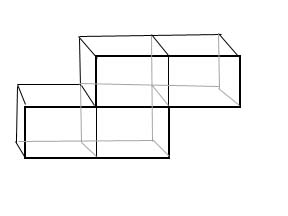
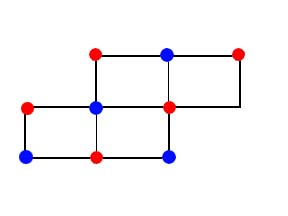
Let B be a graph of a concatenation of cubes such that each pair of vertices on any cube can be shared with at most one other cube. Let K be the set of all subgraphs of the two dimensional graph resulting from slicing the graph in half through the plane in which it is moving. So if we take the ordered pairs of the entire 2-D graph (ie the largest graph in K), we will obtain all of the perfect matchings of the "cube" graph that do not contain a "depth" edge, but only "width" and "height" edges. The first matching in the ordered pair of 2-D snakes represents the matching of the front face of the 3-D cube, while the second matching in the ordered pair represents the matching of the back face of the cube. If the front and back face are perfectly matched, then so is the cube, since there exist no vertices outside of the front and back side. Note that we also have perfect matchings of the cube that contain edges that are incident to vertices in both the front and back faces of the cube. Note that if we choose an edge that is incident to vertices in both the front and back faces to be included in our edge set of some perfect matching, then the corresponding vertices cannot be used again, so we must delete them from our ordered pairs of 2-D snakes. As a sidenote, this provides a good basis for a proof that any cube snake travelling in one plane will not have a perfect matching with an odd number of edges that are incident to the front and the back faces, since the edges that are not incident to both must be contained in a perfect matching of a subgraph of the corresponding 2-D graph, and every perfect matching of them must contain an even number of edges. Furthermore, since the 2-D snakes are bipartite, we can also exclude the possiblity of a cube snake having any even number of vertices incident to the front and back face that require the removal of unequal amounts of even and odd "parity"(denoted by blue and red dots below) since those also do not allow for perfect matchings of the 2-D snakes.
Notice that this operation can be reversed from ordered pairs of the 2-D snakes to the "cube" snakes. The algorithm is that everytime you see a vertex removed on the ordered pair of 2-D snakes, draw a line connecting the two faces(front and back) on the "cube snake". Then, every edge that is contained in the perfect matching of the 2-D snake in the first position of the ordered pair is to be included in the front face of the 3-D cube snake and every edge that is contained in the perfect matching of the 2-D snake in the second position of the ordered pair is to be included in the back face of the 3-D snake. Voila! A perfect matching. A direct consequence of this fact gives that M(B) = sum (j)^2 for all elements j in K. The squared comes from the fact that we are dealing with ordered pairs.