*** Introduction 2 Buddhism ***
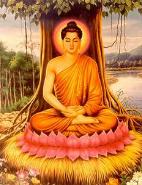
"Ta la Phat dda thanh. Cac con la Phat se thanh."
-- Phat Thich Ca --
"Ta la Phat dda thanh. Cac con la Phat se thanh."
-- Phat Thich Ca --
Below is Buddhism in the nutshell. My knowledge on the subject is quite limited, thus
I am going over only the basics.
These are the facts agreed by all Buddhists regardless of schools or branches.
If you want to explore deeper into some of the concepts,
feel free to click on the links page.
In truth, Buddhism is a very broad subject.
Some of the concepts can certainly take one's life to expand & research on.
Recently, there has been a rising interest in integrating Western psychology
and Buddhist teachings. But those thoughts are quite profound & require
high knowledge of Buddhism to expand on. That is, speaking from the
scholarly view.
For Buddhists who rely on faith, they dont have to know & understand
in-depth doctrines or sutras.
One just has to understand & practice the basic, fundamental ideas like
"compassion & kindness," because those are the core teachings of this belief.
If one can train oneself to be compassionate to all sentient beings &
treat everyone w/ kindness, one will have a fulfill, harmonic life.
If you are a compassionate person,
you would be able to understand others' pains & sufferings
& take them to be your own. Through such personal understanding,
you would be able to grasp the concepts of "suffering" &
know the impermance of things &
realize how futile and hurtful it is to try
to attach to materialistic things in life.
You would then try all you can (even if it means you have to sacrifice yourself)
to help others & spare them of griefs,
because their sufferings are your own sufferings.
And with that kind of mentality, you would be able
to have the respect, the appreciationg, & the love for all things in life,
& such in turn would enable others to return the appreciation,
love & respect for you, which brings up the important concept of "karma", also known as
the law of cause & effect.
Some of the greatest inspirational beings I have the fortune to encounter in my life
are those that are amazingly compassionate & possessed by boundless kindness.
They dont necessarily know all the long sutras
or every details about the Dharma, but they are the TRUE Buddhists for
they practiced the essential concept set by the Buddha
"True happiness, the real happiness, comes from helping others."
Prince Siddhartha (Si Dat Ta) was born about 560 BCE at Lumbini (Lam Ti Ni) park into the royal Shakya clan
of a small kingdom located near the Himalayan Mt. in what is today the country of Nepal.
His mom, Queen Maya, died after given birth to him. And thus, the young prince was
raised by the Queen's sister,Mahipajapati Gotami,
At his birth, the old, renown soothsayer Asita (A Tu Dda), who
had spent most his life meditated alone on a recluse mountain, came to pay
homage to the young prince. After observing the infant prince, the old medicant
started to laugh & cry hysterically.
Puzzled by such mingled reactions, king Suddhodana (Tinh Phan),
asked for explainations. Asita then replied,
"I am happy because the Prince will become an enlightened being and help to save
others from this painful, endless cycle of life.
But I cried here because I am very old now and will die soon.
I, thus, wont be able to benefit from the wisdom & teaching of the Enlightened One."
-----> To listen about this momentous eevent, click here to hear tan co:
"Loi Tien Tri cua A Tu DDa" sang by Huu Tho & Bich Phuong.
Hence, predicted the future of Prince Siddartha: He would either become the greatest king or renounce the world & become an enlightened being.
King Suddhodana, upon hearing such prediction, began to set up plans to prevent the latter fact from taking place. He wanted his son to only become the universal monarch. Therefore, he made it such that Prince Siddhartha surrounded by all the luxuries & pleasures in life. He married Princess Yasodara when he was 16. And they had a son whom they named "Rahula" (La Hau La). The young Prince had all that he can ask for & never once get the chance witness any suffering of life. That wass...until one day when Prince Siddhartha decided to take a stroll outside the royal palace w/out telling his father.
He saw: 1) an aged old man, 2) a sick person, 3) a death body, and 4) a smiling mendicant. Never before has he seen such sights. The Prince was shocked & remorseful by the first 3 omens. They made him realize that all his worldly, materialistic pleasures wont be able to help him to escape from old age, deteriorate health, and imminent death one day. And that no wealth in the kingdom can help him attain such peaceful expression as that of the mendicant. He began to question the meaning of life & the endless cyle of rebith & death. The Prince then came to the decision: To renounce all his worldly luxury and go find the way to be like a smiling mendicant & able to help end others' sufferings.
That same night, he silently came to kiss his sleeping wife & young son good-bye, and asked Channa (Sa Nac) to saddle his horse. He then left the palace in the dead of night. Reaching a small stream, he cut off his hair, took off his royal attire to trade for a rag w/ a beggar. and went off into the forest. He was then 29 yrs. old.
For 6 yrs, he wandered about, practiced extreme ascetism, trying to find the answers. Despite endless adversities, temptations, & hardships, Siddhartha was determined to find the end to human suffering. With the hand touching the earth, he swore: "May my body wither on this seat, my skin, bones and flesh decay; until I have attained the Wisdom so hard to achieve in many eons, my body shall not be moved from this spot!" Under the Bodhi Tree (Bo Dde), he achieved Buddhahood at the age of 35 and became known as the "Buddha" or "Enlightened One," the being who has awakened.
Forty-nine days after his profound awakening, the Shakyamuni Buddha (Phat Thich Ca) arrived in the Deer Park at Benares to deliver his first sermon. Called the "Turning of the Wheel of the Law" (dharmachakra), the Buddha's first exposition of his realization under the Bodhi Tree consisted of the "Four Noble Truths" about suffering as well as the "Eight-Fold Path" that provides the means whereby one’s salvation from the perils of human suffering is obtained. Over the remainder of his lifetime the Sakyamuni continued to preach his message of salvation while traveling around upper India. Along the way, he attracted a legion of followers and founded spiritual communities of the faithful called "sanghas." Shortly before the Buddha's death at the age of 80, an impatient merchant asked the great sage to briefly summarize his message of salvation. "Do that which is good, avoid doing that which is not good," replied the great sage. "But any young child knows that!" replied the impatient merchant. "Yes," agreed the Buddha, "but difficult even for an 80-year-old man to accomplish!"
Forty-five years after his spiritual awakening underneath the Bodhi Tree, the Buddha informed his disciples that it would soon be time for him to depart this world. Upon arriving in the town of Kusinagara, the Sakyamuni delivered his final sermon to his followers, picked a spot between two great trees, laid down on his right side, faced the setting Sun, and obtained the eternal peace called "Nirvana" (Niet Ban). http://www.serve.com/cmtan/LifeBuddha/buddha.htm
-- 4 Noble Truths (Tu Dieu Dde)> --
1) dukka (kho dde) - Life is suffering. ("Ddoi la be kho.")
2) samudaya (tap dde) - The arising of suffering is because of craving & desires.
3) nirodha (diet dde) - There is a way to end suffering.
4) magga (ddao dde) - End suffering through the middle way or aka the noble 8-Fold Path.
-- 8-Fold Path --
1) Right View: recognize suffering as it enters our lives. When we are able to recognize suffering as it enters our lives, see that our own desires have brought us this pain, and understand that letting go of this desire can bring us peace we have attained Right View.
2) Right Thought: restraining from poisonous thoughts, tolerating all adversities, developing skills of peacefulness
3) Right Speech: speak words of honest, kindness, nurturing, and worthy
4) Right Action: DO NO HARM, respect all lives
5) Right Livelihood: practicing the ways of Peace
6) Right Effort: discipline and diligence
7) Right Mindfulness: being mindful of hearty matters
8) Right Concentration
-- Triple Gems (Tam Bao) --
-- Taking refuge in Triple Gems (Quy Y Tam Bao) --
In the official ceremony conduct at the temple,
practitioners who want to take the refuge in the Triple Gems to become official Buddhists
repeat 3 times:
I take refuge in the Buddha,
I take refuge in the Dharma,
I take refuge in the Sangha.
- When you say, "I take refuge in the Buddha," you should regard the Buddha as the
Teacher who shows you the Path to Liberation and ask him to show the Path to you and
other sentient beings.
- When you say, "I take refuge in the Dharma," you should regard the Dharma as the
actual path and ask it to be the Actual Path and Vehicle to yours and others' Liberation.
- When you say, "I take refuge in the Sangha," you should regard the Sangha as your
Assistants and Guides for you and others on the Path of Liberation and to help you remove
negative circumstances and bring forth auspicious conditions.
As one become an official Buddhist, one will have to adhere to the rules of lay person which
consists of keeping the 5 precepts.
-- 5 precepts (5 ddieu ngan) --
A good Buddhist must try to remember:
10 ÐIỀU TÂM NGUYỆN
01. Nghỉ đến thân thể thì đừng cầu không bệnh khổ, vì không bệnh khổ thì dục vọng dễ sanh.
02. Ở đời thì đừng cầu không hoạn nạn, vì không hoạn nạn thì lòng kiêu căng nổi dậy.
03. Cứu xét tâm tánh thì đừng cầu không khúc mắt, vì không khúc mắt thì sở học không thấu đáo.
04. Xây dựng đạo hạnh thì đừng cầu không bị ma chướng, vì không bị ma chướng thì chí nguyện không kiên cường.
05. Việc làm thì đừng mong dễ thành, vì việc dễ thành thì lòng khinh thường kiêu mạn.
06. Giao tiếp đừng cầu lợi mình, vì lợi mình thì mất đạo nghĩa.
07. Với người thì đừng mong tất cả đều thuận theo ý mình, vì được theo ý mình thì lòng thêm kiêu mạn.
08. Thi ân thì đừng cầu đền đáp, vì cầu đền đáp là thi ân có ý mưu đồ.
09. Thấy lợi thì đừng nhúng vào, vì nhúng vào thì si mê phải động.
10. Oan ức không cần biện bạch, vì biện bạch là nhân qủa chưa xả.