Creationism, Science and the Age of the Earth: Part I
One of the central disagreements between (many) inerrantist Christians and mainstream science centers around the age of the earth. Whereas most scientists, Christian or otherwise, accept the overwhelming evidence for an earth billions of years old, a small but vocal group of fundamentalist Christians continue to argue for an earth six magnitudes less than this, often less than 10,000 years old. Henry Morris, whose books published in the 1970's did much to arouse interest in the topic, speaks typically when he says:
"The only way we can determine the true age of the earth is for God to tell us what it is. And since He has told us, very plainly, in the Holy Scriptures that it is several thousand years in age, and no more, that ought to settle all basic questions of terrestrial chronology" (H.M. Morris, The Remarkable Birth of Planet Earth, p. 94).
Rather than settling "all basic questions of terrestrial chronology," Morris' observation really only settles all questions about the scientific accuracy of Genesis when it comes to questions of the age of the earth. In this paper, we will look at a few of the many points of evidence which show convincingly that the earth is much, much older than Morris and other young earth creationists assert.
1. Tree Ring Sequences
The principles behind tree ring dating are simple. As a result of increased light, warmth, and moisture, trees grow faster during Spring and Summer than in the they do in the winter. New cells which are added to the tree during these months will be larger than those added during colder months of the year, when growth conditions are less optimal. Therefore, the cyclical change of the seasons leaves a distinct pattern in all trees: large cells ("earlywood"), followed by smaller cells ("latewoood"), followed again by large cells.
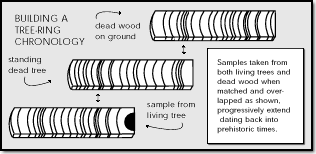
Figure 1: The correlation of ring sequences from trees of different age. By matching tree rings from live trees with those of nearby, but long dead, trees, ring sequences can be counted back over 9,000 years. Image borrowed, with permission, from Leonard Miller's Bristlecone Pine webpage.
Tree-ring sequences are limited in that no single tree spans a significant amount of geological time. On the other hand, tree rings from bristlecone pines can be counted back well past 7000 years. Bristlecone pines often live around 5000 years. By aligning tree-ring sequences with sequences from nearby -- but long dead-- trees, the sequences can be extended further back. Dr. Charles Ferguson of the University of Arizona, two decades ago, had already shown tree ring sequences going back to at least 6273 BC (Popular Science, November 1979, p.76). Becker et al., as published in Nature 353:647-649, 1991, describe a sequence of oak trees from Europe that yields a continuous chronology from the (1991) present back 9,928 years. If one believed in an earth less than 10,000 years old, one must suppose that the trees in Becker's study were created at about the same time as the earth itself.
Of course, we know that trees go back much, much further than 10 thousand years! In his article "The Fatal Flaws of Flood Geology," published in Issue No. 1 of Creation/ Evolution (summer 1980), Christopher Weber describes a sequence of 27 fossil forests buried, one upon the other, at Specimen Ridge in Yellowstone Park. The deposit shows that, at least 27 times in the past, a forest reached maturity (the oldest trees in each layer are about 500 years old) and was then buried by volcanic ash and debris coming from a nearby volcano. Specimen Ridge, then, can not be younger than the sum of ages of the oldest trees in each of the 27 layers. Since the oldest trees in each layer are about 500 years old, and because it takes about 200 years for volcanic rock to weather into forest-growing soil, it follows that each layer required a minimum of 700 years to form. Multiplying by 27, we find that this one formation alone represents at least 19,000 years of earth history.
Most creationist replies to tree-ring datings simply point out that some trees, under some conditions, can produce either more or less rings than the actual age. While this is true, it does nothing to help their case. Firstly, the actual trees used to produce dendrochronological sequences, Bristlecone pines, Douglas Firs, Ponderosa pines, etc., have been studied extensively in terms of ring growth.
After studying about 1000 Bristlecone control samples, tree-ring analysts (Ferguson et al) found only two or three double-rings, and even these few are usually easily spotted. On the other hand, it was confirmed that the trees LACKED, on average, 5% of their rings! This means that the date derived from ring-sequences, especially those using Bristlecone Pines, will tend to give CONSERVATIVE dates rather than inflated ones. In sum, then, there is overwhelming evidence, from tree ring data alone, that confirms an Earth older than 7 thousand years.
Aside from this, concerns about multiple growth rings hardly explains how 27 successive fossil forests, many with trees half a millenia old, others with mostly saplings, could be formed and sorted in one flood. For one, if the trees were alive at the same time, and were all layed down in a single flood, they would all show correlated tree rings, which is not the case. For another, the different layers of forest clearly show differing levels of growth. Some layers contain only small trees, some layers have many large trees. Floodwaters do not sort trees in this remarkable fashion, nor would such violent waters allow the roots to remain rooted in the soil itself, which is also fossilized.
2. Ice Core Sequences
Ice-core dating are analogous to tree-ring dates, in that both structures supply clear annual markers. Ice is formed from frozen atmospheric water, and that water comes almost totally from the ocean. The composition of that water is dependent upon, among other things, the seasonal changes, including temperature and irradiation levels. During the months of the year in which the Earth is furthest from the sun (i.e. winter), the ice laid down is rich in O(16), whereas the ice laid down in the summer months is rich in O(18). The reason this is a temperature-dependent process is because water rich in O(18) is heavier, and hence precipitates at a slower rate than O(16)-containing water during cooler months of the year.
Ice-Core sequences can be cross-checked, moreover, against different markers in the same ice, namely the ratio of certain isotopes trapped in the ice, Beryllium 10 and Chlorine 36. The ratio of these isotopes is dependent upon the distance of the sun from the atmosphere (i.e., the seasons). By comparing the ratios of these isotopes to their nonradioactive counterparts (i.e. 9Be and 35Cl) one can determine the season of the year the precipitation occurred.
In addition to analyzing ice-core layers for Oxygen, Beryllium, and Chlorine isotopes, there are other ways to calibrate and cross-check the ice core. For example, large amounts of volcanic activity will result in the deposition of ash and acidic chemicals within the ice layers. Since these ash layers can often be connected with an eruption of known date, they serve as age markers. Another method used to cross-check ice cores is by comparison with ocean core of known date. Since ocean cores contain roughly the same sequence of inclusions as ice cores, (ash, B10, Cl36, etc), and since ocean cores can be dated radiometrically, they provide another means of verifying the age of the ice core.
Several ice-cores have been dated. The Vostok ice-core was analysed using all the methods mentioned above (ocean core comparison, O18/O16 fluctuations, Beryllium fluctuations, radiometric dating of gaseous inclusions), as well as with additional methods (ice-flow calculations, paleoclimatic comparisons). The data gathered from the Vostok ice-core indicates that the minimum age of the bottom of the core is 160,000 years old, +/- 15,000 years. Furthermore there exists approximately 33% of additional ice below the core sample which would hold a disproportionate number of years due to thinning of the ice layers under the tremendous pressure of the ice above it. Therefore, the Vostok ice-core is likely to be well over 200,000 years old.
Creationists who want to retain belief in a 7 thousand year old Earth have their work cut out for them. First, they will have to explain how 160,000 ice-core layers can be laid down in 6,000 years, which would require a REGULAR rate of deposition 25 times the current, observed rate. Aside from this, their explanation should include a plausible physical mechanism which could cause the fluctuation of O(16) and O(18) prevalances 25 times per year (mimicking the seasons), and the value of those fluctuations must be in agreement with the observed values in the ice-core layers themselves.
3. Varve Sequences
Varves, like, tree rings and ice cores, are formed by annual processes. Varves are formed in glacial lakes, where streams deposit fine sediments. These inflowing sediments move further into the lake, where the waters are relatively calm. Along with other particulate matter such as pollen, these sediments sink to the bottom of the lake, forming annual layers called laminae. In the Green River formation in Wyoming, there are about 6 million varve layers. The composition of these laminae reveals seasonal patterns of deposition, alternating between sediment-rich in the winter and organic-rich in the summer. The organic rich portion of the layer contains such things as algal filaments on bedding surfaces, and billions of arthropod exoskeletons on the surface of many laminations in the formation.
Creationist Henry Morris argued that these shales were formed quickly, in Noah's flood, possibly by turbidity currents. Clearly this is absurd. For example, Twenhofel states that "in the Green River oil shales in the Unta Basin, the organic muds were evidently subject to suncracking and scaling, and, in some cases, fragments of the scales appear to have fallen into suncracks" (p. 409). One would be hard pressed to explain suncracked laminae being laid down during a global flood!
Another difficulty would be the explanation of the fact that pollen and other organic material is found only in portions of the varve layers, distributed roughly according to the months of blooms of their various plants. Discussing varves from a lake in Switzerland, Richard Flint points out:
"A rhythmite deposited in a lake near Interlaken in Switzerland consists of thin couplets each containing a light-colored layer rich in calcium carbonate and a dark layer rich in organic matter. Proof that the couplets are annual, and therefore varves, is established on organic evidence, first recognized by Heer (1865). The sediment contains pollen grains, whose number per unit volume of sediment varies cyclically being greatest in the upper parts of the dark layers. The pollen grains of various genera are stratified systematically according to the season of blooming. Finally, diatoms are twice as abundant in the light-colored layers as in the dark. From this evidence it is concluded that the light layers represent summer seasons and the dark ones fall, winter and spring" (p 400).
Another corroboration of the annual nature of varve formation comes from the work of P. E. Olsen. In a 1986 paper which appeared in the journal Science, Olsen demonstrated a close correlation between radiometric ages and varve count from the Newark Basin in New Jersey. What is amazing, however, is that Olsen also found a correlation between sediment thickness and the so-called Milankovitch forcing frequencies. Named after the Serbian scientist who predicted their existence in the first half of the twentieth century, the Milankovitch frequencies describe periodic changes in the earth's orbit around the sun. Since changes in the earth's orbit will also affect changes in the earth's atmosphere, which will in turn cause variations in amounts of rainfall and sediment deposition, they should be expected to leave some trace in the sedimentary formations. This is exactly what Olsen found in the Newark Basin sediments.
Whereas the Milankovitch frequencies are calculated to be (today) 21,000, 41,000, 95,000, 123,000, and 413,000 respectively, Olsen found evidence for dated the irregularities in the Newark Basin to 25,000, 44,000, 100,000, 125,000, and 400,000. If varve formations are all less than ten thousand years old, as young-earthers claim, it is a truly remarkable coincidence that they display indications of climatic variations predicted to exist, on independent grounds, by calculations of the earth's orbit over great lengths of time.
4. The Absence of Short-Lived Nuclides in the Earth
Most of the atoms in the universe are stable, which means that they neither gain nor lose 'parts' of themselves through spontaneous decay. All atoms heavier than lead, as well as many isotopes of lighter elements, however, enjoy only a temporary existence. They shed parts of themselves, at an extremely regular rate, until they have become stable.
The rate at which this decay process occurs can be determined empirically, and is denoted by the term "half-life." Uranium 258, for example, decays into Lead 204 with a half-life of about 100 million years. For any given sample of Uranium 258, half of it will decay into Lead 204 within this length of time. Thus, given 100 atoms if U258, then after 100M years, you will have 50 atoms of U258 left, and 50 atoms of Lead. After 200m years, the ratio will be 25U258- 75Pb. After 300M years, you'll only have 12.5 of the original U258 atoms. So on and so forth, until there are only Lead atoms, or so few Uranium atoms that they become unmeasurable. Generically, the atom which decays is referred to as the "parent" atom, and the stable atom which it decays into is referred to as the "daughter" product or daughter atom.
The rate at which this transmutation occurs varies considerably from atom to atom, ranging from microseconds to billions of years. Extremely radioactive atoms like Einsteinium and Francium decay completely almost as soon as they are created. Other radioactive atoms, such as Carbon 14, have a half-life of something like six thousand years. On the other end of the spectrum, their are 34 known radioactive nuclides with half-lives greater than 1 million years. The following table includes those nuclides with half-lives greater than 1 million years:
Nuclide |
Half-Life |
Found in Nature? |
|
|
|||
V-50 |
|
6 x 10^15 |
|
yes |
Nd-144 |
|
2.4 x 10^15 |
|
yes |
Hf-174 |
,,,,, |
2 x 10^15 |
............ |
yes |
Pt-192 |
. .,, |
1 x 10^15 |
.............. |
yes |
In-115 |
|
6 x 10^14 |
|
yes |
Gd-52 |
|
1.1 x 10^14 |
|
yes |
Te-123 |
|
1.2 x 10^13 |
|
yes |
Pt-190 |
,,, |
6.9 x 10^11 |
............... |
yes |
La-138 |
|
1.12 x 10^11 |
|
yes |
Sm-147 |
|
1.06 x 10^11 |
|
yes |
Rb-87 |
|
4.88 x 10^10 |
|
yes |
Re-187 |
,,,, |
4.3 x 10^10 |
............... |
yes |
Lu-176 |
|
3.5 x 10^10 |
|
yes |
Th-232 |
|
1.40 x 10^10 |
|
yes |
U-238 |
|
4.47 x 10^9 |
|
yes |
K-40 |
,,,,,, |
1.25 x 10^9 |
............... |
yes |
U-235 |
|
7.04 x 10^8 |
|
yes |
Pu-244 |
|
8.2 x 10^7 |
|
yes |
Sm-146 |
,,,,, |
7 x 10^7 |
.............. |
no |
Pb-205 |
|
3.0 x 10^7 |
|
no |
U-236 |
|
2.39 x 10^7 |
|
yes-P |
I-129 |
|
1.7 x 10^7 |
|
yes-P |
Cm-247 |
,,,,, |
1.6 x 10^7 |
............... |
no |
Hf-182 |
|
9 x 10^6 |
|
no |
Pd-107 |
|
7 x 10^6 |
|
no |
Mn-53 |
|
3.7 x 10^6 |
|
yes-P |
Cs-135 |
,,,,, |
3 x 10^6 |
............. |
no |
Tc-97 |
|
2.6 x 10^6 |
|
no |
Np-237 |
|
2.14 x 10^6 |
|
yes-P |
Gd-150 |
|
2.1 x 10^6 |
|
no |
Be-10 |
,,,,,, |
1.6 x 10^6 |
............... |
yes-P |
Zr-93 |
|
1.5 x 10^6 |
|
no |
Tc-98 |
|
1.5 x 10^6 |
|
no |
Dy-154 |
|
1 x 10^6 |
|
no |
The distribution of nuclides within the earth provides another strong physical argument for the great age of the earth. Here's why: of all the known radioactive nuclides, one very specific variety is missing from the Earth's crust-- those with half-lives LESS than 80 million years! Except for a few nuclides which are constantly being produced by natural processes, such as C14, all nuclides with half-lives less than 80 million years are conspicuously absent from the earth.
Why, for example, do we find Sm 147 and Hf 174, which have half-lives of over 80 million years, but never Sm 146 or Hf 182, which have half-lives of "only" 70 and 9 million years? Similarly, why do we find Iodine 127, which is stable, but not Iodine 129, which has a half-life of 17M years? In both cases, and in the others, there is no physical reason why the processes which created the one would not create the other. For all intents and purposes, the atoms are chemically identical. Any process that could produce the one could also produce the other just as easily. Whats more, these atoms can be created in the laboratory quite easily.
To date, there is only one plausible physical explanation for this peculiar distribution of nuclides according to half-life: the material forming the earth has existed long enough for several half-lives of at least 80 million years to have passed. In other words, all of the nuclides with half-lives less than 80 million years have simply decayed out of existence. Geochronologist Brent Dalrymple suggests that roughly 10-20 half-lives would be necessary to reach undetectability, which would give a minimum time of at least 800-1600 million years since the formation via nucleosynthesis of the material which composes the earth. Assuming that decay constants have not changed over time, and that the processes which currently produce heavy nuclei also produced the nuclei of our earth, then the abcense of these short-lived nuclides after 10-20 half-lives is a straightforward prediction. Assuming that the earth is only ten thousand years old, however, the abcense of these short-lived nuclides is seemingly inexplicable.
In addition to the relative ease with which these nuclides are produced in the lab, it is also apparent that short-lived nuclides ARE formed by stellar processes. For example, the precense of Technitium has been detected in the spectra of old stars (Merril, 1952). Since Technitium has no stable isotope, and since the half-life of its longest lived isotope is a mere 2.6 million years, it is concluded from this that Technitium is being produced in the stars. In addition to Technitium, Promethium has also been detected in the spectra of some stars, even though its longest-lived isotope has a half-life of only 18 years.
And finally, there is indirect evidence from meteorites that some short-lived nuclides once existed in our solar system, but have since decayed away. Some meteorites are rich in Iodine 127, but like the earth contain no Iodine 129, a short-lived nuclide with a half-life of 17 million years. In addition to this, these same meteorites have a great excess of Xenon 129, about 30 times the expected ratio of Xe 129 to other Xe isotopes. Since Xe 129 is the decay product of Iodine 129, both the lack of Iodine 129 and the presence of exaggerated amounts of Xe 129 can be best explained by supposing that the meteorites originally contained Iodine 129, which had since decayed into Xenon 129.
5. Plate Movements
a) Plate Movements and the Mid-Atlantic Ridge
Over the past several decades, the evidence has became conclusive that the earth's crust is composed of many seperate plates which move slowly over a viscous mantle. Looking at a global map, you will see that the east coast of South America, for example, is complementary in shape to the west coast of African. Like a jigsaw puzzle, the continents can be seen to "fit together." Aside from their obviously complimentary shapes, there are many other indications that the continents were once joined together. For example, similar mineral deposits and geologic structures are found on the edges of the continenets. One example of this is the distribution of "bands" of ore deposits on the continents. If the continents are pushed together, these "bands" line up.

Figure 2: The distribution of tin deposits seen against a partial reconstruction of Pangaea (from Duff, 1998).
Of course, the continents are no longer together as in figure 3. Today, the North American plate and the Euro-Asian plate, for example, are seperated by several thousand kilometers, and they continue to move away from each other at a rate of several centimeters per year. Actually, what is really happening is that both continents are moving away from the mid-Atlantic ridge (a divergent plate boundary), which is a great volcanic seam on the ocean floor, midway between the two continents. As the two plates push apart, lava flows up from the mantle and fills in the vacated space. As expected, the shape of this ridge system mirrors almost exactly the shape of the corresponding continental edges.
The processes of sea-floor spreading are still occuring today. Both North America and Europe continue to move away from the mid-Atlantic ridge at the rate of roughly 2cm or so per year (Abell, 36). Assuming that this rate has been fairly constant over time, how long would it have taken for the two continents to have achieved their observed distance of seperation? 2500km, divided by 2cm per year, equals 125 million years, hence it would have been roughly 125 million years ago that both continents would have been very near the ridge system, assuming that the rate of movement has remained constant. Of course, we do not need to merely assume that this rate has remained constant over time, since radiometric dates of the ocean floor also show that this rate has remained almost identical to its present value. In terms of the Atlantic ocean floor, only a very small area is greater than 150 million years old, and is concentrated on the continental shelves.
b) Plate Movements and the Hawaian Islands
As an even better illustration of slow plate movements over a long period of time, consider the Hawaiian islands. The entire Hawaiian chain is volcanic in origin, with the various islands in the chain representing only the exposed tips of huge underwater volcanoes which have risen several kilometers above the ocean floor. These underwater volcanoes formed and continue to form as the Pacific plate moves northwest over a "hot spot" in the mantle. Lava plumes up through the plate surface as it moves, forming new volcanoes and hence islands over time.
This is why, for example, the Hawaian islands run northwest-southeast in orientation. This also explains why volcanic activity is only occuring at the southeastern tip of the island chain (Mauna Loa, Kilauea, etc). Theory predicts that, over time, new volcanic islands will form as the plate continues its northwesterly motion. This prediction is vindicated by the precense of Loihi Seamount, about 35 km off the southern coast of Hawaii. At present, it has risen about 3 km above the ocean floor, and is now within 1 km of the ocean surface. If the Seamount remains active, it will eventually become a new Hawaiian island, and may even fuse with the island of Hawaii itself.

figure 3: the Hawaiian chain
The chain extends from Kilauea in the southeast to Suiko in the northwest, a distance of about 6000km. The amount of lava which has formed these structures is truly immense. According to the US Geological Survey, the Hawaiian Islands/Emporer Seamount chain are composed of at least 750,000 cubic km of lava, which is enough to cover the entire state of California to a depth of roughly 1.5km. The Island of Hawaii is composed of several distinct volcanoes which have become fused together (Mauna Kea, Mauna Loa, Hualalai, Kilauea); measured from the ocean floor, Hawaii is the biggest "mountain" in the world at about 9.2km tall, and nearly 300 miles across.
How long would it have taken to form these huge structures? As it turns out, there are several ways to answer this question.
1) Erosional features. There is a clear correlation between the amount of apparent erosion of an island or seamount and its distance from the "hot spot." The island of Hawaii, being the newest of the islands, shows very little erosion, whereas the islands to the northwest often shows a great deal of erosion. As one moves northwest, there is a progressively greater amount of apparent erosion. While not supplying an absolute age for the islands, erosional features nevertheless offer a rough indication of the relative ages of the islands in the chain.
2) Rate of plate movement. The motion of the pacific plate can now be measured directly through the use of VLBI and other space geodetic measurements. With the assumption that the rate of plate motion has not changed significantly in the past, a quantitative estimate can be made for the ages of the various islands. The pacific plate is moving northwest at about 8-9cm per year. By dividing an island's distance from Hawaii by the rate of plate motion, estimations can be made for the ages of various islands in the chain. For example, Laysan is about 1700km from Hawaii, so we should expect a date of about 20 million years. The Daikakuji seamount is about 3400km from Hawaii, so we should expect an age of about 40 million years. Suiko is one of the seamounts furthest from Hawaii. At a distance of about 4800km from Hawaii, we should expect it to date to roughly 56 million years old. As we will see, radiometric dates of these islands and seamounts correlate almost perfectly with ages predicted by plate movement.
3) Radiometric dating of the islands themselves. Of the 90 or so islands and seamounts in the chain, nearly all have been subjected to isotope dating. As predicted, the radiometric ages of the chain rise smoothly as one moved northwest. Consider again the four predictions made above. Laysan, we predicted, should be about 20 million years old. Its radiometric date is 19.9+/-0.03 million years (Duff, 69). The Daikakuji seamount and Suiko were predicted to be about 40 million years old and 56 million years old respectively. Their radiometric dates are 42.4+/-2.23 and 59.6+/-0.6 million years respectively (Saito and Ozima, Clague and Dalrymple).
We see this same correlation throughout the chain. Midway is about 2500km from Hawaii, which would make its predicted age about 29 million years. Its measured age is 27.7+/-0.6 million years (Duff, p69). Clague and Dalrymlpe (1987) demonstrate this correlation dramatically by plotting measured ages for the islands against predictions based on plate movements. All of the data point fall either directly on the slope of 8.6cm per year or very close to it, indicating that the rate of plate motion and island formation has in fact remained very close to its current rate over the past 60 million years or so.
4) Rates of subsidance. Not only do the islands and seamounts get older as one moves northwest along the Hawaiian chain, they also get progressively shorter. The reason for this is simple: they are all slowly sinking into the ocean floor. Presumably, when a formation is above the hot spot, the addition of new lava results in an increase in size over time. Once the formation moves past the "hot spot," however, new rock will no longer be added, and the formation will decrease in size over time.
This trend is clearly visible as one examines the islands in a sequence from newest to oldest. Hawaii protrudes far out of the water, and reaches over 4km above sea level in places. Maui, just to the northwest, reaches about 3km above sea level in its highest peaks. Kauai, even further northwest, reaches only about 1.6km above sea level at its highest peaks. Midway island has only about 5 square km worth of exposed land area, and rises only a few meters above the ocean surface. Past Midway, nearly all of the seamounts are below the ocean surface, often at a depth of well over 1 km.
Almost all of these seamounts, at one time in the past, rose above the ocean surface. This is demonstrated not only by the presence of subareal lava formations on the seamounts, but also by the presence of ancient coral reefs on the mounts themselves. Since coral only forms within a few meters of the ocean's surface, their precense on the seamounts is strong evidence that the seamounts have sunk by as much as several kilometers.
The rate at which these islands sink can be determined in several ways. First, simple tide gauge data can be used to determine subsidence rates. Taking into account changes in sea level, the rate of subsidence of Hawaii itself is equal to about 2.2mm per year (Moore, et al 1996). Another way to determine the rate of subsidence is through radiometric dating of drowned coral reefs. By comparing the differences in depths of drowned coral reefs to their measured radiometric ages, the rate of subsidence can be determined. For example, if two coral formations are seperated by 50 meters, and the lower formation is dated 18.5 thousand years older, then the rate of subsidence would equal 2.7mm per year. Again, estimates based on dating of these coral reefs suggests a rate of subsidence for Hawaii of about 2.5-3.0mm or so per year. Below is a graph demonstrating the correlation of coral and sediment radiometric ages from the Hawaiian Scientific Drilling Project and those of Ludwig et al to ages predicted by an average rate of subsidence of 2.7mm per year.

figure 4: radiometric ages of Hawaiian corals compared to ages predicted by a subsidence rate of 2.7mm per year. Judging by the close correlation between predicted age and actual age, the rate of subsidence for the island of Hawaii has remained very close to 2.7mm per year throughout at least the last half-million years. From the Hawaiian Scientific Drilling Project homepage.
From the above considerations, it is obvious that the amount of time needed to explain sunken corals on the island of Hawaii alone, the newest of all the islands in the entire chain, is about 50 times greater than the young-earther's entire time scale! What's more, since tide gauge data, radiometric dating, and other methods all agree on the same rate of subsidence over time, the evidence is clear-cut. Unless this rate has in fact remained the same over the past 500K years or so, there is no reason to expect the radiometric ages to agree with ages predicted upon rates of subsidence. As the above chart shows, however, the correlation between these two dating methods is undeniable, and strongly suggests an average rate of subsidence, over the past 500k years, of about 2-3mm.
6) Impact Craters
If any one process can be said to dominate the geology of the moon's surface, it is the process of impact cratering. Except for the younger lunar seas, which have filled in large impact basins, the moon's surface is saturated with craters. These impact structures range in size from microcraters, less than a micrometer in diameter, to gargantuan basins over 2000km wide. Of these large basins, there are hundreds with diameters greater than 100km, and about 43 with diameters greater than 220km (Dalrymple, 203). The Imbrium Basin, visible from earth with binoculars, has a diameter of 1340km, and is roughly the size of Texas. The Orientale Basin, on the moon's far side, is about 900km in diameter. A
Whereas the earth has remained geologically active all throughout its history, the moon has been almost completely inactive over the past 3 billion years. As a result, the moon has retained a visible record of much of its impact history. Similar formations are found on every other solid body in our solar system, including Mercury, Mars, Venus, the moons of Jupiter, Saturn, etc.
Even though most of the old craters on earth have been subjected to crustal recycling and erosion continuously throughout its history, there still exists at least 130 craters with diameters greater than 1km. The largest of these is probably the Chixlub crater, at about 180km in diameter.The oldest of the known earth craters date to only about 2 billon years old, and most are much younger than this. Observations of the moon, as we said, show that the period of heavy bombardment was much longer than 2 billion years ago. This fits well with the fact that the lunar maria, which date to about 3 billion years ago, show much less cratering than the lunar highlands, which often date well over 4 billion years old.
At any rate, it is a safe assumption that the earth, like every other solid body in the solar system, has been subjected to the same heavy bombardment at some point in its early history. Additionally, since the earth has a greater amount of gravity and surface area than the moon, it is almost definately been subjected to heavier bombardment than the moon. For the sake of argument, however, we will simply assume that the earth has been subjected to the same amount of cratering as the moon.
The amount of energy required to produce these features is truly enormous, to say the least. The meteorite that exploded over Tungusca in 1908, for example, is estimated to have been only a few dozen meters in diameter, and it left no crater at all. Yet, the energy released in this small event was enough to scorch, and then flatten to the ground, about 2000 square km worth of trees. If the event had occured over Moscow rather than Siberia, millions would have died.
There is every reason to believe that even one large impact event, such as the one that produced the 180km crater in Chixlub, would be sufficient to kill most if not all humans on earth. For example, of the many pieces of Shoemaker-Levy 9 that hit Jupiter in 1994, several impact "scars" (including the crater as well as the blanket of ejecta surrounding it) were as wide as 1 earth diameter. One of these impacts, fragment G, produced a plume of fire that rose 3000km above the atmosphere of Jupiter. Fragment G alone, at about 3km in diameter, is estimated to have released an energy equivaent to 6 million megatons of TNT, which is about 600 times the earth's entire nuclear arsenal. How then is the young-earther to account for the hundreds if not thousands of similar impacts which undoubtedly occured during our earth's early history?
Works Cited
Abell, George O. (1983). The Ages of the Earth and Universe. In Godfrey, p. 33-47.
Clague, D. A., and Dalrymple, Brent G. (1987). The Hawaiian-Emperor Volcanic Chain. U.S. Geological Survey Professional Paper, 2350:5-54.
Dalrymple, Brent G. (1991). The Age of the Earth. Stanford University Press.
Duff, Joel. (1998). The Hawaiian Islands, Creation Science, and the Age of the Earth.
Ferguson, C. W. (1968). Bristlecone pine: Science and Esthetics. Science, vol.159.
Flint, Richard Foster. (1971). Glacial and Quaternary Geology. John Wiley and Sons, New York.
Godfrey, Laurie R.[ed]. (1983). Scientists Confront Creationism. W.W. Norton and Company, New York.
Merrill, P.W. (1952). Technitium in Stars. Science, vol 115, p 484.
Moore, J.G., et al (1996). Coral Ages and Island Subsidence, Hilo Drill Hole. Journal Geophysical Research 101 (B5):11599-11605.
Stuiver, Minze. (1976). First Miami conference on isotope climatology and paleoclimatology. EOS, vol.57, no.1, pp.830-836
Twenhofel. (1961). Treatise on Sedimentation, p. 409, Vol. 1, Dover Edition (2nd Revised).