
Julian May is a science fiction and fantasy writer, whose novels deal with mental powers, genetic engineering and political intrigue. The bulk of her work consists of two interconnected series, linked by a standalone novel. Most recently, she's started a lightweight science fiction series which, while unrelated to her previous work, is a lot of fun.
| |
|
|
|
|
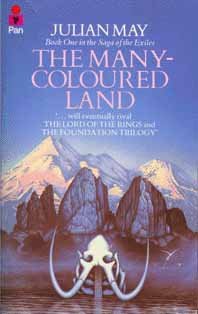
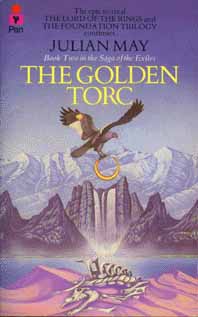
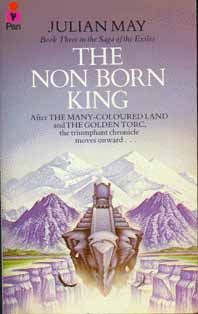
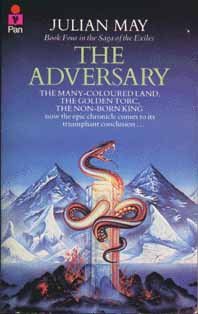
The Saga tells the story of a group of time-travellers who journey back to Pliocene-era Europe through a one-way time portal. There they find that Earth has been settled by two alien races who have an uneasy truce. The aliens have mind powers, and use metal torcs to enslave any humans who come through the portal.
Some of the group's members ally with one alien race or another, and become agents of power in the prehistoric world. Others ally with renegade humans fighting to reclaim Earth for humanity - or, more accurately, humanity's ancestors. As war brews between the factions, the stakes are raised as the key players find ways to greatly increase their descructive powers.
The series, while strictly science fiction, has more of a fantasy feel to it, due to the magic-like mental powers and the exotic alien races. These books are quite good in themselves, but they also set the scene for other novels set in the future world the travellers come from.
While an impressive epic, I don't like this series as much as May's other work. By the end of the series, the key players seem so powerful as to be able to do anything, which consequently made the threat of danger pretty small.
A Pliocene Companion, a sourcebook to the series, gives more details about the Pliocene world May has created, as well as giving sneak previews of the novels set in our future. It's fun to compare those descriptions with the novels that were actually written.
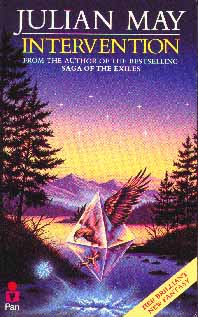
This novel is set in the present and near future, and tells of the events leading up to the Great Intervention.
Intervention is the first volume of the memoirs of Rogatien Remillard, who records his first-hand account of the 200-year-old story of his family. He describes the discovery and development of human metapsychic powers, and their effect on the society and politics. A few of the more powerful metapsychics rise to power through legitimate and less legitimate means, and conflicts arise between factions of metas and non-metas.
These events are monitored closely and with great interest by agents of the Galactic Milieu. The Milieu is an organisation of alien races who have already reached metapsychic maturity. The outcome of events on Earth will determine whether humanity is asked to join the Milieu, or whether we will be left to our own self-destruction.
This is my favourite book of May's. The characters she creates are fascinating, as is the "science" of metapsychology. In the Pliocene Saga, the powers were so great as to be indistinguishable from magic. Here, May places limits on what her characters can do, and gives meaning to the metapsychic categories she introduced in the Saga.
 |
 |
 |
The Galactic Milieu trilogy completes Rogi Remillard's memoirs of his metapsychic family. They describe the events leading up to the Metapsychic Rebellion, a conflict between a faction of humanity and the Galactic Milieu. Rogi also describes the lives of the three main protagonists in that conflict: Jon Remillard, Dorothea MacDonald and Marc Remillard.
While I like these novels better than the Pliocene Saga, they don't quite measure up to the writing in Intervention. Also, the ending of the trilogy - and of May's entire cycle of novels in this universe - is somewhat anticlimactic.
May has indicated that the Saga and Intervention began as backstory to this trilogy, and that this was the story she really wanted to write. What is surprising to me that May seemed to have lost interest in the series by the time it came to write these final volumes.
 |
 |
 |
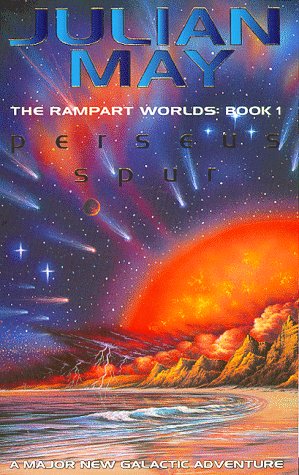
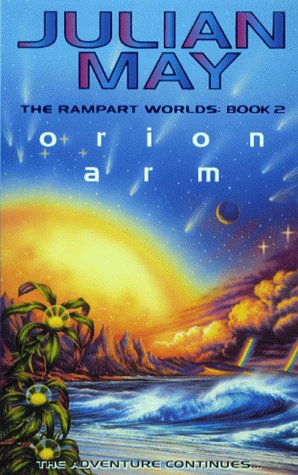
The Rampart Worlds is the memoir of Helly Frost, a disgraced security officer of his family's interplanetary corporation. This corporation is just one of many such entities, the most powerful of which form the Hundred Concerns, the de facto rulers of humanity's presence in space.
Helly is hired back from exile to find his sister, and stumbles onto a conspiracy between the Hundred Concerns and at least one of the hostile alien races limiting - if not outright threatening - the human occupation of space. Of course, the only people who believe him are part of the conspiracy and subsequently try to kill him and his family. The three books recount Helly's efforts to rescue his sister, protect his family's business, and save humanity from alien invasion, while trying to stay alive.
This series is more light-hearted than May's previous work. While the books don't take themselves too seriously, they are, unfortunately, more forgettable because of that. They are a lot of fun to read, but they are somewhat flawed as a comic space opera.
Helly is an arrogant, wise-cracking action hero, but not a sympathetic or particularly interesting character. His bitterness and resentment of his own family adds little to his complexity. The interesting ideas and suspensful plot are enough to keep you reading, but Helly's jaded narrative tends to leave a bad taste in the mouth.
 |
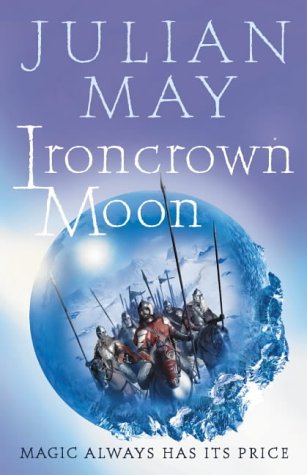 |
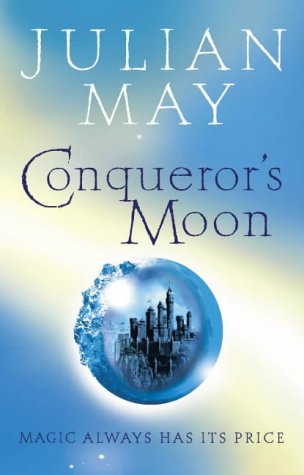
I don't know much about this series. The first volume was published in the UK in 2003, and in the USA in 2004. I haven't read it, but reviews indicate that it is a fastasy epic of above average standard. The second volume is due out in the UK later this year.
Previous (tentative) titles for this series were Sovereign of Blenholme, Tides of Blenholme and Nightfall at Blenholme.