Frank Herbert writes science fiction novels that are hard to understand.
That is my first impression whenever I read one of his novels for the first time. The language is complex, and the characters seem to see many layers of meaning to every little thing that happens and every word which is spoken. Most of the action happens offstage as well.
So it's hard for me to say why I like his novels so much. His ideas are very thought-provoking, and his writing style is very compelling.
Herbert is best known for his Dune novels, but he has also written other excellent science fiction books, which are well worth reading.
|
|
|
|
|
|
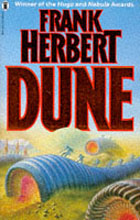
The Dune novels span five thousand years of future history, in a feudal interstellar society. Family houses, financial organisations and religious orders compete and cooperate to gain influence over the empire. The one thing they all have in common is their need for a spice, melange. Melange prolongs life and gives some prescient ability to those who take it. The spice is only found on the planet Dune, a desert world dominated by enormous sandworms.
Dune tells the story of Paul Atreides, whose father, the Duke of a Minor House, is stationed to oversee spice production on Dune. After his father is betrayed by the previous caretakers, the Harkonnens, Paul and his mother flee into the desert and seek refuge with the Fremen, a reclusive tribal people native to Dune. Paul turns out to be the Kwizatz Haderach, the end-product of a breeding program conducted by the Bene Gesserit, a religious sect of which his mother is a member. Combining the Fremen battle techniques, his mother's training, and his own prescient abilities, Paul overthrows the Harkonnens and becomes Emperor.
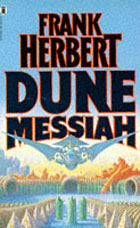
Dune Messiah takes place 12 years later. Paul is Emperor, trying to find a way to curb the jihad being carried out by the Fremen in his name. Meanwhile, a conspiracy between the Bene Gesserit, the Spacing Guild (an organisation with a monopoly on space travel) and the Bene Tleilax (a mysterious, amoral race of genetic engineers) plots to overthrow Paul. They send Paul a ghola - a clone grown from cells of the slain Duncan Idaho, a trusted friend of the family who died protecting Paul and his mother. Paul struggles to prevent the conspiracy from succeeding, while trying to find a way to leave the throne without becoming a martyr. He also tries to escape the future he has already chosen through his prescient visions. How he succeeds is both surprising and ingenious.
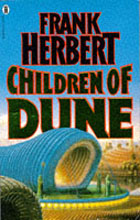
Children of Dune tells of Alia, Paul's sister, who has ruled the Empire in the 9 years since Paul's downfall. She has lost her prescient abilities, and has earned the distrust of her Fremen council. Furthermore, House Corrino, the ruling house whom Paul overthrew, are plotting revenge from exile. And the Bene Gesserit, in an attempt to bring the Atreides line back under the control of their breeding program, send Paul's mother, the Lady Jessica, back to Dune to confront Alia. Paul's children, Leto and Ghanima, struggle to ensure their freedom, survival, and ascendancy in the face of all these schemes. They also try to resolve the paradox of prescience that trapped their father - how to choose among futures without making those future events inevitable.
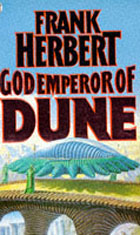
God Emperor of Dune takes place 3500 years after Leto's rule begins. Much transformation has occurred on Dune. Leto has become part-man, part-sandworm; Dune itself has become a verdant forest planet, devoid of sandworms. The only melange left is stockpiled in Leto's secret coffers, granted to the favoured on his whim. All the organisations of Herbert's universe still exist, but are greatly diminished in power. They attempt to both gain Leto's favour for allotments of spice, and to plot against him. Only Leto understands the necessity for his tyrannical millenia-long rule, and he is both amused and frustrated by others' inability to see his plan. Only at his downfall to we see his goal; freedom of humanity from its self-imposed boundaries of space and melange, and from the rule of future prescient leaders.
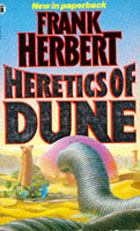
Heretics of Dune reveals the inner workings of the mysterious Bene Gesserit, as they cope with changing events. 1500 years have passed since Leto's death triggered the Scattering, a massive expansion of humanity into unknown space. Now, the descendents of those people are returning to the worlds of the old Empire, and they bring with them knowledge, technology and conflicts which are changing the existing balance of power. Chief among them are the Honoured Matres, a militant religious sect of women who threaten to destroy all they cannot conquer - including the Bene Gesserit. Meanwhile, events on Dune bring the Bene Gesserit's breeding scheme to a critical point, and they struggle to complete their plans in the face of the new threats to their survival.
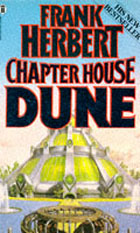
Chapter House Dune continues the story begun in Heretics of Dune. The Honoured Matres have abandoned subterfuge in favour of raw miltary power; they are attempting to hunt down and extinguish the Bene Gesserit. What allies they had have already been eliminated, and the Bene Gesserit prepare to flee the worlds of the old Empire. They hope to take with them the last vestiges of Dune; the ingredients of the sandworm life cycle needed to produce the spice, melange.
Some science fiction series are a continuous story split into separate volumes. Some series consist of one or two initial books, with later books being a vehicle for the author to explore new ideas. The best kind of series, in my opinion, is the series that is self-sustaining; each subsequent book is supported by the exploration of the consequences of events and ideas in the books before it.
The Dune series is one of the better examples of the third kind of series. Each book challenges the dominant ideas of the books preceding it. Few if any wholly new ideas are introduced; rather, the existing ideas are explored further or overturned.
The most obvious example of this is the effectiveness of the Atreides power base. Throughout the first four books, the Atreides establish and maintain their rule through two main power sources: prescience and melange production. By the end of God Emperor, Leto II has rendered both these elements powerless; no subsequent ruler could maintain a hold on humanity in this way. Where Herbert makes it interesting is that it is Leto himself who engineers the people's freedom from his own rule.
In short, a very satisfying and thought-provoking series.