Stephen Donaldson is probably one of the most controversial science fiction and fantasy writers around. He is the subject of passionate debates in net conferences between people who steadfastly believe he is a master writer and those who steadfastly believe he is a talentless hack. People seem to either adore his work, or loathe it utterly.
I fall into the former camp. I think he's one of the best writers around.
The Chronicles of Thomas Covenant are the books that established Donaldson as a fantasy author, and which evoke the most extreme views of his talent - or lack thereof.
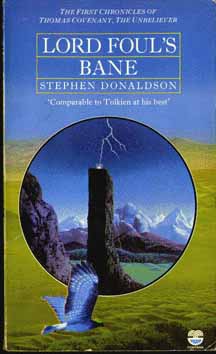
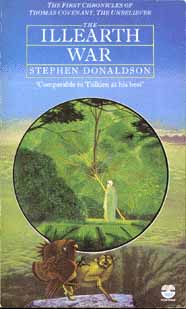
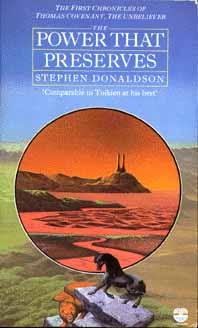
The First Chronicles of Thomas Covenant, the Unbeliever
| |
|
|
Thomas Covenant, a leper, finds himself transported to a magical world called the Land. An evil power called Lord Foul is rising to power, and has summoned Covenant as his tool. The good people defending the Land see Covenant as their hero, but Covenant doesn't believe in the Land or in his ability to defend it. Anything he does have is corrupted by Foul to serve Foul's end. Covenant has to come to terms with his own self despite, and it's only after much is lost that Convenant is able to defeat Foul.
At first glance, The First Chronicles appear to be yet another Tolkien rip-off. However, the themes Donaldson discusses are quite different, and the similarities are superficial. Donaldson's use of language is skilful, evoking strong emotions for the characters he creates. Sometimes his use of very unfamiliar or archaic words is distracting, but it doesn't make the books any less unputdownable. The world-building is top class.
Gilden-Fire
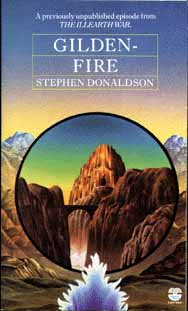 |
Gilden-Fire is an unpublished chapter of the First Chronicles, recounting an episode from The Illearth War that was lost due to editing cuts. The events are briefly described in the published novel, but Donaldson thought the loss significant enough to publish the original chapter after the fact.
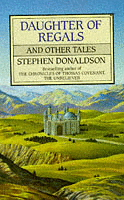
Originally published as a separate volume, Gilden-Fire is also included in more recent versions of Daughter of Regals, Donaldson's first short story collection.
The Second Chronicles of Thomas Covenant
 |
 |
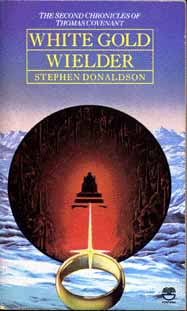 |
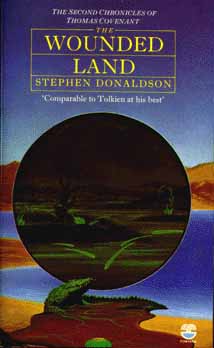
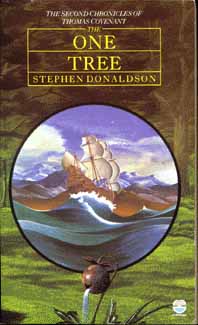
A sequel trilogy to The First Chronicles, the Second Chronicles recounts Covenant's return to the Land with a companion, Linden Avery. The Land is in a bad way; Lord Foul has been in power for some time, and the magic needed to counter his power involves blood sacrifice. Covenant and Linden travel away from the Land to create a new Staff of Law to defeat Foul, but the cost of his defeat is greater than either of them expect.
The style and impact of these novels is just as great as the first trilogy, but I don't enjoy them quite as much. The second book takes place away from the Land, and while the new worlds are interesting, it's hard to get too involved with them when Donaldson has corrupted his Land so completely.
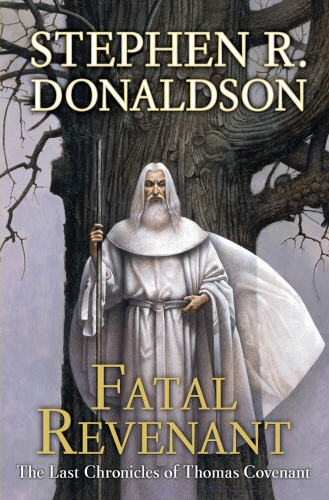
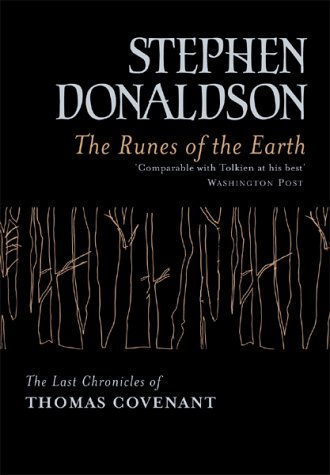
The Last Chronicles of Thomas Covenant
 |
 |
 |
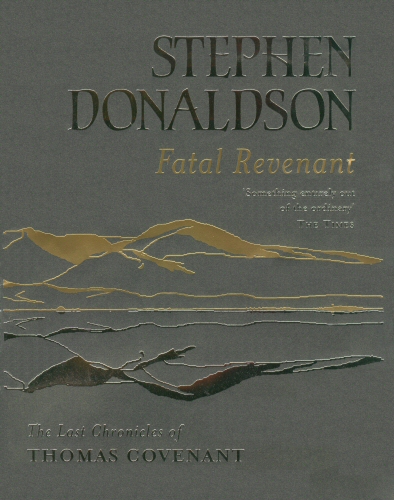 |
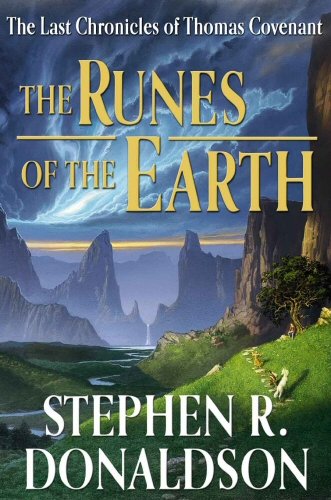
Donaldson has announced that he is writing the Last Chronicles, and that it will be a four-volume series. The first, The Runes of the Earth, will be published in October 2004. There are many hints (and spoilers) on the Internet about the story. I won't divulge them here (as I've avoided reading them).
Donaldson has hinted for years that he might write this series, that he conceived of its plot during the writing of the Second Chronicles, and that he was able to include elements in the Second series to set up the Last.
I was fortunate enough to meet Stephen Donaldson during a book signing to promote Runes of the Earth. See the photos here.
 |
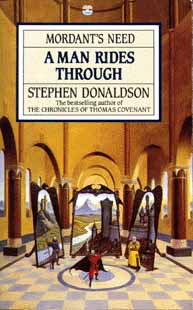 |
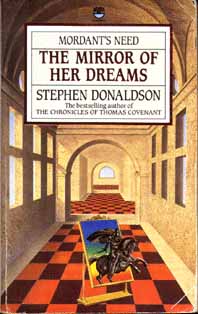
This is another story of travel to a different world. Terisa Morgan, a rich man's daughter who sees little reason for her own existence, is taken to the land of Mordant. There she meets Geraden, an apprentice in a form of sorcery which uses mirrors as windows into other worlds. War is threatening, the King of Mordant is mad, and there is evidence of treason within the court itself. As Terisa finds purpose to herself, she comes to realise she has a role to play in Mordant's salvation as well.
This series is more light-hearted than the Covenant novels, but no less gripping. The Mirror of Her Dreams sets up a complex web of alliances, motives and developments, ending in the worst of cliffhangers. A Man Rides Through quickly resolves most of the ambiguities to develop the main conflict, but turns into a bit of a travelogue as Terisa and Geraden travel the lands of Mordant. Donaldson does bring the series to a satisfying conclusion, however.
 |
 |
 |
 |
 |
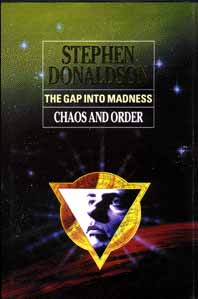
This science fiction story takes place in the future, where the development of the gap drive has allowed humans to colonise other systems. Contact has been made with a hostile alien race called the Amnion, and an uneasy alliance exists. Protection from the Amnion is the responsibility of a private police force called the UMCP. The very personal conflict between three people - Angus Thermopyle, Morn Hyland and Nick Succurso - gradually reveals itself to be important to the outcome of the failing alliance between the two races.
The writing style of these novels is very different to Donaldson's earlier work. Instead of the complex and flowery phrasing of his fantasy series, Donaldson uses short, punchy sentences to achieve his impact. Also, the story is much more brutal than his others; Donaldson does very nasty things to his characters. There's a lot of tension and angst in these novels, and it's not always a pleasant experience to keep reading.
Having said that, the plot is incredibly complex and intriguing. For a long time, the characters' motives and alliances are unclear, and their actions are therefore pretty mysterious. There's also a lot to follow as alliances change - or appear to change - as events affect characters' motivations. This is his most gripping series; it's hard to keep reading, but it's impossible to stop.
At times, though, I got the feeling that Donaldson had to have his characters act in ways that they normally would not, and then had to justify it through a contrived motive. Certainly Donaldson spends a lot of words establishing attitude and motive in order to use it in this way. This does result in the books being quite long; I particularly found that Chaos and Order dragged a little because of all the character introspection.
However, I have to say that Donaldson does manage to conclude the series in a way which justifies all the complexity, brutality and angst. Donaldson really delivers in book 5.
 |
 |