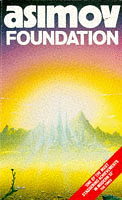
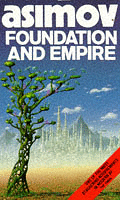
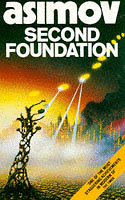
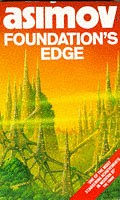
Isaac Asimov is probably the best-known - and one of the best-loved - science and science fiction writers. His work includes novels, essays, short stories, science texts, reviews and commentaries.
Of his fiction, his Foundation series is probably best-known, and are probably among his best novels. But I think Asimov's greatest fiction is in his short stories.
| |
|
|
|
|
|
|
The Foundation series is probably the best-known science fiction series ever written. And rightly so. It was written at a time when the science fiction genre only had a fringe following, but it still compares favourably against modern authors' works.
The novels tell of the fall of a galactic empire, in a future so distant that even the existence of Earth as our planet of origin is unknown. To counter humanity's descent into barbarity, a psychohistorian named Hari Seldon creates a society called the Foundation. This society, placed at the edge of the galaxy, embarks on a thousand-year plan to reunite humanity under a new Empire. They are guided by psychohistory, a mathematical science which can predict the course of events through the statistical analysis of large numbers of people - so large that the actions of an individual are irrelevant to the sweep of history.
The first three books - Foundation, Foundation and Empire and Second Foundation - were written as novellas during the early fifties. They recount the first four hundred years of the Foundation. During that time, the leaders of the Foundation must deal with internal unrest, emerging independent powers, and the remnants of the dying Empire. Just when it seems that the Foundation cannot be defeated, the plan itself is derailed by the unforseen - a military leader with mental powers. To restore the Foundation and the plan, another society founded by Seldon - a Second Foundation - must risk discovery and defeat by both conqueror and conquered.
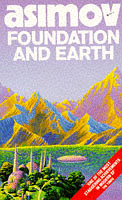
Foundation's Edge and Foundation and Earth were written much later - during the early eighties - and tell of events during the 498th year of the Foundation. Foundationer Golan Trevize suspects that the thousand-year plan is succeeding just a little too well given past problems. He investigates, and finds a secret idyllic planet called Gaia, on which everything is somehow linked in shared mental communion. Questions about Gaia's origins lead him, in turn to search for Earth, the (possibly mythical) planet of humanity's origins. His journey leads him to the ancient Spacer worlds - thus linking these novels to Asimov's Robot series - and finally to Earth. There, some answers are found, but more questions are raised about the future of the Foundation and of humanity.
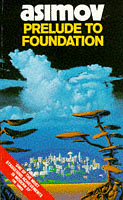
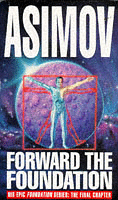
Unfortunately, those questions were never answered. Asimov never continued the story of the Foundation past this point. Instead, he wrote Prelude to Foundation and Forward the Foundation, which tell of the early life of Hari Seldon and the development of psychohistory. Forward the Foundation was Asimov's last novel, and Seldon's death at its conclusion is particularly poignant. It is also ironic that while the Foundation series is based on the premise that individual's choices don't matter, these later books focus almost exclusively on the loves, hopes and aspirations of their characters.
 |
 |
 |
 |
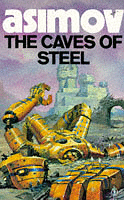
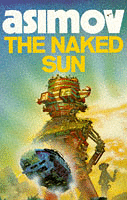
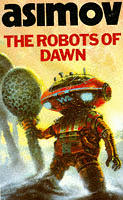
The Robot Novels are set in Earth's near history, at least compared with the time of the Foundation. Humanity has expanded to colonise fifty worlds, called the Spacer worlds. On Earth, humanity is packed into huge, crowded underground cities. On the Spacer worlds, lower populations and greater resources has led to longer-lived humans and greater technological advances. This has led to tensions between Earth and the Spacer worlds.
In this setting, detective Elijah Bailey is forced to partner with Spacer R. Daneel Olivaw to solve a series of murders. The R. in Daneel's name stands for "Robot", and that is what Daneel is, instilled with Asimov's famous Three Laws of Robotics.
Bailey bristles at having to be teamed up with a Spacer who is not even human, but as the first three books progress, Bailey not only solves the murders, but learns to trust and respect Daneel. Furthermore, Bailey becomes convinced that despite the prosperity of the Spacer worlds, they are stagnating. The only way humanity can continue to colonise space is through a second expansion initiated from Earth.
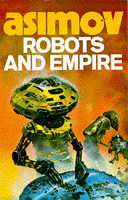
The final Robot novel, Robots and Empire shows the results of Bailey's convictions. Earth has colonised a small number of Settler worlds, and Spacer factions plot to overthrow them. Daneel, the robot of the first three novels, struggles within the confines of the Laws of Robotics to thwart these plans, allowing the Settler worlds to prosper.
Asimov dabbled in the mystery genre, writing many short stories and even a few novels. This series combines mystery and science fiction to produce detective stories set in the future, in which robots and technology add unexpected twists to the usual format.
As the series progressed, however, the science fiction elements tended to dominate, as Asimov tried to tie these stories to his Foundation universe. Indeed, by Robots and Empire the detective elements have all but disappeared, and evolution of the Settler worlds into the Empire of Foundation is made explicit.