Pierre's Planes: Tubular Belle
|
Specifications:
|
|
Specifications:
|
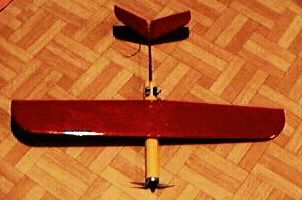
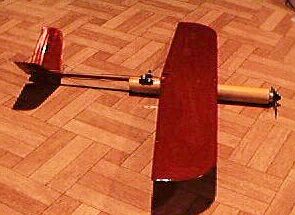
This was an exercise in designing a pylon racer with a minimal investment and quick building techniques. I could have spent some extra effort to make it lighter, by using carbon fiber and adding lightening holes in the balsa, but I wanted a quick build plane. I don't have any plans, as I designed it as I was building it, using KISS principles.
Building:
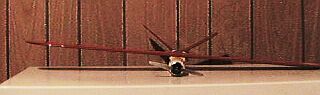
Wing: Solid balsa, 1/4" x 4" with a 3/4" wide trailing edge. Minimal sanding is therefore required to 'fake' an airfoil. Wing tips are 1/4" x 1" wide cross-grain, glued to the wing with the trailing edge raised 1/16" to create some washout. The tips are then cut to a radius, and sanded to shape. One aileron cut, 1" wide, and the whole thing covered in monokote, which also makes up the single aileron hinge.
Fuse: simplistic pod and boom. The boom is a fiberglass arrow shaft, while the boom is a discarded household cardboard tube (food wrap or aluminum foil, don't remember). It's barely wide enough to fit 600AE cells. Pod and boom are epoxied and pinned together. 1/8" plywood motor mount epoxied on, then the whole pod is covered with 0.6 oz fiberglass cloth, tacked on with 3M77, and covered with polycrilic paint to saturate the cloth. The hatch was then cut, almost half way in the tube, the length of the wing root, and epoxied to the wing. Acrylic spray paint finishes it off. Two dowels on the front of the wing secures it to fuse, while a captive nut stuck in the boom ties the back end of the wing.
Tail: 3/32" balsa V-tail, set at 110 degrees, covered with monokote for finish and hinges. Proportions for the fins were taken from this site , but scaled down to 5.5".
Servos: Cut outs at the back of the fuse, behind the wing, with external linkages. I know it's draggy, but it's quick to build, and the fuse was too narrow and short to try otherwise. The aileron servo is also in the fuse, connected to only one aileron, with a wheel collar as a quick disconnect. A servo mount bushing was used to move the attachment point out, so the rod wouldn't contact the aileron edge.
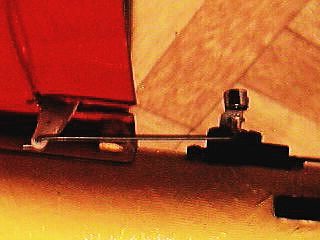
CG: Simply adjusted by sliding the battery pack in the fuse. 30% of root chord seems to work fine.
Flying:
Wow , it satisfies my current need for speed! I'm scaring myself silly with this one. It's the fastest ship in my fleet at this time. I don't have the luxury of having a computer radio, so the throws are still a bit too much for me, as it is extremely sensitive at high speed. Diving for a fast pass right in front of me is a neck snapping exercise. Still not use to landing a fast ship, it needs a fairly long approach to bleed off speed.
Detailed views:
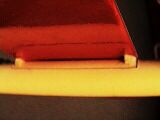
|
Wing in place and bolted to the fuse. |

|
Trailing edge attachment detail, with elevator servo. |
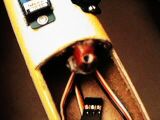
|
Captive T-nut glued to fiberglass boom. |
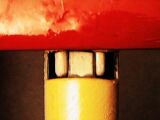
|
Wing partially engaged into fuse. Two wooden dowels on the wing straddle 1/8" plywood tab glued to the fuse. |

|
Underside of wing, with half tube and wooden dowels, which need to be high enough to clear the battery pack. I ended sanding them to provide sufficient clearance. |
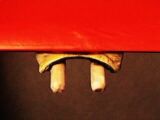
|
Same, but viewed from the top. The edges of the cardboard are soaked with CA glue. |
|
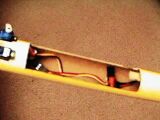
View of the fuse, with the 1/8" plywood locating tab on the right hand side. |
|
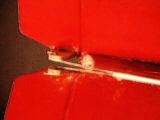
Elevator linkage: separate control horns, with double thin wire fitted into 1/16" I.D. aluminum tube. |
|
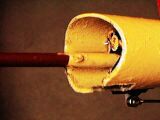
Boom attachment to the fuse, with epoxy and 1/16" wire through both. |
Pierre Audette
pfaudet (a) videotron.ca
08/29/2001