Orthopedic Surgery
In the chronically affected hip (usually in adults), the joint capsule, normally paper thin, is markedly thickened to � inch or more. Subsequently, extension of the hip becomes difficult. This results in shorter, choppy steps when running. Due to the discomfort and pain, the dog sits rather than stands when it stops. When rising, it does so slowly and with some degree of difficulty. The dog may be reluctant to chase, jump or run a long distance. Finally, when pain has restricted limb use for weeks to months, muscle atrophy and loss of muscular support in the rear limbs becomes severe. At the same time, weight is shifted to the forelimbs and the shoulder muscles enlarge.
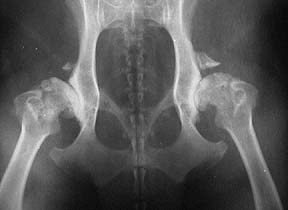
Once the patient has radiographic (x-ray) evidence of degenerative arthritis (Figure 1), it is no longer a candidate for a triple pelvic osteotomy procedure. Over time, many of these dogs will become less responsive to analgesic medications and surgical therapy should be considered.
1) FEMORAL HEAD & NECK EXCISION (FHNE): Removal of the femoral head & neck.
Femoral head excision works (Figures 2&3) well for dogs under 30 lbs but large and giant breeds may only attain satisfactory function. It is crucial to understand that this surgery is a salvage procedure for those owners who cannot afford the cost of a total hip replacement, but need an alternative to constant medication and debilitating pain.
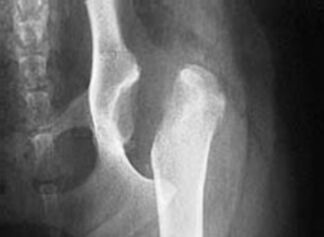
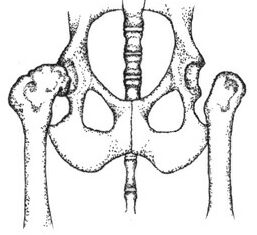
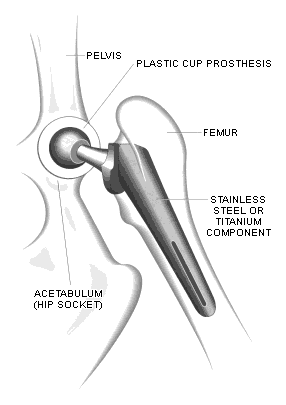
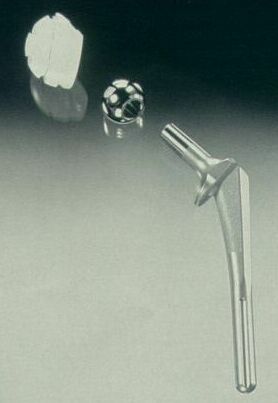
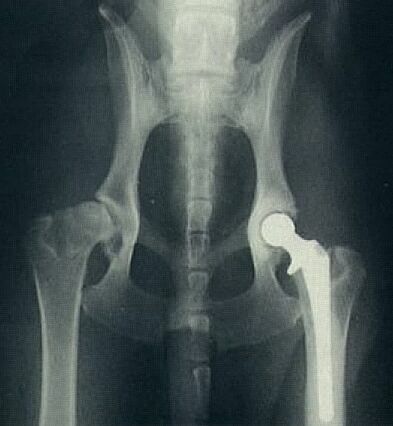
Introduced in 1976, the Total Hip Replacement (also known as Total Hip Arthroplasty-THA) (FIGURES 4-6) has become the only treatment available that provides normal hip joint function once advanced arthritis is present. With this technique, the femoral head and neck (ball portion of the hip joint) are replaced with a stainless steel or titanium component and the acetabulum (hip socket) is replaced with a plastic cup prosthesis. A five year follow up study of 221 total hip replacements revealed an overall success rate of 91%. Total hip replacement can be done on both hips, although many dogs (80-90%) do very well with only one side replaced.