 The
Weimaraner
The
Weimaraner
Description Common Medical Problems
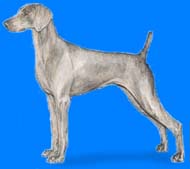
A medium-sized gray dog, with fine aristocratic features. The Weimaraner should present a picture of grace, speed, stamina, alertness and balance. Above all, the dog's conformation must indicate the ability to work with great speed and endurance in the field.
Height at the withers: dogs, 25 to 27 inches; bitches, 23 to 25 inches. One inch over or under the specified height of each sex is allowable but should be penalized. Dogs measuring less than 24 inches or more than 28 inches and bitches measuring less than 22 inches or more than 26 inches shall be disqualified.
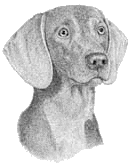
Weims have a moderately long and refined head, with moderate stop and slight median line extending back over the forehead. They have a rather prominent occipital bone and trumpets well set back, beginning at the back of the eye sockets. Measurement from tip of nose to stop equals that from stop to occipital bone. The flews should be straight, delicate at the nostrils. Skin should be drawn tightly.The coat is short, smooth and sleek, solid color, in shades of mouse-gray to silver-gray, usually blending to lighter shades on the head and ears. While not desirable, a small white marking on the chest is permitted, but should be penalized on any other portion of the body. White spots resulting from injury should not be penalized. A distinctly long coat is a disqualification. A distinctly blue or black coat is a disqualification, There is no true blue or brown coat Weimaraner; these dogs are a result of mixed breed or inbreeding.
A Weimaraners temperament should be friendly, fearless, alert and obedient. The Weim
requires your attention and languishes without daily human companionship. Weimaraners
make very good family pets ; they love children and are good guardians and watch dogs.
They are protective and loving of their families . Some Weims can manage the presence of
a cat. The problem is: no one knows which Weims will tolerate cats. The hunting instinct is
alive and well in most Weimaraners and they see the cat as vermin. Weims are high energy
dogs and if this energy is not 'burned off' in constructive ways, they use it to make life
miserable: pouting, tearing up everything, urinating in inappropriate places, etc... Weimaraners
need lots of exercise; they do not make good city apartment dwellers unless their exercise
needs can be adhered to.
These are very dominant dogs and should be put through obedience training. You must be
able to control your Weimaraner or he will control you. Always establish dominance first
thing. To do this, do not use physical force, rather the canine world's own mind game: when
you have rebuked your dog, stare in to it's eyes and do not look away until after it has.
When the dog begins to look away quickly while being reprimanded, you have won
dominance. This is the same trick a dog will use with its puppies and within their pack.
A DOG SHOULD NEVER COWER WHEN YOU ARE REPRIMANDING IT. This shows
fear, not submission to your authority.
The Weimaraner dates back to the early 19th century in Germany. "The Grey Ghost", as it is
nicknamed, was used primarily for fowl hunting. Obedience trials incited the first interest in
the Weimaraner in the United States. This was even before the breed was recognized by the
AKC in 1943. The Weimaraner has seen more actual competition of various types in the United
States than it did in all its decades in Germany.
Medical Problems common to the breed
Gastric Dilitation-Volvulus (GVD) Hypertrophic Osteodystrophy (HOD)
Gastric Dilitation-Volvulus (GVD) or Bloat
GDV is a severe and life threatening problem common in large dogs with deep chests, such as
the Weimaraner, Great Dane, German Shepherd Dog, Saint Bernard and Irish Wolfhound. The
condition is a medical emergency and must be treated quickly if the dog is to have any chance
of survival. Nevertheless, many dogs will not survive even with the very best of care.
First, the stomach of the dog becomes grossly dilated when gas, fluid, and food becomes
trapped. Then, rotation of the stomach occurs within the abdomen which totally blocks the
esophageal and intestinal openings to the stomach. Furthermore, the twisting sets in play a series
of VERY SEVERE heart and metabolic changes that quickly threaten the life of the dog.
Collapse and death can occur
within hours or even minutes in some cases.The exact cause of this condition is unknown, but it is thought the causes include: eating or
drinking large quantities of food and water followed by exercise which serves to loosen the attachments of
the stomach, simply eating or drinking too much at one time, trauma, dysfunctions of the sphincter
valve between the stomach and the esophagus, previous vomiting episodes, and other genetic factors
not yet understood.
Clinical signs often come on very quickly and totally unexpectedly. It is not uncommon at all to
find a dog that was eating and playful suddenly down or dead a few hours later. Symptoms
include: an enlarged or bloated abdomen, unusual posture, collapse, retching or trying to vomit
without results, salivation, pale gums, difficulty breathing, blue or very red gums, and extreme
restlessness. Dogs who start out with a simple bloating due to overeating or excess gas can quickly
be in danger if they are not belching up the gas. Diagnosis is based on the history, physical
examination and X-rays. We cannot overemphasize the need to seek rapid attention for
any dog with even mild symptoms of GDV.
Rapid administration of IV fluids, electrolytes,oxygen, and high levels of cortisone to stabilize the dog are needed. Some dogs may benefit from
either passing a stomach tube, which sometimes may be impossible, or surgically inserting a tube in
to the distended stomach to relieve the pressure. If a tube can be passed, pumping and flushing the
stomach with cool water while under mild sedation may be all that is needed to allow the dog to
recover.
In other cases, either the dog will defy decompression or the bloating will reoccur shortly after
treatment. More aggressive therapy is then indicated. This may include some semi-permanent
placement of a tube to maintain decompression, or performing surgery to return the stomach to its
usual position and hold it there. Continued supportive care with fluids, antibiotics, sedation and
steroids will all be needed. In some cases, the stomach will be found to have almost completely
rotted and euthanasia may be the only option. In other cases, part of the stomach can be removed
and the patient saved.
Among dogs that die, shock, electrolyte disturbances, cardiac arrhythmia, and severe infection all
contribute to the cause. Survival is based on quick responsive treatment and a little luck. While there
is not sure way to prevent GDV, it is advisable to feed smaller more frequent meals, feed high
quality and highly digestible foods, avoid excess water intake at any one time and avoid exercise
after meals.
Common in several breeds of dogs, especially larger breeds, Hip Displaysia is the malformation of the
hip joint. Depending on the severity of the malformation, the discomfort level may range from a
stiffness in walking to a crippling of the back legs. Regular exercise and a healthy diet can help in the
proper maintenance of the hip joints. All Breeding stock must carry a hip rating from the Orthopedic
Foundation of America (OFA) or Wind-Morgan. Acceptable OFA ratings are Excellent, Good and Fair.
Unacceptable breeding rating are Borderline and Moderate.
CLOTTING FACTOR DISORDERS involve the proteins in the blood which are suppose to be part
of the clotting process are not functional or even present in adequate quantities. This problem is
usually hereditary. Blood clotting proteins are called clotting factors.. These factors react in step
like fashion, similar to how one domino falls onto another until a chain is made. Failure of any one
of these factors to function properly, or an absence thereof, will result in clotting failures.
Clinical symptoms will vary with the type of disease, if more than one problem at a time is present
and because of natural variation in severity that occurs with each different condition. It should again
be noted that multiple defects described above could be present at the same time, greatly
complicating the severity of the problem.
The main clinical sign is bleeding. This can be manifest as small or larger hemorrhages or bruises on
the skin, lips, gums and other moist membranes. Bleeding from gums, lips, anus or genitals may occur.
Bloody or dark stools may be present. Some dogs may have spontaneous nosebleeds or bloody urine,
or blood clots may form under the skin. Dogs may fail to clot when small cuts or cut toenails bleed.
Dogs can undergo "routine" surgery and bleed heavily during or after the surgery. In most cases,
bleeding is sudden, unexpected and without warning. Many dogs have otherwise been normal.
Diagnosis is based on historical information, clinical signs, blood and platelet counts, serum
chemistries, hormone analysis, X-rays, specific serologic tests and clotting tests to determine the
specific defects and clotting times. Bone marrow and liver biopsy may be indicated, but consideration
is always given to the potential for severe bleeding should this type of surgery be needed.
As always, specific treatment related to any underlying condition is the first approach to curing a
bleeding disease. For more severe or immediate cases, IV fluids, vitamin K, calcium injections, blood,
platelet or plasma transfusions, and supportive care are all necessary. B-vitamin/iron supplements are
used to build up the blood. As most dogs have some other dysfunction that leads to clotting
problems, most dogs can live a normal life with proper treatment. However, all dogs with this disorder
should not be bred.
Hypertrophic Osteodystrophy (HOD)
HOD is an inflammatory disease of young, rapidly growing, large breed dogs wherein the growth
areas of the bones (called the metaphysis) becomes swollen and inflamed. The condition is rare and
the cause completely unknown. Most dogs exhibit a very sudden onset of lameness; some dogs being
reluctant to stand or move at all. Pain and swelling will occur near the joints, with a loss of appetite,
fever and weight loss occurring concurrently are also signs of this disease. Diagnosis is based on
history, clinical signs and specific bone changes that can be seen on X-rays. HOD is another disease
that will run its course and then go away. The dogs, however, are in severe pain so the use of aspirin,
butazolidin, etodolac, carprofen or arquel is highly advisable. Try to keep dogs moving and free from
bedsores. (Some will lie down and not be willing to move) Making sure the pet is consuming food
and proper amounts of liquids is also very important
Not as common in the Weimaraner, this occurs when the eyelids and lashes are turned in towards
the cornea. The condition is usually inherited. Some dogs may have symptoms as soon as their eyes
open, but more often the inversion becomes worse as the skin and lids develop.
Clinical signs will depend upon how severe the entropion, or how many lashes are contacting the
corneal surface. Tearing, pain, exposure of the third eyelid (a pain response) and keeping the eye
more closed will all occur. In advanced cases, conjunctivitis and keratitis will occur. If allowed to
persist, permanent damage to the cornea will lead to blindness due to corneal pigmentation and
corneal ulceration that may badly damage the eye. Diagnosis is based on physical examination.
In young dogs, a procedure known as "eye tacking" is employed. Sutures are placed in affected lids
to reposition the lid margin in an extroverted manner. Sutures are left in 7-10 days, then removed.
Some dogs can be re-sutured several times if unsuccessful. If this fails to train the lids to lie where
they should, surgical correction will be needed.
Surgical correction amounts to the removal of a portion of excess skin and suturing the margins
leading to lid repositioning. The technique chosen should best suit the entropion present, but the
experience of the surgeon is most important in producing the most functional and cosmetic results.
Contrary to popular belief, Weimaraners do shed. Their fur is very short and most of it comes out in
the spring. Keep the dog bathed and brushed and you will not have much problem with the fur. Most
of the time, people who suffer allergies get along with a clean Weimaraner.
Weims do not need to be washed more than once every couple of months unless they smell. Over
washing can cause skin dryness and allergies.
The price for well bred Weim will range from pet quality, about $6-700, to show quality, about
$7-800, and championed dogs, about $800-1000. You could pay more for an older dog that has
already been trained for field work. When dealing with a breeder who is charging substantially more,
without a good reason given, be on your guard.