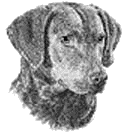
Description Medical Problems common to the breed
The 'Lab' is an athletic, well-balanced sporting dog that should be capable of performing a
number of duties in various weather conditions. The most distinctive characteristics are a
short, dense, weather resistant coat; their "otter" tail; Clean-cut head; powerful jaws; and it's
kind, dark brown eyes that convey it's tremendous intelligence and wonderful temperament.
The female Lab will stand 21 1/2 to 23 1/2 inches at the shoulder and males 22 1/2 to 24 1/2
inches. Approximate weight for conditioned and working females is 55 to 70 lbs. and working
males will range between 65 and 80 lbs. Some breeders are encouraging breeding for a taller
field dog, stating that they are more capable of field work. AKC is currently reviewing their
height standards.
The coat of a Labrador should be short, straight (although a slight wave down the rump is
acceptable) and very dense. Labs have a soft weather resistant under coat that gives
protection from water and all types of weather. Although a Labrador should have a healthy
shiny glow to their coat, silky, slick or woolly textured coats are a disqualification. Coat
colors are black, yellow, and chocolate. Other colors or combinations of colors is not
acceptable. A slight white patch on the chest of the dog is permissible, but not overly desired.
This usually occurs by breeding a yellow and black together to try to obtain a sound field
dog and color is not important. This dogs are wonderful purebred Labs that may not do as
well in an AKC show.
A Labradors finest characteristic is their temperament. Labs are extremely loving, loyal people
dogs. They are most definitely happiest when they are right by your side. Contrary to the
belief of some, Labs are not a dog that can be put outside and left to its own devices. They
crave attention and can become destructive or naughty if left alone to long. Labradors are
outstanding family dogs and tend to be extremely patient with children. Although Labs will
bark protectively, they are not guard dogs and generally will not act aggressively. Well breed
and cared for Labrador Retrievers are never hyper or nervous. Though extremely active, their
temperament is mellow.
Labs are easily trained and extremely eager to please there master; due to size and high
activity levels, training is essential. Training will need to be continuous until at least three years
of age, when they reach full maturity. A Lab the knows it is loved will not need discipline that
exceeds verbal reprimanding. A gentle but firmly consistent hand is always your best trick.
Always establish dominance first thing. To do this, do not use physical force, rather the
canine world's own mind game: when you have rebuked your dog, stare in to it's eyes and
do not look away until after it has. When the dog begins to look away quickly while being
reprimanded, you have won dominance. This is the same trick a dog will use with its puppies
and within their pack. A DOG SHOULD NEVER COWER WHEN YOU ARE
REPRIMANDING IT. This shows fear, not submission to your authority.
A young Lab will chew, 'retrieve' household items, and clear your coffee table with its' tail.
To prevent chewing and retrieving, make sure you have plenty of toys and bones inside and
out for your dog. Clearing a coffee table while wagging their tail, will be something you
have to get used to; it is not on purpose or controllable, just a show of affection for you.
The Labrador Retriever was developed in England in the mid 1800s by a few private kennels
who were devoted to developing and refining the ultimate gundog. Each kennel had its own
idea of what such a dog should possess, which is the reason behind the variety of retriever
breeds. The initial class of "Retrievers" included flat coats, curly coats (Chesapeake),
Liver colored retrievers and the Norfolk Retriever (now extinct). As the types developed
fixed and distinct characteristics, separate breeds were created .
Medical Problems common to the breed
Hip and Elbow Displaysia Retinal Dysplasia
Common in several breeds of dogs, especially larger breeds, Hip Displaysia is the malformation
of the hip joint. Depending on the severity of the malformation, the discomfort level may
range from a stiffness in walking to a crippling of the back legs. Regular exercise and a
healthy diet can help in the proper maintenance of the hip joints. All Breeding stock must
carry a hip rating from the Orthopedic Foundation of America (OFA) or Wind-Morgan.
Acceptable OFA ratings are Excellent, Good and Fair. Unacceptable breeding rating are
Borderline and Moderate.
Progressive Retinal Atrophy (PRA)
PRA is slow continuing damage to the retina in which it is replaced by scar tissue. A
veterinary ophthalmologist can examine the retina with an instrument called an indirect
ophthalmoscope. Changes in the retinal blood vessel pattern, the optic nerve head and the
reflective substance within the dog's eye, called the tapetum, can be seen; these changes are
classic for PRA. However in some breeds PRA characteristics have little or no early changes.
The eyes of these dogs may appear normal until they are in the later stages of the disease.
Progressive Retinal Atrophy will progress at different rates in different breeds. This variation
causes difficulty in determining just how long any one particular dog will continue seeing.
Testing for the recessive gene that causes PRA will be available in the near future.
Retinal dysplasia involves abnormal development of several structures of the visual system.
Dogs may be very mildly affected and demonstrate folds in the retina. These are areas
where extra retina develops and instead of forming a thin membrane over the back surface
of the eye, the extra retina develops into folds. This fold results in a blind spot. Often times
the retina is also undernourished and an area of retinal degeneration will occur. Dogs with
mild changes (i.e. a few retinal folds), usually have no visual compromise. Subtle changes
on the part of the dog, on the positioning of the head while marking a bird, help affected
Labradors make use of normal areas of the retina. Larger blind spots may cause dogs to miss
a mark or miss stationary objects, while these dogs are able to perceive moving objects with
less difficulty. Labradors with a more severe form of retinal dysplasia may result in blindness
due to large areas of retinal folds or degeneration. Retinal detachment can also
develop resulting in blindness. The more severe form of retinal dysplasia can occur with
retinal separation, cataracts, and eye enlargement in dogs which inherit the gene from both
the bitch and stud dogs. These dogs also may suffer from skeletal dysplasia or dwarfism, as
the same gene for retinal dysplasia (which works in a dominant fashion for the eyes) cause
skeletal dysplasia (in a recessive fashion). Because of the possibility that dogs ocular
abnormalities may be produced by breeding two mildly affected dogs, the ACVO (American
College of Veterinary Ophthalmologists) Genetics Committee advises breeders not to breed
affected stock, and CERF (Canine Eye Research Foundation) certificates are not issued for
affected animals.
Cataract is the medical term referring to opacity (cloudiness) - in the lens. it is due to a
breakdown of the normal structure. Cataracts can range in size from a barely detectable spot
to involving the entire lens. Even small opacities in the lens can result in blurred vision or
glare problems. Cataracts can be classified according to age of onset: congenital,
developmental (juvenile), and senile. A congenital cataract is present at birth. It may be
inherited or teratogenic (a teratogen is any substance that causes abnormalities in the
developing fetus). Developmental cataracts appear from birth to about six years of age.
Most of these are hereditary. Senile cataracts are seen in old age, and their cause is
unknown. Many factors may be involved. Labradors can develop the "juvenile retriever
cataract" which does not result in a vision problem. Or they may be affected with complete
corneal progressive cataracts that cause a severe visual deficit. Cataracts due to old age
develop in dogs as they do in people. After six or seven years of age the lens of the dog
begins to harden. This can result in relative farsightedness and dogs may seem to be out of
focus for close vision. Eventually the lens becomes so hard that the proteins in the lens begin
to deform, take on water and a senile cataract develops. Senile cataracts are not inherited
but are the result of aging of the eye. If they become sufficiently advanced, cataract
surgery can be done as long as the retina and other structures of the eye are functional.
Animals diagnosed with cataracts should not be used for breeding and will not be given a
CERF number.
Regular brushing with a slicker brush is recommended for a Lab, especially during regular
shedding or 'blowing' times. Bathing with shampoo should only be done when the dog smells
bad. If dusty or muddy a simple water bath will be sufficient. Over shampooing can strip
essential oils from your Labs coat and cause dry skin, which they are prone to. Your dog
nails should be clipped regularly; your vet can demonstrate the proper way to do this.
The price for well bred Labrador will range from pet quality, about $4-500, to show quality,
about $5-600, and championed dogs, about $6-850. You could pay more for an older dog
that has already been trained for field work. When dealing with a breeder who is charging
substantially more, without a good reason given, be on your guard.