 The
Basenji
The
Basenji
Description Common Medical Problems
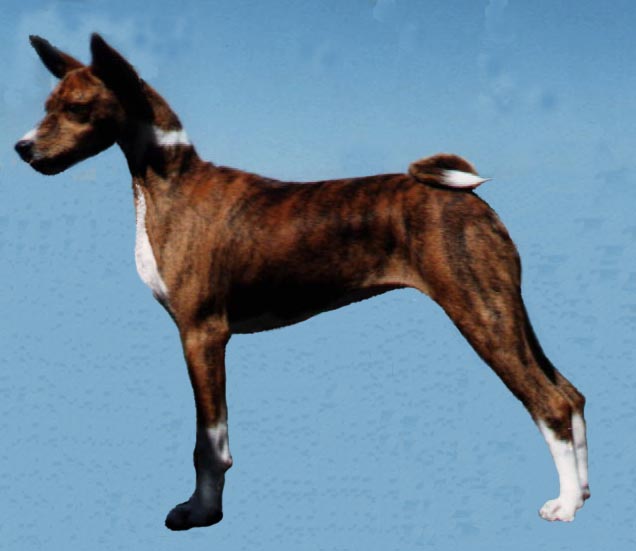
The Basenji, in the hound group, is a small, short haired hunting dog that originated in Africa. It is
short in length in comparison to it's 'high' legs. The wrinkled forehead and cheeks give it an
inquisitive look. An arched neck, slightly muscular body and high set curled tail add to the
overall gracefulness of the dog. The Basenji's gait is effortless and racehorse-like.
Ideal height for females is 16 inches and for males 17 inches at the shoulder. Optimum weight
should be about 24 pounds for males and 22 pounds for females.
A Basenji's coat is short and fine. Colors range from chestnut red to black to tri (black with red
cheeks and 'eyebrows') to brindle (black stripes on a red body, pictured above) all with white feet,
chest and tail tip. White blaze and collar are acceptable, however, white should not be the dominate
color.
The nose should be black and it's eyes almond shaped and deep brown. A Basenji's feet should be
small, compact and oval shaped with well arched toes. Dewclaws are removed when very young.
The tail should sit high and be tightly curled at least one time, although 2-3 times is preferred by
most AKC judges.
While a barkless and often silent dog, the Basenji is not mute. These dogs are capable of a range of
sounds including: growls, 'purrs', shrieks and yodels, according to their mood. Basenjis can also give
a single "woof", but do not have the vocal cords of a normal dog and therefore do not 'bark' in the
traditional sense.
A Basenji is a naturally clean dog that does not shed much and will groom it self much like a cat;
they are considered a 'hypo-allergenic' dog. You should only wash your dog when it gets or smells
dirty.
Basenjis are often more likened to a cat than a dog. They can be somewhat difficult to train; they
enjoy doing it on their own time, not yours. A gentle but firmly consistent hand is your best trick.
Always establish dominance first thing. To do this, do not use physical force, rather the canine world's
own mind game: when you have rebuked your dog, stare in to it's eyes and do not look away until
after it has. When the dog begins to look away quickly while being reprimanded, you have won
dominance. This is the same trick a dog will use with its puppies and within their pack.
A DOG SHOULD NEVER COWER WHEN YOU ARE REPRIMANDING IT. This shows fear, not
submission to your authority.
In general, Basenjis love people; although at first they may seem a bit snobbish, they warm up quickly.
Exceedingly intelligent and highly energetic, Basenjis can be very demanding of time. They are not the
dog to get if you are going to continuously be away for long periods at a time. Every time they greet
you will be like the first. They will smell every inch, rub up against you and welcome you as if you've
been away for months.
Basenjis are very good with children, especially if raised with them. Although protective of
their humans, Basenjis are not a guard dog. Most often they will verbally back down an outsider, but
will rarely go much further.
Basenjis are known escape artists. And as you know, where there's a will, there's a way. Your best
defense: a 6' fence or run (not jumpable is the key) and always keep you dog on a leash when you
are out.
Basenjis become bored very easily so putting them on a chain is not a good idea; if they can break
it they will, if not, they will get into a lot of mischief after let off they chain.
Basenjis are very adaptable. They will be your running partner or your couch potato. They can live in
the country or the suburbs and with most other animals. I say most because Basenjis have an aversion
to their own breed. If you want two basenjis, it is best to have 1 male and 1 female. Same sexed
Basenjis will be in constant competition with each other, especially the females. A 'pack ' of Basenjis
is possible, just try to do it young or introduce the new dog slowly and always have lots of patience.
The Basenji is a pariah (wild dog) native to Africa. There it is used as a sight and scent hunting dog.
Many of the Basenjis in America originated from 13 dogs, although AKC has made allowances for the
Basenji Club of America to obtain more dogs from Africa and broaden the breeding lines while
staying true to the breed.
Medical Problems common to the breed
Fanconi Syndrome Thyroid Levels Malabsorbtion
Umbilical Hernias Progressive Retinal Atrophy
Persistent Pupillary Membrane (PPM) Hemolytic Anemia
Fanconi (pronounced: fan-cone-ee) is likened to diabetes in humans and is a common disease among
Basenjis. The potentially deadly disease that affects the processing of sugars and proteins, typically
appears between 4 and 7 years of age; although is it completely possible for the disease to show up at
any age.
Early detection is the key to controlling Fanconi. Usual symptoms are elevated urine glucose, but not
blood sugar levels, and excessive drinking and urination. Testing for glucose in the urine is the easiest
way to identify Fanconi early. You can purchase test stripes, over the counter, from your pharmacy.
Fanconi is caused by both heredity and environment. There is no way to predict if a puppy will develop
Fanconi and every puppy in a litter has the same chance of inheriting it. If any breeder tells you that
they are 100% sure that their line does not carry the disease, walk away. Instead find a breeder who
will tell you the truth. Ask for the number of occurrences in their line. This will not guarantee you a
non-afflicted pup, but it will give you a good chance.
Another way to prevent Fanconi is by making sure your pup has a beneficial diet. DO NOT restrict your
Basenji's protein intake. These dogs require higher amounts of protein on a normal basis and when
afflicted by Fanconi, the dog 'passes' the proteins and amino acids necessary for healthy living. Recent
studies have shown that the Basenji breed does better when given small amounts of raw meat - 1/2 of
stew meat once a week is sufficient.
Common in several breeds of dogs, Hip Displaysia is the malformation of the hip joint. Depending on
the severity of the malformation, the discomfort level may range from a stiffness in walking to a
crippling of the back legs. Regular exercise and a healthy diet can help in the proper maintenance
of the hip joints. Hip Displaysia is not as common in Basenjis but it is always recommended to have
your dog checked by your veterinarian. All Breeding stock must carry a hip rating from the
Orthopedic Foundation of America (OFA). Acceptable OFA ratings are Excellent, Good and Fair.
Unacceptable breeding rating are Borderline and Moderate.
Basenjis like humans have "inny" and "outty" belly buttons. You should not be worried unless the
"outty" belly becomes violently red and/or swollen. If this happens, see your vet immediately.
Hypothyroidism is common to Basenjis. Basenjis have a higher thyroid activity level than other breeds
of dogs and an under active thyroid will cause obesity and poor coat and skin conditions.
Hypothyroidism can be controlled with medication; breeding should be only under a veterinarian's
supervision.
Persistent Pupillary Membrane (PPM)
PPM is a fine sheet of veins that feed the developing eye of a puppy. Before the eyes open, a protein
that dissolves this membrane will be excreted. If the membrane is not completely dissolved, visible
cobweb like strands will be left. In the worst cases, the eyes of the dog will look blue instead of the
deep brown they are supposed to be. Again, reputable breeders will have their dogs tested and
'CERF'ed and will not breed two PPM 'heavy' dogs. To have a CERF rating a Basenji has to be found
'clear' in comprehensive optical testing. Because of the possibility that dogs ocular abnormalities may
be produced by breeding two mildly affected dogs, the ACVO (American College of Veterinary
Ophthalmologists) Genetics Committee advises breeders not to breed affected stock, and CERF
(Canine Eye Research Foundation) certificates are not issued for affected animals.
Colomba, or a gap or hole in the eye structure, can range from mild to severe. Usually found at the
bottom of the eye, the gap can occur in the eyelid, iris, lens, choroids, or optical nerve. A responsible
breeder will have their dogs check for Colomba and will not breed their dog if it is found. Again, ask
for a CERF rating and to see medical records of the dog and its parents.
PRA is a fairly common problem with Basenjis. As with Fanconi Syndrome, your breeder should always
be up front with the number of occurrences in their line. PRA is slow continuing damage to the retina
in which it is replaced by scar tissue. A veterinary ophthalmologist can examine the retina with an
instrument called an indirect ophthalmoscope. Changes in the retinal blood vessel pattern, the optic
nerve head and the reflective substance within the dog's eye, called the tapetum, can be seen; these
changes are classic for PRA. However in some breeds PRA characteristics have little or no early
changes. The eyes of these dogs may appear normal until they are in the later stages of the disease.
Progressive Retinal Atrophy will progress at different rates in different breeds. This variation causes
difficulty in determining just how long any one particular dog will continue seeing. Testing for the
recessive gene that causes PRA will be available in the near future.
A recessive gene which can be tested for, this form of anemia is not curable. A reputable breeder will
test their dogs before breeding them. Affected pups usually die early on.
Malabsorbtion or Immunoproliferative Systemic Intestinal Disease (IPSID) is an inherited disease that is
fatal. You can maintain a dog with IPSID for several years, however, they will be anorexic, have long
term diarrhea, and can not be breed or shown.
Regular brushing with a soft brush is recommended, especially during regular shedding times, which is
extremely mild. Being a naturally clean and not a "doggy smelling" dog, bathing with shampoo should
only be done when your dog smells bad. If dusty or muddy a simple water bath will be sufficient.
Over shampooing can strip essential oils from their coat and cause dry skin. Your dog nails should be
clipped regularly; your vet can demonstrate the proper way to do this.
The average price for a Basenji will range from pet quality, about $4-500, to show quality, about
$5-600, and championed dogs, about $6-750. When dealing with a breeder who is charging
substantially more, without a good reason given, be on your guard. Adoption of abandoned dogs is
also available; your best resource for adoption is The Basenji club of America.