I was asked whether or not I was concerned about the annual Pilot Whale hunt in the Faroes Islands. A group of North American (primarily) activists are attempting to stop what they see as a blood-driven sporting event. They first came to my attention during their attempts to stop the Makah Indians, up in Washington, according to treaty rights, began hunting up to five whales a year. Treaty rights are important to me. Treaty rights are important to all Indians, of course, and to many anglos who are concerned about rectifying the many abuses of the United States toward it's first peoples. How the United States observes and honors treaty rights is an indicator of national integrity, of a national conscience.
The number of treaties with Indian nations that have been honored over the last two hundred years and twenty five years is abysmally small. Lands guaranteed forever have been sold to the highest bidder. The Bureau of Indian Affairs is perhaps the most scandal-plagued government agency--except, maybe, the Pentagon.
The anti-Indian whaling folks who descended upon the Makah are part of a old tradition of people attempting to deny Indian rights. Not "claims," but "rights." Treaties are, as the Supreme Court has said, the highest law of the land; and whatever the Indians may have ceded to the United States, what they didn't ceed are still rights. The rights that weren't specifically surrendered are still held by various Indian Nations. For example, the government doesn't "allow" Indians to fish: they are entitled to fish.
The state of Washington has a particularly long and sad history of attempts to deny Indians these rights. For nearly 30 years, Washington Senator Slade Gorton has been trying to reduce Indian power--ever since he was the attorney general of Washington at the time of the Boldt Decision, which reaffirmed the rights of Indians to fish for salmon. Even after the Boldt decision, Gorton orchestrated the famous "Salmonscape" raid on a group of traditional Columbia River Indians, who fish because they believe The Creator instructed them to fish. This raid was as ill-timed and pig-headed as any recent moves by the ATF and FBI; luckily no one was killed, although David Sohappy, a tradional leader of the River People, was sent to prison for many years; there he suffered a debilitating stroke and died shortly after his release...
Some of the same angry and racist slogans that first appeared after Judge Boldt's decision have reappeared in the hands on anti-whaling. One of the most offensive slogans, back in the 1970s, was "Save a salmon: can an Indian." This reappeared a while back as "Save a whale: spear a Makah." Gorton and Congressperson Jack Metcalf have been political leaders in attempting to stop Makah whaling. Anti-whaling activists have courted them. But Gorton and Metcalf are no friends of the environment: both politicians have accepted campaign donations from various aspects of the "Wise Use Movement," a group of people attempting to gut the Endangered Species Act, release government held lands to private ownership, and cut the hell out of what's left of the National Forests.
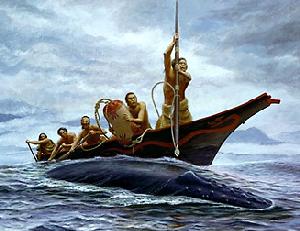
The anti-whaling forces, claiming a spiritual connection to the whales and to a pristine environment, have eagerly accepted whatever help these politicians have offered, without caring what their records are. The Sea Shepherd Foundation, led by "Captain" Paul Watson, has been in the forefront of the fight against the Makah, regardless of treaty rights. The Makah are hunting whales on an individual basis: one whale at a time, with a hand-thrown harpoon, from a traditional whaling canoe. There are, according to estimates, as many Grey Whales as there were before commercial whaling began. The fight against the Makah has been less than honorable: the anti-whaling forces have accused the Indians of: secret deals with the Japanese; rampant drug and alcohol among the crew of the canoe (as well as the Makah population in general); demonstrators have fire flare guns at the whalers and attempted to swamp the canoe in cold northwest waters; the Stop Whale Kill e-mail lists periodically posts jokes about Indian stereotypes; the anti-whaling people on various cyber forms regularly make threats; Indian schools in the Puget Sound area have received bomb threats when the Makah took their first (and so far only) whale last year; and native children have been threatened. There's no honor in this, only blind arrogance.
Now, "Captain" Paul Watson has moved the focus to the Faeroes Islands and their whale hunts. The population of Pilot Whales is estimated at over three-quarters of a million. The Faeroes kill whales by hand. It is admittedly bloody. When living things are killed, it usually is. I've watched bears bite living salmon in half, and I've seen coyotes take down deer and begin eating before the animal is dead; eagles and osprey and hawks don't often deliver a coup de gras before beginning their meals. It seems to be the way it is. Nature is not like Disney, or Audobon Society calendars. Nature isn't very sanitary or kind; it just is.
But there seems to be a theme in modern life that demands tidiness, cleanliness, picturesque order, niceness. I suspect it has something to do with guilt-avoidance. We hoped that once World War Two was over, we would never seen the sight of atrocities against people again. We were wrong.
Chechnya, Congo, Guatemala, Nicaragua, Rwanda, Burma, Cambodia, Kosovo--monthly, almost, streams of atrocities against people: men, women, and children. We see the homeless and emotionally ill wandering the streets of American cities. One-fifth of Americans are hungry. Ethnic minorities and the poor of all colors in the United States face daily discrimination and humiliation. Millions of citizens don't have medical care. Millions more don't have hope. These problems, in America and elsewhere, are enormous. Are we to blame? Can we do anything?
I'm more concerned about the rights of Indian people than I am about the pitiful harvest of pilot whales. IÕm more concerned about the lack of health care. These are some of the areas I'm working on.
A FEW FACTS ABOUT WHALES AND THE MAKAH RIGHT TO WHALE OR A FEW OF THE MORE COMMONLY REPEATED ANTI-MAKAH WHALING ASSERTIONS; AND THE FINDINGS OF FACT
ASSERTION:
'The Treaty of Neah Bay,1855' states in Article 4 ;The right of taking fish and of whaling or sealing at the usual and accustomed grounds and stations is further secured to said Indians in common with all citizens of the United States." That clearly and unequivocally means the Makah have no more right to kill whales than the rest of us Americans!
FINDINGS OF FACT
The United States Supreme Court has a long-established, three-pronged precedent regarding our treaties - first, ambiguous expressions must be resolved in favor of the Indian parties concerned, McClanahan v. State Tax Commission, 411 US 164 (1973); second, Indian treaties must be interpreted as the Indians themselves would have understood them, Choctaw Nation v. Oklahoma, 397 US 620 (1970); and third, that Indian treaties must be liberally construed in favor of the Indians, Choctaw Nation v. US, 318 US 423 (1943). The construction of Indian treaties is akin to the construction of adhesion contracts, in that Indian treaties, like adhesion contracts, are liberally construed in favor of the weaker party, and their terms are given the meaning attached to them by laymen unversed in the law. The goal is to achieve the reasonable expectations of the weaker party.
The precedent case law that governs Ms. McEnerney's second complaint is long established as well. In US v. Winans, 198 U.S. 371 (1905), Justice McKenna wrote for the Supreme Court
"The right to resort to the fishing places in controversy was a part of larger rights possessed by the Indians, upon the exercise of which there was not a shadow of impediment, and which were not much less necessary to the existence of the Indians than the atmosphere they breathed. New conditions came into existence, to which those rights had to be accommodated. Only a limitation of them, however, was necessary and intended, not a taking away. In other words, the treaty was not a grant of rights to the Indians, but a grant of right from them,-a reservation of those not granted. And the form of the instrument and its language was adapted to that purpose. Reservations were not of particluar parcels of land, and could not be expressed in deeds, as dealings between private individuals. The reservations were in large areas of territory, and the negotiations were with the tribe. They reserved rights, however, to every individual Indian, as though named therein. They imposed a servitude upon every piece of land as though described therein. There was an exclusive right of fishing reserved within certain boundaries. There was a right outside of those boundaries reserved 'in common with citizens of the territory.' As a mere right, it was not exclusive in the Indians. Citizens might share it, but the Indians were secured in its enjoyment by a special provision of means for its exercise. They were given 'the right of taking fish at all usual and assustomed places,' and the right 'of erecting temporary buildings for curing them.' The contingency of the future ownership of the lands, therefore, was foreseen and provided for; in other words, the Indians were given a right in the land,-the right of crossing it to the river,-the right to occupy it to the extent and for the purpose mentioned. No other conclusion would give effect to the treaty. And the right was intended to be continuing against the United States and its grantees as well as against the state and its grantees."
--Mike Two Horses
ASSERTION:
The Makah hunt is illegal because the tribe has not received permission from the International Whaling Commission to hunt whales.
FINDING OF FACT:
In 1994, the IWC granted the US a quota which permits the Makah to take 20 whales between now and 2004.
ASSERTION:
The IWC has refused to recognize the aboriginal subsistence need of the Makah to hunt whales. The United States, as a party to the Convention of the IWC, may not grant its domestic aboriginal tribes the right to hunt whales in the absence of IWC subsistence recognition.
FINDING OF FACT:
It is a principle of Constitutional law that treaties are the law of the land. Thus, the Treaty of 1855 has precedence over the Convention of the IWC. See the above in-depth section on US Supreme Court rulings on treaties.
ASSERTION:
The U.S. Whaling Convention Act of 1949 explicitly requires IWC recognition of subsistence need for any U.S. tribe that wishes to go whaling.
FINDING OF FACT
The Whaling Convention Act of 1949 does not even mention subsistence Whaling
ASSERTION:
The domestic treaty of the Makah Tribe with the United States does not supersede the International Convention for the Regulation Of Whaling.
FINDING OF FACT
See above discussion of US Supreme Court rulings on treaties. In addition, 16 USC Sec. 916(b) preserves US autonomy in carrying out regulation of whaling.
ASSERTION:
Gray whales are endangered.
FINDING OF FACT
The gray whale was removed from the Endangered Species list in 1994, because population had been restored to pre-industrial whaling levels, more than 20,000 animals.
A FEW FACTS ABOUT WHALES AND THE MAKAH RIGHT TO WHALE OR A FEW OF THE MORE COMMONLY REPEATED ANTI-MAKAH WHALING ASSERTIONS; AND THE FINDINGS OF FACT
ASSERTION:
'The Treaty of Neah Bay,1855' states in Article 4 ;The right of taking fish and of whaling or sealing at the usual and accustomed grounds and stations is further secured to said Indians in common with all citizens of the United States." That clearly and unequivocally means the Makah have no more right to kill whales than the rest of us Americans!
FINDINGS OF FACT
The United States Supreme Court has a long-established, three-pronged precedent regarding our treaties - first, ambiguous expressions must be resolved in favor of the Indian parties concerned, McClanahan v. State Tax Commission, 411 US 164 (1973); second, Indian treaties must be interpreted as the Indians themselves would have understood them, Choctaw Nation v. Oklahoma, 397 US 620 (1970); and third, that Indian treaties must be liberally construed in favor of the Indians, Choctaw Nation v. US, 318 US 423 (1943). The construction of Indian treaties is akin to the construction of adhesion contracts, in that Indian treaties, like adhesion contracts, are liberally construed in favor of the weaker party, and their terms are given the meaning attached to them by laymen unversed in the law. The goal is to achieve the reasonable expectations of the weaker party.
The precedent case law that governs Ms. McEnerney's second complaint is long established as well. In US v. Winans, 198 U.S. 371 (1905), Justice McKenna wrote for the Supreme Court
"The right to resort to the fishing places in controversy was a part of larger rights possessed by the Indians, upon the exercise of which there was not a shadow of impediment, and which were not much less necessary to the existence of the Indians than the atmosphere they breathed. New conditions came into existence, to which those rights had to be accommodated. Only a limitation of them, however, was necessary and intended, not a taking away. In other words, the treaty was not a grant of rights to the Indians, but a grant of right from them,-a reservation of those not granted. And the form of the instrument and its language was adapted to that purpose. Reservations were not of particluar parcels of land, and could not be expressed in deeds, as dealings between private individuals. The reservations were in large areas of territory, and the negotiations were with the tribe. They reserved rights, however, to every individual Indian, as though named therein. They imposed a servitude upon every piece of land as though described therein. There was an exclusive right of fishing reserved within certain boundaries. There was a right outside of those boundaries reserved 'in common with citizens of the territory.' As a mere right, it was not exclusive in the Indians. Citizens might share it, but the Indians were secured in its enjoyment by a special provision of means for its exercise. They were given 'the right of taking fish at all usual and assustomed places,' and the right 'of erecting temporary buildings for curing them.' The contingency of the future ownership of the lands, therefore, was foreseen and provided for; in other words, the Indians were given a right in the land,-the right of crossing it to the river,-the right to occupy it to the extent and for the purpose mentioned. No other conclusion would give effect to the treaty. And the right was intended to be continuing against the United States and its grantees as well as against the state and its grantees."
--Mike Two Horses
ASSERTION:
The Makah hunt is illegal because the tribe has not received permission from the International Whaling Commission to hunt whales.
FINDING OF FACT:
In 1994, the IWC granted the US a quota which permits the Makah to take 20 whales between now and 2004.
ASSERTION:
The IWC has refused to recognize the aboriginal subsistence need of the Makah to hunt whales. The United States, as a party to the Convention of the IWC, may not grant its domestic aboriginal tribes the right to hunt whales in the absence of IWC subsistence recognition.
FINDING OF FACT:
It is a principle of Constitutional law that treaties are the law of the land. Thus, the Treaty of 1855 has precedence over the Convention of the IWC. See the above in-depth section on US Supreme Court rulings on treaties.
ASSERTION:
The U.S. Whaling Convention Act of 1949 explicitly requires IWC recognition of subsistence need for any U.S. tribe that wishes to go whaling.
FINDING OF FACT
The Whaling Convention Act of 1949 does not even mention subsistence Whaling
ASSERTION:
The domestic treaty of the Makah Tribe with the United States does not supersede the International Convention for the Regulation Of Whaling.
FINDING OF FACT
See above discussion of US Supreme Court rulings on treaties. In addition, 16 USC Sec. 916(b) preserves US autonomy in carrying out regulation of whaling.
ASSERTION:
Gray whales are endangered.
FINDING OF FACT
The gray whale was removed from the Endangered Species list in 1994, because population had been restored to pre-industrial whaling levels, more than 20,000 animals.