| Sasanians
 and perceived it as their role to restore the greatness of Iran. Such
ambitions inevitably brought the Sasanian monarchs into conflict with Rome
and later Byzantium in the west, and war on that front was to become a
constant refrain of Sasanian history. Both sides were motivated by a
desire to control the lucrative east-west trade route bringing silks,
spices and other luxury goods from the Orient.
and perceived it as their role to restore the greatness of Iran. Such
ambitions inevitably brought the Sasanian monarchs into conflict with Rome
and later Byzantium in the west, and war on that front was to become a
constant refrain of Sasanian history. Both sides were motivated by a
desire to control the lucrative east-west trade route bringing silks,
spices and other luxury goods from the Orient.In order to create a state that could fulfill his grandiose schemes, Ardashir introduced strong central government, reformed the coinage and made Zoroastrianism the state religion. Under the Hellenistic and Parthian kings Zoroastrianism had been decline, and even though the religion was widespread in Achaemenid times it is not certain that the kings themselves were orthodox Zoroastrians. The date of the prophet Zarathustra (Greek Zoroastar) is keenly disputed: he is traditionally regarded as having lived from 628 to 551BC, but some modern scholars believe he flourished in a much earlier period. some time in the second millennium BC. According to his doctrine, a dualistic system existed with opposing forces of good, created by the supreme god Ahuramazda, and 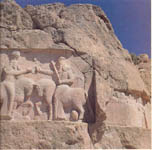 evil,
symbolized by Ahriman. Other deities such as Anahita and Mithra, whose
cult spread across the Roman empire, were regarded as emanations of
Ahuramazda. Fire played an important part in Zoroastrian religion, as
indicated by the many fire temples (chahar taq) surviving from Sasanian
times and fire altars shown on Sasanian coins. evil,
symbolized by Ahriman. Other deities such as Anahita and Mithra, whose
cult spread across the Roman empire, were regarded as emanations of
Ahuramazda. Fire played an important part in Zoroastrian religion, as
indicated by the many fire temples (chahar taq) surviving from Sasanian
times and fire altars shown on Sasanian coins.The reign of Ardashir's successors Shapur I ( AD240-72) is marked by some significant successes against Romans and the defeat of three Roman emperors, Gordian III, Philip the Arab and Valerian. In addition, Armenia was conquered and the Kushan empire in central Asia was largely overrun. At the end of Shapur's reign the Sasanian empire was at its largest long-term extent, and stretched roughly from the river Euphrates to Indus. In the north it included Armenia and Georgia and lands up to and probably beyond the river Oxus. Thereafter, though, the empire was constantly changing in size as it reacted to threats on different frontiers. 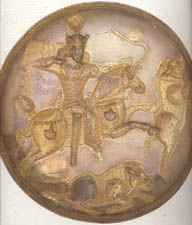 In religious matters Shapur was remarkably tolerant, and although himself a Zoroastrian he allowed religious minorities to practice freely. He may have had a personal interest in the teachings of the prophet Mani, whose religion combined elements of Zoroastrianism and, Christianity and Buddhism. This religious toleration did not last, however, and during the reigns of Shapur's three successors, Bahram I, II, III, all religious minorities but particularly the Manichaeans (who were regarded as heretic by orthodox Zoroastrians) were savagely persecuted. This persecution was orchestrated by Kartir, a priest who wielded enormous power. During this time, also, much territory was lost to the Sasanians. After Bahram III (AD293) minorities were again tolerated, and Jews, Christians, Manichaeans, Mandaeans and Buddhists were all able to practice their religions.  During the long reign
of Shapur II (AD 309-79), Sasanian fortunes were to a large extent
restored, and also the Zoroastrian holy book, the Avesta, was written down
in Middle Persian, the language of the Sasanian period, using the Aramaic
script.
During the long reign
of Shapur II (AD 309-79), Sasanian fortunes were to a large extent
restored, and also the Zoroastrian holy book, the Avesta, was written down
in Middle Persian, the language of the Sasanian period, using the Aramaic
script.After the reign of Shapur II, the Sasanians were increasingly beset with problems on their northern and eastern frontiers. These were caused by various nomadic groups, particularly the Hephthalite Huns in central Asia, to whom Sasanians were forced to pay an annual tribute. These problems were compounded by drought and famine and by the disruptive message of a new prophet, Mazdak, who advocated a form of communism. This was incompatible with the rigid hierarchical system of Sasanian society, which was divided into four classes - priests, warriors, scribes and common people - between which it was practically impossible to move. There was a Sasanian renaissance under Chosroes I Anushirvan (AD531-79). This energetic monarch, whose name means "of the immortal soul", completed a detailed survey 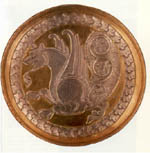 of resources within the empire, and reformed the taxation system. With the
increased revenue he was able to maintain a paid army and undertake major
irrigation works that resulted in a great increase in agricultural
productivity. During his long reign he defeated the Hephthalites and was
successful in the long-standing struggle with Byzantium. After a period of
internal unrest and dynastic squabbling in Iran, Chosroes II (AD591-628) renewed
the conflict and overran much of the Near East. He even captured
Jerusalem, carrying off what was said to be the "true cross".
of resources within the empire, and reformed the taxation system. With the
increased revenue he was able to maintain a paid army and undertake major
irrigation works that resulted in a great increase in agricultural
productivity. During his long reign he defeated the Hephthalites and was
successful in the long-standing struggle with Byzantium. After a period of
internal unrest and dynastic squabbling in Iran, Chosroes II (AD591-628) renewed
the conflict and overran much of the Near East. He even captured
Jerusalem, carrying off what was said to be the "true cross".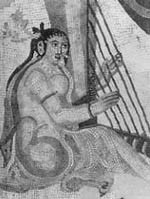 The
splendor in which the Sasanian monarchs lived is well illustrated by their
surviving palaces, such as those at Firuzabad and Bishapur in Fars, and
the capital city of Ctesiphon in Mesopotamia. All are characterized by the
barrel-vaulted iwans introduced in the Parthian period, but now they
reached massive proportions, particularly at Ctesiphon. At Bishapur some
of the floors were decorated with mosaics showing scenes of merrymaking as
at a banquet. The
splendor in which the Sasanian monarchs lived is well illustrated by their
surviving palaces, such as those at Firuzabad and Bishapur in Fars, and
the capital city of Ctesiphon in Mesopotamia. All are characterized by the
barrel-vaulted iwans introduced in the Parthian period, but now they
reached massive proportions, particularly at Ctesiphon. At Bishapur some
of the floors were decorated with mosaics showing scenes of merrymaking as
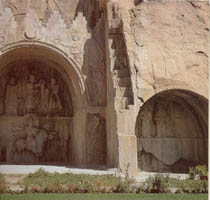
at a banquet.Other notable Sasanian sites include Takht-i Suleiman in Azerbaijan, where an important fire temple and palace were built around a supposedly bottomless lake; the tower at Paikuli in Iraq Kurdistan, with long inscriptions of King Narseh (AD293-302); and the temple at Kangavar, dedicated to Anahita. But the best-known monuments of the Sasanian period are the rock-reliefs carved by nearly all Sasanian kings from Ardashir to Shapur III (AD383-8) and then again by Chosroes II (AD591-628). There are fine examples at Bishapur, Firuzabad, Naqsh-i Rustam, Naqsh-i Rajab, and Taq-i Bustan near Kermanshah. Most common are investiture scenes, showing the king being given the right to rule by a deity, normally Ahuramazda. In these the deity hands over a diadem or headband 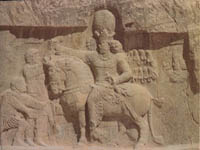 with flowing ribbons, clearly a type of head-dress symbolic of kingship.
Another frequent theme in the reliefs is victory over the Romans, with
Shapur I recording his successes no less than four times. In two reliefs
at Bishapur the central panel probably shows the victorious Sasanian king
on horseback, trampling the body of Gordian. Before him kneels Philip the
Arab, while Valerian is standing submissively behind the king.
with flowing ribbons, clearly a type of head-dress symbolic of kingship.
Another frequent theme in the reliefs is victory over the Romans, with
Shapur I recording his successes no less than four times. In two reliefs
at Bishapur the central panel probably shows the victorious Sasanian king
on horseback, trampling the body of Gordian. Before him kneels Philip the
Arab, while Valerian is standing submissively behind the king.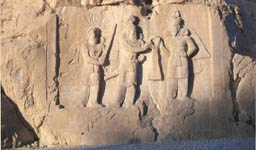 But the most
remarkable Sasanian reliefs are at Taq-i Bustan. Here a king, probably
Chosroes II, carved an iwan out of the rock. On the back wall is an
investiture scene with the king on horseback below; the side walls show
the king hunting wild boar and deer.
But the most
remarkable Sasanian reliefs are at Taq-i Bustan. Here a king, probably
Chosroes II, carved an iwan out of the rock. On the back wall is an
investiture scene with the king on horseback below; the side walls show
the king hunting wild boar and deer.Sasanian silks were treasured far beyond Iran - they have been identified in Europe, Egypt, central Asia and Chinese Turkestan. There was also a tradition of fine glassware. In AD637 disaster overtook the Sasanians. They were defeated at Qadisiya near Ctesiphon 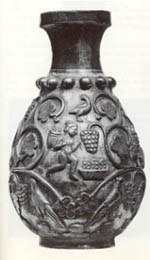 by
an Arab army filled with crusading zeal of Islam. A further reverse
followed at Nahavand in AD642, and the last Sasanian king Yazdigird III
(AD632-51) was forced to flee the battle; he was eventually murdered at
Merv. So ended Sasanian rule in Iran, and the Islamic era began. The
reasons for the sudden collapse of the Sasanian empire are not clear.
However, one important factor must be that the Arabs had previously made
inroads into Mesopotamia, but their potential threat was largely ignored.
Also, by the mid-seventh century the Sasanian state must have been exhausted
by its long years of struggle with Rome and Byzantium, and oppressive
taxation coupled with a rigid class system would have made Islam an
attractive alternative to many disaffected subjects of the great king. by
an Arab army filled with crusading zeal of Islam. A further reverse
followed at Nahavand in AD642, and the last Sasanian king Yazdigird III
(AD632-51) was forced to flee the battle; he was eventually murdered at
Merv. So ended Sasanian rule in Iran, and the Islamic era began. The
reasons for the sudden collapse of the Sasanian empire are not clear.
However, one important factor must be that the Arabs had previously made
inroads into Mesopotamia, but their potential threat was largely ignored.
Also, by the mid-seventh century the Sasanian state must have been exhausted
by its long years of struggle with Rome and Byzantium, and oppressive
taxation coupled with a rigid class system would have made Islam an
attractive alternative to many disaffected subjects of the great king. Ancient Persia John Curtis
|