|
Parthians
Hellenistic influence was particularly strong at Susa, continuing
well into Parthian period. Susa became a proper Greek polis with a Greek
civic organization, gymnasiums, theatres and so on. Even Greek gods were
worshiped in the city. In origin they were a nomadic tribe who migrated
into the area from central Asia. Their two most important early capitals
were at Nysa (ancient Mithradatkirt), now in Soviet Turkmenistan, and
Shahr-i Qumis (ancient Hecatompylos) near Damghan.
Parthia was firmly straddling the Silk Route, greatly benefiting from
its role as a middleman in the exchange of goods between China in the
east and Rome in the west. The Parthians enjoyed cordial relations with
the Chinese Han dynasty, but their expansion westwards brought them into
sharp conflict with Rome. Another source of contention was Armenia, as
both Rome and Parthia sought to influence the course of events there.
The first major encounter between the two powers was at Carrhae (modern
Harrab in Turkey) in 53BC, which resulted in a decisive defeat for
Crassus and his Roman legions. On this occasion the Romans found their
infantry no match for the mobile Parthian cavalry commanded by Suren,
whose prowess in archery (the so-called "Parthian shot") has
become proverbial.
For more than a century thereafter no serious challenge was made to
the territorial integrity of Parthia, but this period of comparative
quiet was shattered by the aggressive ambitions of Trajan. In his
campaign of ADII6 this emperor succeeded in capturing Ctesiphon and
marching to the shores of the Persian Gulf. Although he soon had to
withdraw, from this point onwards Parthia was in decline, racked by
internal dissension and threatened externally by the Kushans in the
east, the nomadic Alani in the north-west and the Romans in the west.
Ctesiphon was sacked twice more , and although there were periods of
Parthian revival, notable under Vologases IV in the second half of the
second century AD, the state was largely a spent force.
Parthian coins are helpful for establishing the succession of kings
and their dates.
Before the establishment of Parthian rule, the urban centres of
Mesopotamia and Iran had been subjected to a fairly intensive period of
Hellenisation, and naturally this influence did not suddenly disappear
with the advent of a new ruling dynasty. Thus, in the early part of the
Parthian period, Greek was retained as the official language.
Towards the end of the first century BC and certainly in the first
century AD, however, the situation began to change and oriental features
became more prominent in Parthian culture.
Evidence for art in the late Parthian period comes mainly from
semi-autonomous regional centres such as Elymais in Khuzistan and Hatra
in northern Mesopothamia. In Elymais we have the religious centres of
Masjid-iSulaiman and Bard -i Nishandeh, dated to the late second and
early third centuries AD, with many reliefs and statues showing
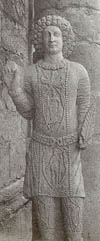
worshipping figures. All are represented frontally and most wear the
Parthian tunic and trousers. Elsewhere in Elymais there are rock-reliefs
of this period at Tang-i Sarvak and Shimbar. At the important site of
Hatra, situated on the transdesert route linking northern Mesopotamia
with sites such as Palmyra and Dura Europes in the west, many life-size
statues of worshippers have been found in the complex of temples.
During the Parthian period the iwan became a widespread architectural
form. Particularly fine examples have been found at Ashur and Hatra.
Burial practices in the Parthian period were diverse, perhaps
testifying to the degree of religious toleration at this time. For
example, in the south-western part of the Parthian empire, bodies were
often interred in so-called slipper-coffins with oval lids, sometimes
elaborately decorated in blue-green glaze. Associated with such coffins
were a variety of grave-goods including terracotta figurines, coins,
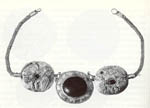
vessels in pottery and glass, gold and silver jewellery, crude bone
figurines and so on. Quite different forms of burial have been attested
at Nineveh.
The last Parthian king, Artabanus
v, was overthrown about AD224 by
Ardashir, a local dynast in Fars whose seat was at Istakhr. He is said
to have been a descendent of one Sasan, who gave his name to the
Sasanian dynasty founded by Ardashir.
Ancient Persia
John Curtis
|