|
Achaemenes
The achaemenid
period may be said to begin in 550 BC, when Cyrus the Great deposed the
Median king Astyages. Cyrus, who styled himself "king of Anshan".
belonged to the ruling house of Persia but also had connections through
his mother, whose father was supposedly Astyages, king of the Medes.
Cyrus thus established himself as undisputed king of the Medes and
Persians. Amongst his ancestors he counted the legendary king Achaemenes,
the eponymous founder of the Achaemenid dynasty.
A
few years later Croesus, the king of Lydia notorious for his vast
wealth, saw an opportunity with the change of regime in Iran to expand
his kingdom, and he crossed the river Halys, previously regarded as the
boundary between the Lydians and the Medes. Cyrus hastened westwards,
and after an inconclusive encounter Croesus retired to his capital city
of Sardis. But Cyrus followed him, and in an historic battle defeated
the Lydians and captured Sardis in 547 or 546 BC. In this way, much of
western Anatolia was brought under his control. Shortly afterwards Lycia,
Caria and even the Greek cities of Asia Minor were added to his newly
founded Persian empire.
About
this time Cyrus built himself a capital, in keeping with a king of his
status, at Pasargadae - the name may mean "the Persian
settlement" - in Fars. At Pasargadae various structures are spread
out across the site, including a gate-house, two small palaces, two
pavilions and a large unfinished platform of ashlar masonry (the Tall-i
Takht) which was probably the base for a palace that was never built.
The palaces have columned halls and porticos on the sides, and the
pavilions are similarly constructed with columns. A solitary column with
a stork's nest on top marks the position of one palace.
These
buildings were probably reproductions in stone of traditional forms in
mud-brick and wood.
Cyrus
next turned his attention to his eastern domains: The time was ripe to
add Babylonia to his conquests. Nabonidus, its fanatically religious
king, was deposed, and Babylon was captured in 539BC. With it came those
parts of the Babylonian empire that had not already defected to Cyrus,
and in this way much of Syria and Palestine fell into his hands. Cyrus
was now master of an area stretching from the Mediterranean to eastern
Iran and from the Black Sea to the borders of Arabia.
Cyrus
was eventually killed in 530Bc while campaigning on his north-east
frontier against the Massagetae, somewhere to the east of the Aral Sea.
His body was probably brought back to Pasargadae and placed in the
structure traditionally called the Tomb of the Mother of Solomon. It is
a magnificent stone edifice with a gabled roof, occupying a dominant
position set apart from the other buildings at the site.
Cambyses
(530-522BC), the elder son of Cyrus and his successor, is chiefly
remembered for his invasion and subjugation of Egypt. On his way from
Syria to deal with the revolt, Cambyses was accidentally killed, and the
imposter held away for some months, and then Darius, became the next
king.
Under
Darius the Achaemenid empire reached its greatest extent, embracing
Egypt and Libya in the west and extending to the river Indus in the
east.
To
administer this vast empire Darius divided it into twenty provinces,
each with its own provincial governor or satrap. Each satrapy was
assessed for tax purposes and obliged to provide a fixed annual tribute.
In addition to organising the empire, Darius was the first Persian king
to mint coins, and during his reign cuneiform was first used for
inscriptions in Old Persia (as at Bisitun). In Egypt he built a canal
between the Red Sea and the Nile, anticipating the modern Suez Canal.
And it is in Darius' reign that mention is first made of the Royal Road,
a great highway from Susa to Sardis with posting stations at regular
intervals.
The
fact that the road went to Susa was no accident, as this was the most
important administrative centre throughout the Achaemenid period and the
court probably spent part at least of each year there, as well as at
Hamadan. It is a mark of Susa's importance that Darius undertook much
building work here; extensive traces have been found in excavations at
the site. Most impressive are the Apadana, or audience hall, and an
adjoining palace consisting of rooms grouped around large courtyards in
the Babylonian tradition.
In
the palace that Darius constructed adjoining the Apadana were panels of polychrome
glazed bricks, probably decorating courtyard walls.
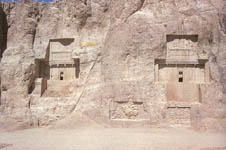
Darius
was buried in a rock-out tomb at Naqsh-i Rustam, some 6 km north of
Persepolis. The facade of the tomb is cut into a cliff and resembles a
Greek cross in shape. The central part of the cross is carved to
represent the portico of a palace, complete with engaged columns; a door
in the centre gives access to the interior of the tomb. Above this
palace facade, two rows of bearers, representing the different subject
nations of the empire, support a dais on which the king stands before an
altar. Above is the figure in the winged disc, possibly Ahuramazda. Also
in the same stretch of cliff at Naqsh-i Rustam are three other royal
tombs. That of Darius is the only one identified by an inscription.
Towards
the end of Darius' reign the much publicised struggle with Greec began,
which ended in ignominy for the Persians.
It
has been suggested that Persepolis was a ceremonial site, principally
used for the Noruz (New Year ) festival at the time of the spring
equinox.
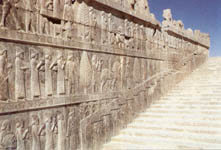
Apadana
at Persepolis is built on a stone platform decorated with staircases and
relief sculpture on the north and east sides. Each side is a mirror
image of the other. The reliefs originally showed the enthroned Persian
king in the centre, while towards him moved processions of tributaries.
Altogether twenty-three different subject peoples are shown, including
Medes, Elimates, Babylonians, Lydians, Scythians, Indians, Egyptians,
Nubians and Libyans. All are dressed in their national costume and all
bring different sorts of presents.
Ancient Persia
John
Curtis
|