|
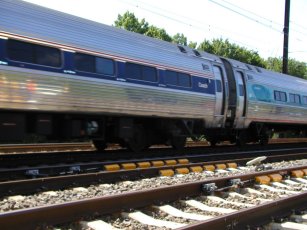
| Amtrak set out to weigh some train wheels "on the hoof" and ended up with a quite nice wayside tool designed to analyze wheel condition of all wheels over the site and pick out shelling, flatspots, out of round conditions, and other such goodies, identify the car and it's owner if one decided to land out of safety parameters, and just to keep the freight carriers honest, weigh each wheel of the train as well. |
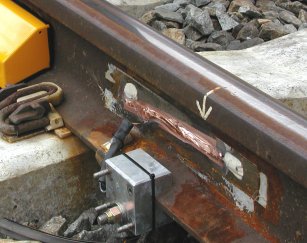
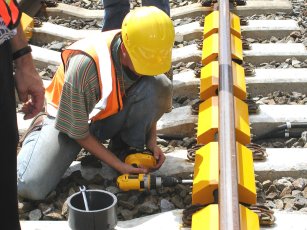
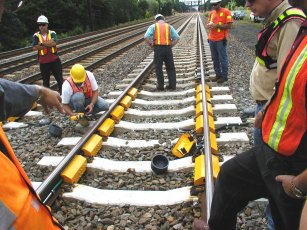
| The site was chosen for it's varied traffic, ease of access and it's straight flat tangent track. A contractor was called in before we came onsite and applied strain gauges to the rail to measure shear for purposes of weighing each wheel as it rolled across the site. Here the gauges are shown covered in gold mylar foil to prevent electronic noise. also shown is the wiring block bolted to the rail to terminate the wheatstone bridge connections. |
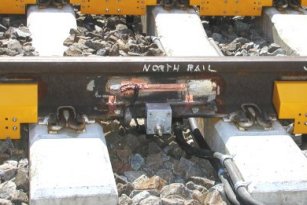
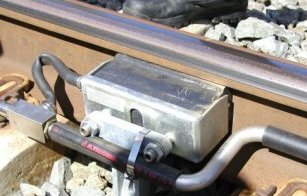
| Once the site was prepared with the strain gauges, the rest of the instrumentation could be applied. The strain gauges were connected into their electrical "bridges" and junction blocks applied to the rail with clamps to house all wiring, serve as a mount for accelerometers, and to hold our pretty new safety covers that protect each node of the array |
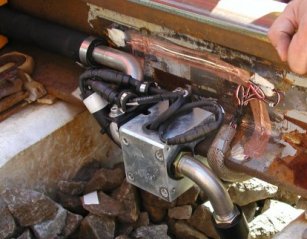
| The condition of the wheels is determined with complex computer algorithms as they decipher the output of accelerometers attached to the blocks bolted to the rail. As wheels pass over the site, any "bad spots" impact the rail and the motion is picked up by the ultrasensitive accelerometers. |
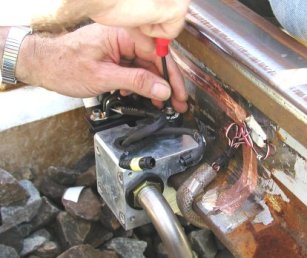
| As you can see, the accels aren't hard to change, tho they should rarely need changing. They are specially built ultra-robust units with great survivability. All instrumentation needs calibrated. These units are no different, but as this is a user friendly installation, the accels "self calibrate to the system and no external tweaking is necessary. What will they think of next.... |
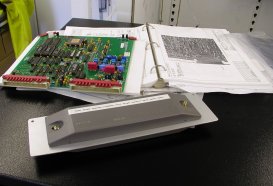
| I said in the beginning that if a "bad actor" car came through with bad wheels or other measureable defects, we could determine what car it was and who owned it, among other things This is accomplished with "freight car tagreaders" All freight cars in the nation are tagged with transponders that contain info about them. In addition, Amtrak is tagging it's fleet to use the site as part of an extensive maintenance checkpoint system. |
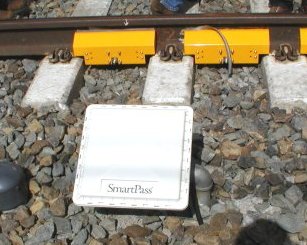
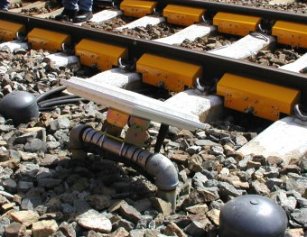
| The tags are not unlike the "EZ-Pass" toll tags one uses to pay tolls on turnpikes and bridges as they cruise through the toll at up to 50 miles an hour. The wheels pass over a "trigger" that determines the train's speed and also turns the testing array on. part of the array is the tagreader itself which stands on a mast beside the track. It transmits a radio signal that "wakes up" each tag and subsequently transmits data back.... all within milliseconds... dont blink or you'll miss it! |
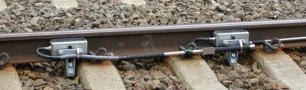
| The "trigger" is an inductive wheel sensor that senses the metal mass of the wheel as it passes over. The sensor as a single unit tells the system to wake up . Another unit in conjunction with the first determine the speed of the wheel as it wizzes by. the wheel sensors are a critical part of the whole mess as all the other array sensors are told by the wheelsensor findings when to do their thing. As they say... timing is everything. |
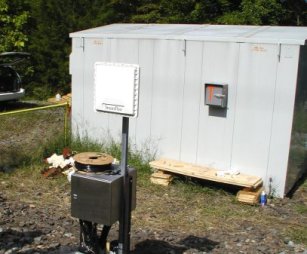
| All the outputs from all the sensors are gathered in a signal hut beside the track. It's climate controlled and impervious to predators, both two and four legged and has all the amenities needed to process and send our newly gathered information. Notice the high mount tag reader in the foreground. This is the preferred mount, but those between the tracks were mounted low at an angle for clearance from passing trains. |
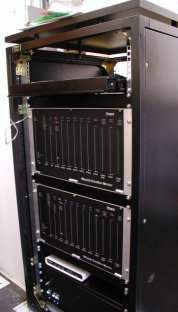
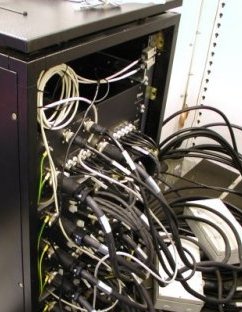
| Inside the hut, the signals eventually find their way to the instrumentation rack that house the signal processors and computer controls that make the heart of the system. All the computers are proprietary design, specially made for this application. You definately wont find this stuff at your local electronics superstore. |
|
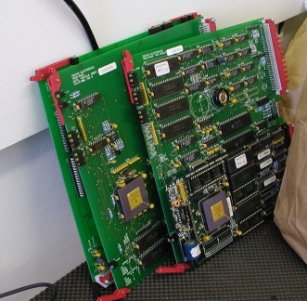
| Each "card" in the rack has it's own processor and it's own software. Some of the less complicated ones simply take their instruction from EPROMS that are burned with the software needed. Others have a solid state flash memory "hard drive" to store data as well. All the cards have networking on them also and talk to each other in their quest for accurate data. |
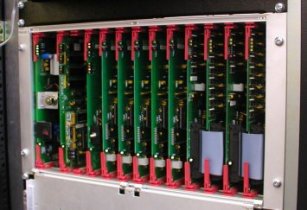
| All the individual computer cards fit neatly in their rack, individual in their function and connections but married together with a common "backplane" architecture that allows them to share information as well as common power. Each is also self diagnostic and will "light red" if it is ill. They also self calibrate and calibrate to each other every few minutes as well. |
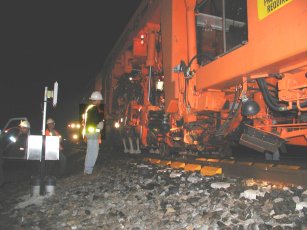
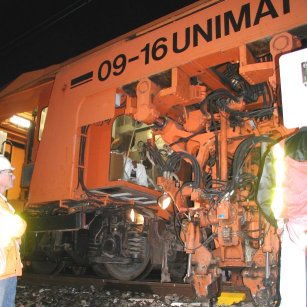
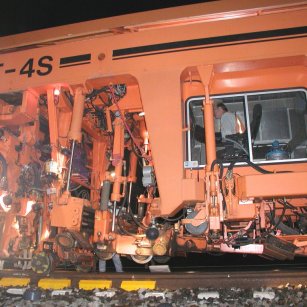
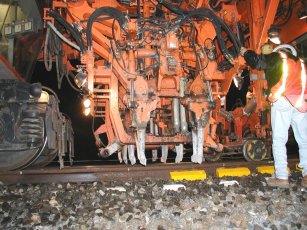
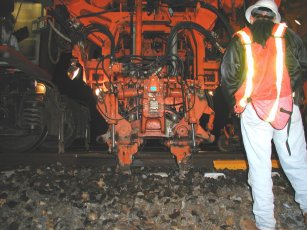
| When the ductlines were dug into the track, it of course left us a "soft spot" in the subgrade and the ballast. Immediately after the installation was complete, then again about a month later, we called in the "raisin gang" to raise, line, and stabilize the site to firm it up and make it smooth, flat, and pretty. When they were done it was virtually perfect. But hey... The fellas are "that good". |
|
|
|
|
| The instrumentation and it's support components are all of such high quality and made to such exacting tolerances that the installation as a whole was a breeze. We enjoyed the interaction with the Teknis experts and it was a great learning experience as well as enjoyable. |