|
Interstellare Phenomene und Besonderheiten | ||
|
| ||
Stellarer Cluster (Deltaquadrant):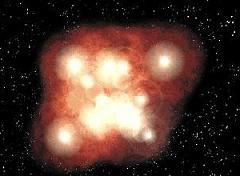 | Kuerzlich erfolgte Ueberwachungen von Sternenformenden Regionen ergaben, dass die meisten Sterne und wahrscheinlich alle massiven Sterne in dichten stellaren Clustern geboren werden. Der Mechanismus mit welchen molekulare Wolkenfragmente sich in hunderte sogar tausende von einzelnen Sternen umformen ist jedoch schwer erfassbar geblieben.
(credit:Monthly Notice of the Royal Astronomical Society,Volume 343 Issue 2 Page 413 - August 2003) | |
|
| ||
Flash Plasmastorm: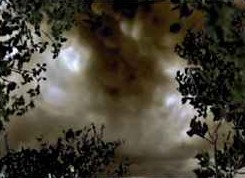 | angetroffen von Voyager im Deltaquadranten auf einem Planeten der "New Earth" genannt wurde | |
|
| ||
Gravimetrische Verzerrung: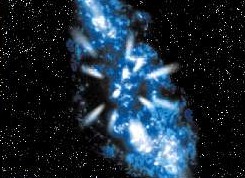 |
Gravimetrische Fluktuationen gehen manchmal einher mit Unterbrechungen im normalen Fluss von Zeit und Raum. | |
|
| ||
Quantum Singularität: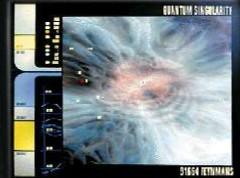 | | |
|
| ||
Inversion Nebula: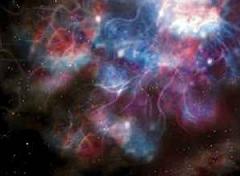 | Interstellare Gaswolke
angef�llt mit hochunstabilen Plasmastr�ngen. Normalerweise sind sie so unstabil,
dass sie sich in kurzer Zeit selbst "ausbrennen". Inversion Nebula's k�nnen
wunderbare Farbsprektren aufweisen. | |
|
| ||
Nekrit Expanse Region: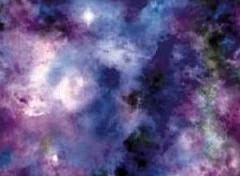 | Ein ausgedehnte Region im Delta
Quadranten. Sie ist angef�llt mit einer unbekannten Form von interstellaren
Staubwolken und Plasma St�rmen. Die Nekrit Expanse Region ist so gross und
unstabil, dass sie bisher noch nicht kardeographiert wurde. Aufgezeichnet durch
Voyager 2373 | |
|
| ||
Gravitations Ellipse: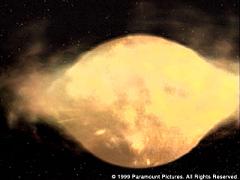 |
Ein seltened Phenomen, welches sich im Subraum bewegt und periodisch im normalen Raum auftaucht. Es wird von der Energie und Schildpolaritaet der Voyager angezogen als diese 2372 auf das Phenomen trifft. | |
|
| ||
Nexus: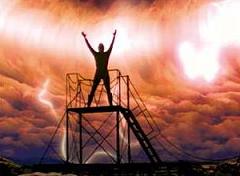 | Der Nexus ist ein nonlineares
tempor�res Kontinium in dem die Realit�t sich nach den innersten
W�nschen einer Person zu ver�ndern scheint. Sie erleben ihre Erinnerungen
und Tr�ume, k�nnen diese auch beliebig ver�ndern. Der Nexus kann auch nach
Belieben wieder verlassen werden, wobei die R�ckkehr danach nicht mehr so
einfach ist. Der "Eingang" ist ein Energieband das sich nach einem festen
Schema durch die Galaxie bewegt. Alle 39,2 Jahre kommt es wieder an einem
fixpunkt vorbei. | |
|
| ||
| Bilder aufgenommen von Terra im 20th und 21th Jahrhundert (fehlende Übersetzungen folgen noch) | ||
|
Sombrero Galaxy: 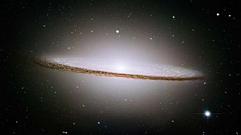 |
Diese Seitenansicht der Sombrerero-Galaxy zeigt wie duenn die Scheiben der Spiralgalaxien sind.
Das Photo zeigt dunkle Staubwege an, in denen viele junge und helle Sterne liegen.
Das Hubble Teleskop zeigt, da� die gl�hende zentrale Ausbuchtung fast 2.000 kugelf�rmige Sternen-Cluster beherbergt, 10mal soviele, wie
unsere Milchstra�engalaxie.
Aufgenommen vom Hubble Teleskop Terra im Jahre 2003 (credit:NOAO/AURA/NSF) | |
|
| ||
Pferdekopfnebel: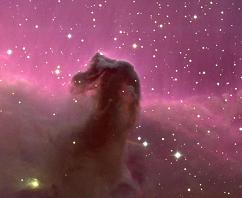 |
Der Pferdekopf Nebula in Orion, ist ein Teil einer gro�en, dunklen, molekularen Wolke, auch bekannt als Barnard 33. Die ungew�hnliche Form wurde zuerst im sp�ten 1800s auf ener photographischen Platte entdeckt.
Das rote Gl�hen entsteht durch Wasserstoffgas, welches �berwiegend hinter dem nebula angesiedelt ist, ionisiert durch den nahe gelegenen hellen Stern Sigma Orionis.
Die Schw�rzung des Pferdekopfes wird überwiegend durch starken Staub verursacht, obgleich der untere Teil vom Ansatz des Pferdekopfes einen Schatten nach links wirft.
Die Str�me von Gas, die dden nebula verlassen werden durch ein starkes magnetisches Feld konzentriert. Helle Punkte an der Unterseite des Pferdekopf Nebulas sind junge Sterne
, die sich gerade erst formen. Licht braucht ungef�hr 1500 Jahre, um uns vom Pferdekopf Nebula aus zu erreichen.
Das Bild wurde im Jhare 2002 mit dem 0.9 m Teleskop des Kitt Peak National Observatory (Terra) aufgenommen. (credit:NOAO/AURA/NSF) | |
|
| ||
Dunkle Molekulare Wolke: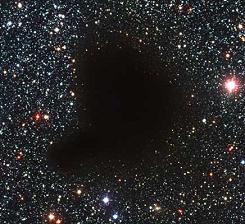 |
In der dunklen molekularen Wolke absorbiert die hohe Konzentration von Staub und molekularem Gas nahezu alles sichtbares Licht, welches von dem Sternen im Hintergrund abgestrahlt wird.
Das umliegende Dunkel macht das Innere einer solchen Wolke zu einem der kältesten und am meisten isolierten Plätze im Universum.
Einer der bemerkenswertesten Nebel dieser Art ist eine Wolke nahe der Ophiuchus Konstellation bekannt als barnard 68. Er ist ungefähr 500 LJ entfernt und ein halbes Lichtjahr im Durchmesser.
Es ist nicht bekannt, wie sich Molekulare Wolken wie Barnard 68 formen, aber es ist bekannt, dass diese Wolken selbst Plätze sind, wo sich neue Sternen bilden.
(credit:NOAO/AURA/NSF) | |
|
| ||
Katzenaugen Nebel: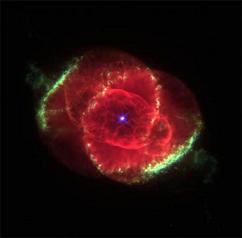 |
Dreitausend Lichtjahre enfernt schleudert ein sterbender Stern Huellen aus gluehendem Gas von sich. Dieses vom Hubble Space Teleskop aufgenommene Bild zeigt den Katzenaugen Nebel, einer der komplexesten der bekannten planetaren Nebel. Die Eigenschaften sind so komplex, das Astronomen davon ausgehen das der zentrale Stern ein Doppelsternsystem ist.
Der Begriff planetarer Nebel, mit dem im allgemeinen solche Objekte beschrieben werden ist eigentlich irrefuehrend. Obwohl diese Objekte mit kleinen Teleskopen rund und planetenaehnlich aussehen, hochaufloesende Bilder zeigen, dass es Sterne sind umgeben von einem Gespinst aus Gas, welches im letzen Stadion der Evolution vom Stern abgegeben wurde bzw. wird.
Image Taken in the year 1995 Terra
(credit:NOAO/AURA/NSF) | |
|
| ||
Lagoon Nebel: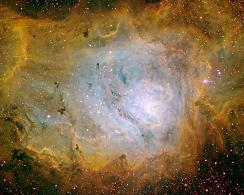 |
Der helle Lagoon Nebel ist das zu Hause einer ganzen Reihe von astrometrischen Objekten. Besonders interessant sind dabei ein offener Sternencluster und einige aktive sternfomenden Regionen. When mit dem blossen Auge betrachtet wird das Licht von Clustern dominiert von einem roten Schein, der von Hydrogengas hervorgerufen wird. Die dunklen Faeden werden verursacht von der Lichtabsorbtion von besonders dichten Staubstraengen. Das Bild, aufgenommen vom Curtis-Schmidt Teloskop zeigt die Ausstrahlung des Nebels in exakt drei Farben, hervorgerufen von hydorgen, oxygen und sulfur. Der Lagoon Nebel auch als M8 oder NGC 6523 bekannt liegt 5000 Lichtjahre entfernt. Er kann mit dem Fernglas im Sternbild des Schuetzen beobachtet werden. Er ueberspannt eine Region dreimal so gross wie der Durchmesser des Vollmondes.
(Credit: R. Barba, N. Morrell et al. (UNLP), CTIO, NOAO, NSF )2002 | |
|
| ||
Rho Ophiuchi Wolken: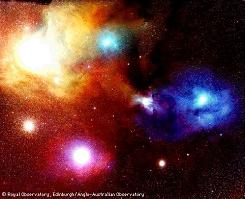 |
Die vielen spektakulaeren Farben der Rho Ophiuchi SternenWolke betonen die vielen Prozesse, die dort auftreten. Die blauen Regionen scheinen hauptsaechlich mit reflektiertem Licht. Blaues Licht vom nahen Stern Rho Ophiuchi und anderen nahen Sternen wird effizienter von dieser Region reflektiert als rotes Licht. (aus dem gleichen Grund erscheint der Himmel der Erde am Tage blau) Die orten und gleben Regionen scheinen hauptsaechlich durch den Ausstoss des atomischen und molekularen Gases des Nebels. Licht von nahen Sternen - im besonderen der helle Stern Antares in diesem Fall - stoesst Elektronen des Gases weg, welche leuchten wenn sie sich wieder mit dem gas vereinigen.
Die dunklen Regionen werden von Staubkoernern verursacht, -geboren in youngen stellaren Atmosphaeren - welche effektiv das Licht blocken, das hinter ihnen ausgestrahlt wird. Die Rho Ophiuchi Sternenwolken, gelegen direkt vor dem globularen Cluster M4, sichtbar an der unteren linken Seite, sind eigentlich noch viel bunter als menschliche Augen erkennen koennen. Sie strahlen Licht in jeder Wellenlaenge aus, von Radiostrahlen bis Gammastrahlen.
(Credit: Photograph made from plates taken with the UK Schmidt Telescope. Color photography by David Malin. Copyright: Royal Observatory, Edinburgh, Anglo-Australian Observatory)1996 | |
|
| ||
Cygnus Loop Supernova Schockwelle: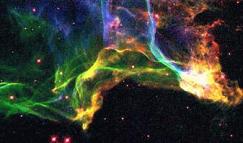 |
Vor 15000 Jahren explodierte ein Stern in der Cygnus Konstellation. Dieses Bild zeigt einen Teil der Schockwelle, dieser Supernova, welche sich immernoch nahe Sterne passierend ausbreitet. Die Kollision der Gasschockwelle mit stationaerem Gas hat das Gas aufgeheizt, dass es nun in spektakulaeren Farben glueht. Das ganze wurde als Cygnus Schleife bekannt. Dieses Bild wurde mit der Weitfeld Camera 2 an Bord des Hubble Space Teleskopes aufgenommen.
(Credit: NASA, HST, WFPC2, Jeff Hester )1995 | |
|
| ||
Eta Carinae: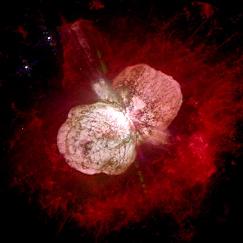 |
Der Stern Eta Carinae, hier im Mittelpunkt des Photos, wird sich hoechstwahrscheinlich in einer spektakulaeren Explosion in wenigen Millionen Jahren selbst zerstoeren. Zur Zeit ist es einer der hellsten, massivsten und am wenigsten stabilsten Sterne, die zur Zeit bekannt sind.
Viel von dem Gas auf dem Photo wurde vom Stern selbst abgestossen. Einige der Gaswolken haben ungefaehr die gleiche groesse wie unser Sonnensystem. Astronomen koennen noch nicht voellig die Bewegungen des umgebenden Nebels erklaeren, aber sie werden weiterhin dieses System beobachten und studieren.
(Credit: NASA, HST, WFPC2, J. Hester (ASU))1995 | |
|
| ||
Orion Nebula: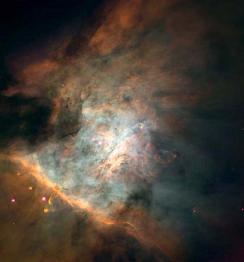 |
Der grosse Nebel im Orion, M42, kann am Nachthimmel gleich unterhalb des einfach auszumachenden "Guertel des Orion" gesichtet werden. Dieser Nebel ist einer der am naechsten gelegenen Sternen-Geburtsstaetten, wo auch gerade jetzt sich neue Sternen formen. Klumpen des Gases (meist hydrogen und helium) und Staub werden im Nebel von ihrer eigenen Gravitation zusammengepresst bis sie kollabieren und Sterne formen. Einige Sterne die wir besonders vom Nebel verdunkelt erkennen koennen, sind erst 100000 Jahre alt - Babies, verglichen mit den 5 Milliarden (5.000.000.000) Jahren der Sonne.
(Credit: NASA, Hubble Space Telescope )1995 | |
|
| ||
HH 47 Star Jet: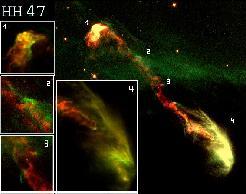 |
Der Stern, verdeckt von einer Staubwolke (4 - am rechten unteren Ende), sendet einen energetischen Strahl geladener Partikel in den interstellaren Raum. Dieser "Jet", sich von rechts nach links bewegend (3 & 2) hat sich durch viel interstellares Material gegraben (2) und expandiert nun in den interstellaren Raum (1). Obwohl die Jetpartikel sich mit nahezu 300 km/s bewegen, koennen wir immernoch nicht eine taegliche Bewegungen sehen, da enorme Entfernungen einbezogen sind, denn er ist Billionen von Kilometern lang. Dieser Stellarjet tritt in einem System auf, dass HH-47 genannt wurde und nahe am Ende des Gum-Nebels liegt.
(Credit: NASA, HST, WFPC 2, J. Morse)1995 | |
|
| ||
Cocoon of a New White Twarf: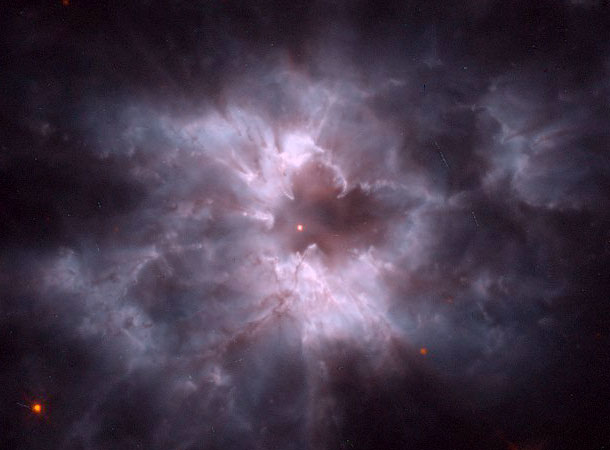 |
Like a butterfly, a white dwarf star begins its life by casting off a cocoon that enclosed its former self. In this analogy, however, the Sun would be a caterpillar and the ejected shell of gas would become the prettiest of all! The above cocoon, the planetary nebula designated NGC 2440, contains one of the hottest white dwarf stars known. The white dwarf can be seen as the bright dot near the photo's center. Our Sun will eventually become a "white dwarf butterfly", but not for another 5 billion years. The above false color image and was post-processed by Forrest Hamilton.
(Credit: H. Bond (STScI), R. Ciardullo (PSU), WFPC2, HST, NASA) | |
|
| ||
Wings of a Butterfly Nebula: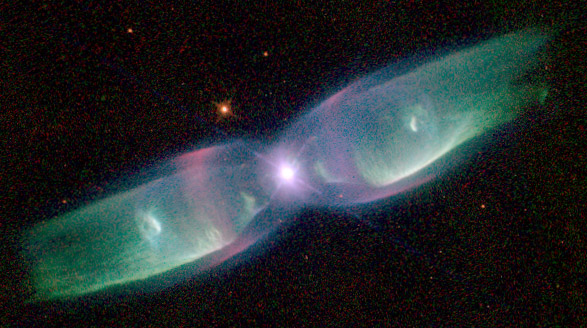 |
Are stars better appreciated for their art after they die? Actually, stars usually create their most artistic displays as they die. In the case of low-mass stars like our Sun and M2-9 pictured above, the stars transform themselves from normal stars to white dwarfs by casting off their outer gaseous envelopes. The expended gas frequently forms an impressive display called a planetary nebula that fades gradually over thousand of years. M2-9, a butterfly planetary nebula 2100 light-years away shown in representative colors, has wings that tell a strange but incomplete tale. In the center, two stars orbit inside a gaseous disk 10 times the orbit of Pluto. The expelled envelope of the dying star breaks out from the disk creating the bipolar appearance. Much remains unknown about the physical processes that cause planetary nebulae.
(Credit: B. Balick (U. Washington) et al., WFPC2, HST, NASA )12/1997 | |
|
| ||
Gaseous Pillars M16: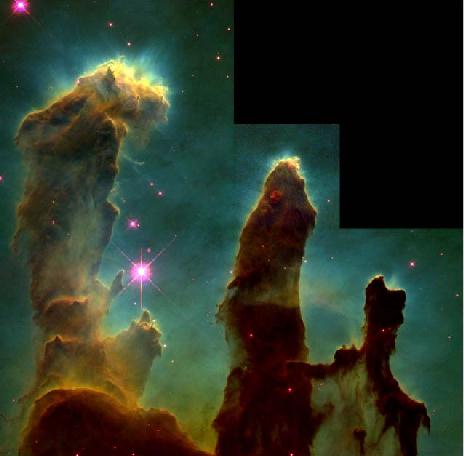 |
Explanation: Newborn stars are forming in the Eagle Nebula. This image, taken with the Hubble Space Telescope in 1995, shows evaporating gaseous globules (EGGs) emerging from pillars of molecular hydrogen gas and dust. The giant pillars are light years in length and are so dense that interior gas contracts gravitationally to form stars. At each pillars' end, the intense radiation of bright young stars causes low density material to boil away, leaving stellar nurseries of dense EGGs exposed. The Eagle Nebula, associated with the open star cluster M16, lies about 7000 light years away.
(Credit: Credit: J. Hester, P. Scowen (ASU), HST, NASA)11/1995 | |
|
| ||
Wings of a Butterfly Nebula: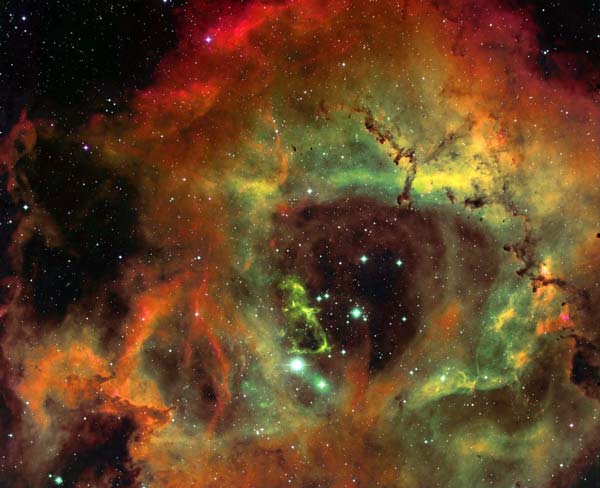 |
The Rosette Nebula is a large emission nebula located 3000 light-years away. The great abundance of hydrogen gas gives NGC 2237 its red color in most photographs. The wind from the open cluster of stars known as NGC 2244 has cleared a hole in the nebula's center. The above photograph, however, was taken in the light emitted by three elements of the gas ionized by the energetic central stars. Here green light originating from oxygen and blue light originating from sulfur supplements the red from hydrogen. Filaments of dark dust lace run through the nebula's gases. The origin of recently observed fast-moving molecular knots in the Rosette Nebula remains under investigation.
(Credit: T. A. Rector, B. Wolpa, M. Hanna (AURA/NOAO/NSF) 12/1997 | |
|
| ||
North American Nebula: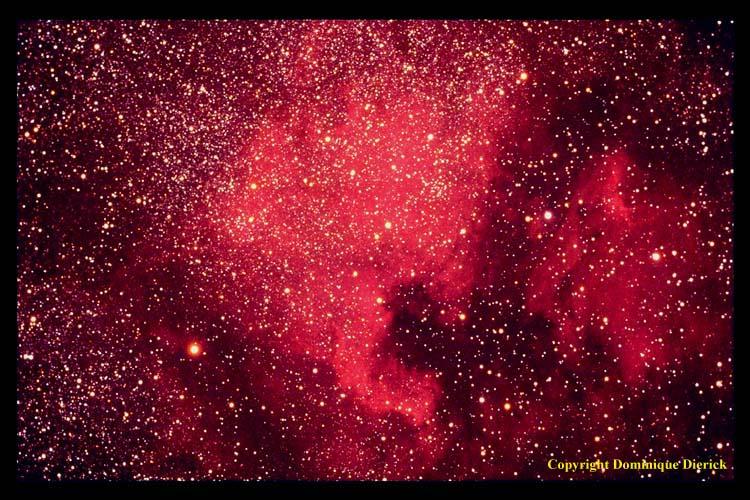 |
Explanation: Here's a familiar shape in an unfamiliar location! This emission nebula is famous partly because it resembles Earth's North American Continent. To the right of the North America Nebula is a less luminous Pelican Nebula. Let's be grateful that pelicans aren't really that large! The two emission nebula are located about 1500 light years away and are separated by a dark absorption cloud. The nebulae can be seen without a telescope from a dark location. Look for a small nebular patch north-east of Deneb in the constellation of Cygnus. It is still unknown which star or stars ionize the red-glowing hydrogen gas. (Credit and Copyright: Dominique Dierick and Dirk De la Marche ) | |
|
| ||
Hydrogen Trifid: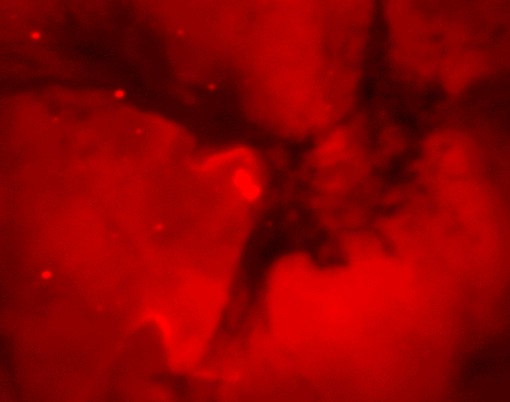 |
Clouds of glowing hydrogen gas mingle with dark dust lanes in the Trifid Nebula, a star forming region in the constellation Sagittarius. In this and other similar emission nebulae, energetic ultraviolet light from an embedded hot young star strips electrons from the surrounding hydrogen atoms. As the electrons and atoms recombine they emit longer wavelength, lower energy light in a well known characteristic pattern of bright spectral lines. At visible wavelengths, the strongest emission line in this pattern is in the red part of the spectrum and is known as "Hydrogen-alpha" or just H-alpha. This image of the nebula was taken using a filter to select only light near the H-alpha wavelength. It shows those regions with substantial emission from atomic hydrogen. The relative strength of this emission can trace the densities of atoms within the gas cloud. (Credit and Copyright: David McDavid ( Limber Observatory) | |
|
| ||
The Witch Head Nebula
: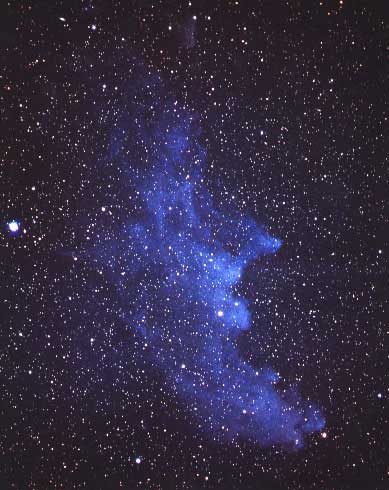 |
Double, double toil and trouble; Fire burn, and cauldron bubble ... Maybe Macbeth should have consulted the Witch Head Nebula. This suggestively shaped reflection nebula is associated with the bright star Rigel in the constellation Orion. More formally known as IC 2118, the Witch Head Nebula glows primarily by light reflected from Rigel. Rigel is located about one photo-width off the image to the right. Fine dust in the nebula reflects the light. The blue color is caused not only by Rigel's blue color but because the dust grains reflect blue light more efficiently than red. The same physical process causes Earth's daytime sky to appear blue, although the scatterers here are molecules of nitrogen and oxygen. The nebula lies about 1000 light-years away.
(Credit: G. Greaney ) | |
|
| ||
The Crab Nebula from VLT: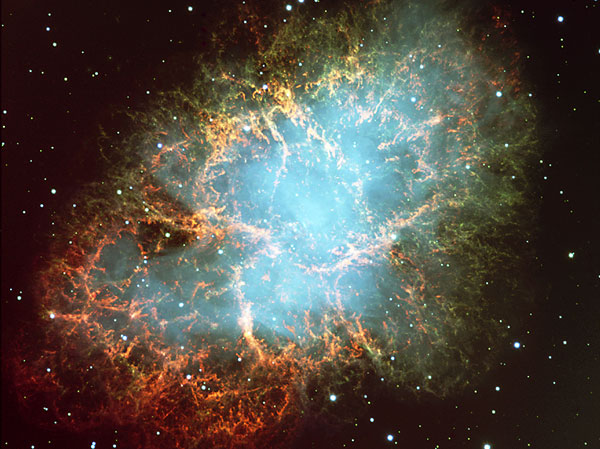 |
The Crab Nebula, filled with mysterious filaments, is the result of a star that was seen to explode in 1054 AD. This spectacular supernova explosion was recorded by Chinese and (quite probably) Anasazi Indian astronomers. The filaments are mysterious because they appear to have less mass than expelled in the original supernova and higher speed than expected from a free explosion. In the above picture taken recently from a Very Large Telescope, the color indicates what is happening to the electrons in different parts of the Crab Nebula. Red indicates the electrons are recombining with protons to form neutral hydrogen, while blue indicates the electrons are whirling around the magnetic field of the inner nebula. In the nebula's very center lies a pulsar: a neutron star rotating, in this case, 30 times a second.
(Credit: FORS Team, 8.2-meter VLT, ESO ) | |
|
| ||
Disorder in Stephan's Quintet: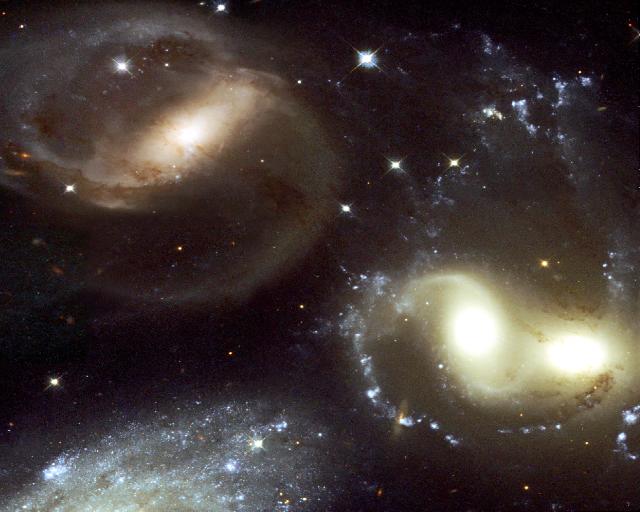 |
What are four closely grouped galaxies doing in this image? The grouping composes a majority of the large galaxies in Stephan's Quintet, with the fifth prominent galaxy located off the above image to the lower right. Three of these four galaxies show nearly the same redshift, indicating that they reside at the same distance from us. These three galaxies are in the midst a titanic collision, each ripping the others apart with gravitational tidal forces. The large bluish spiral below and left of center is a foreground galaxy much closer than the others and hence not involved in the cosmic battle. Most of Stephan's Quintet lies about 300 million light-years away towards the constellation of Pegasus.
(Credit: Jane C. Charlton (Penn State) et al., HST, ESA, NASA)11/1995 | |
|
| ||
Closeup of Antennae Galaxy Collision
: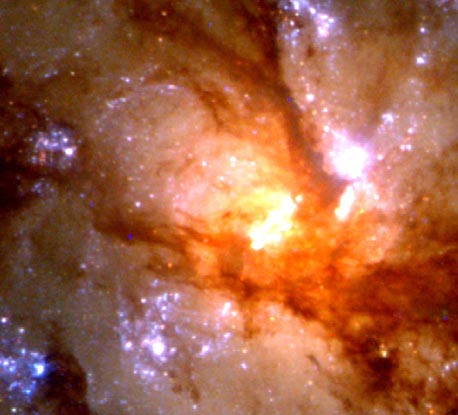 |
It's a clash of the titans. Two galaxies are squaring off in Corvus and here are the latest pictures. When two galaxies collide, however, the stars that compose them usually do not. This is because galaxies are mostly empty space and, however bright, stars only take up only a small amount of that space. But during the slow, hundred million year collision, one galaxy can rip the other apart gravitationally, and dust and gas common to both galaxies does collide. In the above wreckage, dark dust pillars mark massive molecular clouds, which are being compressed during the galactic encounter, causing the rapid birth of millions of stars.
(Credit: B. Whitmore (STScI), F. Schweizer (DTM), NASA ) | |
|
| ||
M31: The Andromeda Galaxy: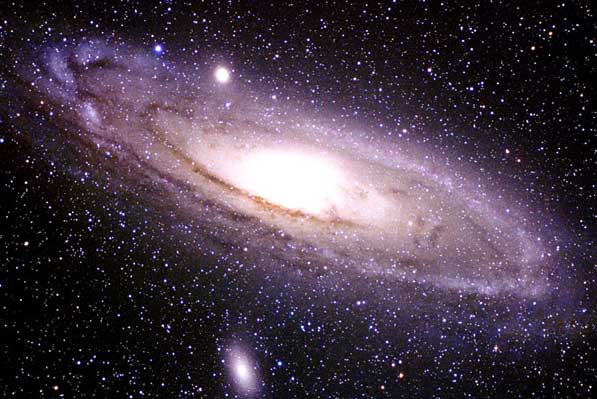 |
Andromeda is the nearest major galaxy to our own Milky Way Galaxy. Our Galaxy is thought to look much like Andromeda. Together these two galaxies dominate the Local Group of galaxies. The diffuse light from Andromeda is caused by the hundreds of billions of stars that compose it. The several distinct stars that surround Andromeda's image are actually stars in our Galaxy that are well in front of the background object. Andromeda is frequently referred to as M31 since it is the 31st object on Messier's list of diffuse sky objects. M31 is so distant it takes about two million years for light to reach us from there. Much about M31 remains unknown, including why the center contains two nuclei.
(Credit: Credit: J. Hester, P. Scowen (ASU), HST, NASA) | |
|
All pictures of the second section were published on  Astronomy Picture of the Day
Index - Main Page and are copyright on their particular owners. Astronomy Picture of the Day
Index - Main Page and are copyright on their particular owners.
für mehr email an mich | ||