THREE GODDESSES IN THE BOOK OF THE DEAD; CONCEPT AND FUNCTION
(figures in red indicate endnotes)
Introduction
The Book of the Dead, or the Chapters of Coming Forth by Day as they were known to the ancient Egyptians, was one of a number of funerary papyri written as guidance for a deceased person on how to reach the afterlife in safety. The Egyptians believed that the afterlife called by them the Field of Rushes or Field of Offerings, could only be reached after negotiating a seemingly endless amount of traps, undergoing countless tests, and guarding against numerous demons. This could only be done successfully if the deceased knew the correct speeches to recite at the appropriate points and the answers to questions that would be asked on the way. All this would contained within the papyrus, and as all papyri always record a successful outcome, the Book of the Dead was therefore and absolute guarantee that this would happen. "Traveling to the next world was very much like taking an examination with prior knowledge of all the questions and a supply of prepared answers in one’s possession." 1
The Book of the Dead was the culmination of a tradition of funerary literature reaching back into the Old Kingdom. Some of the spells of the Book of the Dead have their origins in the Pyramid Texts, first inscribed on the walls of the burial chamber and anteroom of the pyramid of King Unas, the last ruler of the Fifth Dynasty, about 2345 BC, although it is clear that some of this material had already been in existence for centuries by this date. Several different beliefs are already recorded in the Pyramid Texts, which at that time were reserved for Pharaoh only. He could become one of the circumpolar stars, which, as they were never seen to set from Egypt, were regarded as symbols of eternity; he could travel with Re in his sacred bark on his daily journey across the sky; he could be identified with other gods, or be chief of them; or he could accompany Osiris in the underworld. Although most of these beliefs were passed down into later times, perhaps the most important belief, one that was to persist and grow from the Pyramid Texts, was the identification of the dead king with Osiris.
After the collapse of the Old Kingdom, the political fragmentation of what is called the First Intermediate Period led to a democratization of funerary beliefs. Guaranteed access to the afterlife was now available to all that could afford the correct burial equipment. The Utterances of the Pyramid texts were added to and written on the coffins of commoners of the Middle Kingdom, 2040 – 1786 BC. The spells of the Coffin Texts, as they are now known, were the direct predecessors of the spells of the Book of the Dead.
During the New Kingdom, these spells were written on papyrus making their use even more widespread than before, such a roll being well within the reach of someone with little means. The earliest Books of the Dead date to the mid fifteenth century BC and remained important until Ptolemaic times, although there were several revisions. These papyri were either buried with the deceased in the coffin; sealed into a statue of the funerary deity Ptah-Sokar-Osiris; or certain chapters could be inscribed on the walls or written on the coffin. There are almost two hundred spells in the Book of the Dead, many accompanied by illustrations called vignettes, although no one papyrus contains all two hundred. If he was wealthy, a buyer could choose the spells he wished to include on his copy while he was still living; if he was less well-off, he could make do with an already prepared text with spaces left for his name to be filled in.
The long history of many of the spells and of the beliefs included in them, which were occasionally added to, frequently make the text difficult to understand. The ancient Egyptians themselves often did not understand the spells, as is apparent in the mistakes that can be seen in surviving copies, but their meaning did not matter to them as much as their effectiveness. It can be seen that the origins of many spells have their roots in the Pyramid Texts, but even when new beliefs were included, the old ones were not discarded, even when one contradicted the other, and the Egyptians saw no incongruity in this. It is almost as if they were planning for every possible outcome. "That is why the Egyptians could believe in an afterlife in which the deceased would spend eternity in the company of the circumpolar stars as an akh [a transfigured soul], at the same time as being restricted to the burial chamber and offering chapel of the tomb as a ka, but also visiting the world of the living, inhabiting the Elysian Fields and traveling across the sky and through the underworld with the sun-god as a ba." 2
The multiplicity of beliefs and the complexity of the spells in the Book of the Dead can make it very difficult to study, but I have found that the roles of the deities in it are, for the most part, quite defined. The three goddesses Isis, Nephthys and Hathor, although they took an important part in the daily life of the Egyptians, especially for women (this is less true of Nephthys who seems to have little existence outside the funerary cult), were also important in the cult of the dead, and this can be seen in the Book of the Dead. All three goddesses are frequently mentioned in it, sometimes at length, all being called upon to help the deceased gain access to the afterlife. I shall be attempting to understand how they were thought of as doing this by the ancient Egyptians, the nature of each of the goddesses as it relates to the funerary cult, and the duties they were thought to perform for the deceased, while also occasionally relating their roles to other aspects of ancient Egypt.
Isis, Nephthys and the Osirian mythological cycle
Understanding the mythology of ancient Egypt is vital to understanding the nature of Isis, Nephthys and Hathor in the Book of the Dead as many of these spells refer directly or indirectly to these myths. Mythology is invented by man as an attempt to explain certain aspects of life and death, while man uses mythology as a guide on how to live, and, of course, on what to expect after death. The myth of Osiris and Isis and of the conflict between their son Horus and their brother Seth over the kingdom of Egypt was central to Egyptian theology from the earliest times, although the fullest and most complete account survives from the work of Plutarch who wrote in the second century AD. Osiris and his sister-wife Isis, Seth and his sister-wife Nephthys, their parents Geb (earth) and Nut (sky), their grandparents Shu (air) and Tefnut (moisture) and their creator Atum form the group of gods known collectively as the Ennead of Heliopolis, who occasionally appear in the Book of the Dead, performing such functions as admitting the deceased into the realm of the dead after he has been judged in Spell 30B. Osiris inherited the kingship of Egypt through the male line from Atum, but this caused Seth to be jealous. Tricking his brother into lying in a coffin, he shut the lid and cast it into the Nile. Isis then went in search of her husband and eventually found the coffin encased in a living tree. Using her magical powers she was able to bring her husband back to life and take him back to Egypt.
This was not the end of the story, for Seth then managed to cut his brother into pieces and throw those pieces into the Nile. With the help of Nephthys, Isis searched for each piece and again using her magic powers, reassembled the body and revived it long enough to conceive a son. Osiris then became ruler of the underworld, while Isis hid herself and her son Horus in the marshes, with Nephthys as nursemaid. During his infancy, Isis had to use her magical powers often to defend her son and cure him of snakebite and scorpion stings, to which he seemed prone. When he came of age and battled with his uncle for the kingship of Egypt, she helped him humiliate Seth and also used her magic to trick him. Eventually Horus took his place as rightful king of Egypt.
The roles of Isis and Nephthys have their mirror in the Book of the Dead. Most importantly, they are the protectors of the dead. Isis is the goddess most often depicted in this role, while Nephthys is rarely mentioned, or depicted in the vignettes that accompany the text without her sister, seeming to take only a secondary role to Isis. In fact, in Spell 128 they are described as "Isis and her sister Nephthys" 3 which demonstrates the regard in which Nephthys was held compared to Isis. Their pairing, with Nephthys having such a small role compared to her sister, may be related to the Egyptian habit of putting deities into pairs, although few are grouped into same-sex pairs, another notable exception being Horus and Seth. Together, Isis and Nephthys are described in Spell 149 as protecting the deceased as he travels through the Field of Rushes, identifying the fourteen mounds there. At the tenth mound, the spirits and shades who "eat what is fresh and gulp down corruption" 4 are required to put themselves on their bellies, as Isis is before him, and Nephthys is behind him.
In many of the spells the deceased person was identified with Osiris, becoming "the Osiris" in other words, bearing the name like a title. According to the Egyptologist Erik Hornung; "This usage does not betoken a genuine identity with the ruler of the dead; rather, it means that through is own efforts the human being takes on a previously determined role that bears the name Osiris." 5 However, taking this role meant that the deceased was entitled to the protection of the goddesses Isis and Nephthys as he travelled the difficult path to the afterlife, which was beset by demons and other dangers. In Spell 151 both goddesses declare that they have come as the protection of Osiris. 6 Isis also has a further role. In myth, she twice resurrected the dead Osiris and this myth is alluded to here when Isis says; "I have let your throat breathe, I have caused you to be a god…" 7 Resurrection was what every deceased person was aiming for, and identifying oneself with the role of Osiris and invoking the power of Isis was thought to make this happen. Resurrection is also described in Spell 161 "…there shall be opened four openings in the sky, one for the north wind – that is Osiris; another for the south wind – that is Re; another for the west wind – that is Isis; another for the east wind – that is Nephthys. As for each one of these winds which is in its opening, its task is to enter into his nose." 8 Presumably, the winds would then bring the dead back to life.
The power of Isis is again referred to in Spell 156, Spell for a knot amulet of red jasper. This spell was to be recited over a tit-knot amulet, also known as "the girdle of Isis" of red jasper and placed on the deceased for protection. The spell calls upon Isis; "You have your blood, O Isis; you have your power, O Isis; you have your magic, O Isis." 9 As Isis was known for her power and magic, it was hoped that she would use this power to protect the deceased and bring him safely into the afterlife.
Magic is a significant aspect of the nature of Isis. In Spell 113, Spell for knowing the souls of Nekhen, 10 there is a description of part of the battle between Horus and Seth, in which Isis cuts off the hands of Horus after he has caught the semen of Seth, and throws them into the Nile. Re sends Sobk to find them so Isis can reattach them with her magical powers. Eventually, the hands find their way to Nekhen where they remain, but the point here is that Isis is known for having magical powers that could be invoked for the deceased’s benefit. Her magic is again mentioned in Spell 181 where the spells of Isis are described as pervading the members of Osiris, 11 alluding to the part of the myth where she resurrected him. Earlier in the spell, together with Nephthys this time, she is also described as giving Osiris life, health and prosperity, and enclosing everything good within his arms, something that the deceased person no doubt wished that they would provide him with.
Isis, Nephthys and female roles
Another role where Isis and Nephthys are important is mourning. In Spell 20, which is an appeal to Thoth to vindicate the deceased before the tribunals of the gods, Isis is described mourning for her brother Osiris. 12 In Spell 17 Isis is described as having disarranged her hair and disordered her scalp, 13 and later in the same spell; "Isis was in the shrine of Sokar, and she rubbed her hair." Sokar was another funerary god, often identified with Osiris, and tearing at the hair was a common feature of Egyptian mourning. In a vignette to Spell 1 from the first century BC papyrus of Kerasher, 14 (figure 1) Isis and Nephthys attend the mummy, Isis in her traditional position at its foot, Nephthys at its head. Both are kneeling with one arm raised towards their foreheads in the ritual gesture of mourning, perhaps symbolizing tearing at the hair mentioned above. Isis and Nephthys, in their search for the body of Osiris, were the first mourners, and in the funeral processions of the wealthy in historic times, two women imitating Isis and Nephthys would follow the bier on which the body was carried. Women, who were sometimes paid for their services, traditionally performed mourning, which also involved loud wailing and the casting of dust over the body. It was one of several jobs a woman could take outside the home, perhaps made respectable because they were following the example of the diving mourners, Isis and Nephthys.
Fig.1 Part of a vignette to Spell 1 from the first century BC papyrus of Kerasher. Isis kneels at the foot of the mummy, Nephthys at the head. Both have their hands raised to their foreheads in a gesture of mourning.
In their search for the parts of Osiris that had been scattered throughout Egypt, Isis and Nephthys transformed themselves into kites. In a lengthy and often confusing spell, Spell 17, Isis and Nephthys are described as two kites who, described also as "plumes," put themselves on the head of Horus, perhaps to protect or guide him. 15 They are also depicted as kites in the vignette to Spell 17 in the nineteenth dynasty papyrus of Hunefer, 16 (figure 2) flanking his mummy. Several suggestions have been made as to their appearance in this form. One is that they are birds that appear in pairs waiting for offal from the preparation of the corpse 17. Another is that the cry of the kite is similar to the wail of mourning women, but their identification with this bird of prey could also be as a result of their close association with Horus 18.
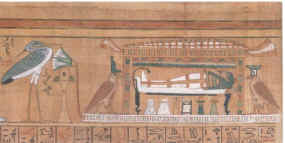
Fig. 2 Part of a vignette to Spell 17 from the nineteenth dynasty papyrus of Hunefer. Here Isis and Nephthys are depicted as kites flanking the mummy.
Together with their association with Osiris, this association with Horus is probably one of their most important roles, especially, of course, for Isis. She is described simply as "mother of Horus," or Horus is described as "son of Isis" in a very large number of spells. As the mother of Horus, whom she struggled to raise in the marshes, partially described in Spell 157 19, she is portrayed as the ideal mother who will go to great lengths to protect and nurture her child, and could therefore be seen as a role model for all Egyptian women, whose primary function in society was to give birth to and raise healthy children. Although Nephthys is not described as a mother in the Book of the Dead, she can occasionally be given a similar nurturing role as the nurse of Horus, which is described in Spell 134; "His mother Isis bore him, and Nephthys nursed him." 20
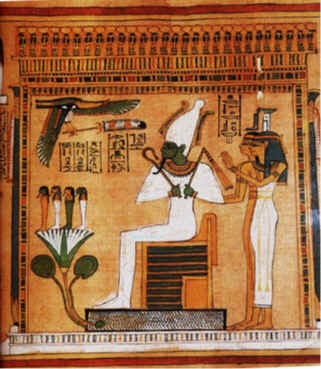
In the description of Isis as wife of Osiris and her portrayal in vignette with him (in fact, he rarely seems to appear without her) Isis is also fulfilling another role as the ideal woman, this time as the ideal wife. Although described more often as brother and sister in the Book of the Dead, Isis is described as the mother of Osiris’s son, which would imply the marriage that is confirmed in mythology. Both examples occur in Spell 69, Spell for being the successor of Osiris; "I am the Radiant One, brother of the Radiant Goddess, Osiris, the brother of Isis; my son and his mother Isis have saved me from my enemies who would harm me." 21 In the vignettes that feature Osiris (figures 3 and 4) he is usually seated, while Isis maintains a position directly behind him. Often, she has her arm around him, or her hand upon his shoulder. Her position therefore seems to imply her support for her husband, a role that would be expected of all Egyptian wives. Indeed, Pharaoh and his wife are often pictured in a similar fashion. Nephthys is mostly, although not always, included in these scenes and stands slightly behind her sister, again indicating her secondary importance to Isis.
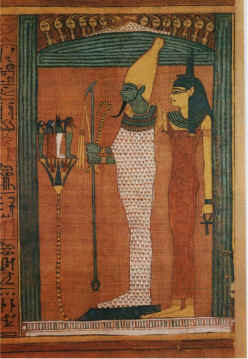
Fig. 3 Vignette
of Osiris from the nineteenth dynasty papyrus of Ani. Isis stands slightly
behind Osiris with one arm supportively around his shoulders.
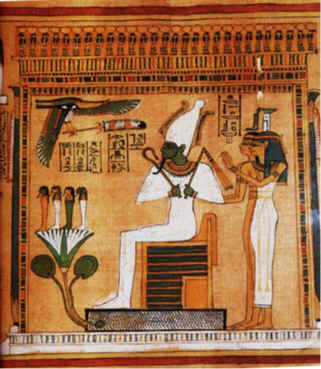
Fig. 4 Part of a vignette to Spell 125 from the nineteenth dynasty papyrus of Hunefer. Isis and Nephthys stand behind an enthroned Osiris, Isis standing slightly before her sister.
The Egyptians obviously saw no barrier to Osiris and Isis being husband and wife although they were also brother and sister. However, this does not necessarily imply that marriages between close family members was considered normal in ordinary society, despite the claims of Diodorus Siculus 22; modern studies have shown that there is no definite proof of marriage between full brother and sister 23. The exception to this was the royal family, who was semi-divine, and therefore entitled to emulate the gods. Even then, marriages between full brother and sister are only known to have happened in the Ptolemaic period. Before this, there is evidence of marriages between half-brother and sister within the royal family, the best examples of this coming from the early New Kingdom. The reason for the brother-sister marriage of Osiris and Isis was probably quite simple; lack of other available marriage partners. Osiris married Isis and Seth married Nephthys because there were no other suitable goddesses to marry.
The importance of names
Many of the instructions contained in the Book of the Dead are very elaborate, but considered essential for reaching the afterlife. Some of these spells involve naming rituals, such as Spell 99, which concerns giving the correct names to the parts of a boat before it would take the deceased over to the Field of Rushes 24; and Spell 42, which identifies parts of the bodies with deities 25. Many of these names either directly identify with deities, as in the latter case; "My eyes are Hathor," and so forth, or involve the names of deities in some other way, for example in Spell 153B, Spell for escaping from the catcher of fish; "Do you know that I know the names of it’s cords? They are the sinews of Isis." 26
Although the names of the deities in many of these spells are not only of Isis, Nephthys and Hathor, but include the names of many other gods and goddesses also, a number of these do feature these goddesses and their inclusion in them is, therefore, significant. Names were very important to the ancient Egyptians. They believed that to know the name of someone or something was to have power over it. In Spell 153B, knowing the names of parts of the net meant that the deceased would have power over it, and therefore escape the catcher of fish. Identifying parts of the body with deities may have a slightly different purpose, to invoke the different powers of the deities to protect the object with its name. The names of Isis, Nephthys and Hathor, as prominent goddesses of the Egyptian pantheon, together with several of their equally prominent male counterparts, would naturally be called upon to fulfill this role.
Hathor the sky goddess
The role of Hathor in the Book of the Dead was also closely related to mythology. Originally, Hathor was probably the mother of Horus; her name, Hwt-hr, means, "House of Horus" which would imply this relationship. As Horus was also identified with the sun, "House of Horus" would therefore indicate the sky, so Hathor was a sky goddess. As the Book of the Dead took on new beliefs without discarding the old, this relationship can be seen in Spell 166, where Horus is actually described as the son of Hathor. 27
Her relationship with the sky was never forgotten. In Spell 68 she is described as being "pre-eminent in the wide solar disc when she travels to Heliopolis." 28 Heliopolis was also the home of the worship of the sun god Re, and her connection with Heliopolis is also mentioned in Spell 82 29. Also strengthening her relationship with the sky is the common association of her name with that of Re. In Spell 39, Spell for repelling a rerek-snake in the realm of the dead, Hathor and Nut, who herself is the personification of the sky, encourage the soldiers of Re to drive away the rerek-snake 30. The Egyptians believed that as the bark of Re travelled across the night sky, also thought of as the underworld, his enemy, the snake Apep would try to prevent him from rising again on the other side. Therefore every night the snake had to be killed. As one of the beliefs about the afterlife was that the deceased would travel with Re, the killing of Apep was important, and this spell would ensure that it was done.
Her name is also linked with that of Re in Spell 91. This spell allows the deceased to come and go in the realm of the dead and in it the deceased asks; "…make a way for me to the place where Re and Hathor are," 31 which would obviously be the sky. The spell continues later; "…he shall not be restrained at any gate of the West whether coming or going." The Egyptians thought that the realm of the dead existed to the west, where the sun sets, or "dies" every evening.
Consequently, Hathor is also described as "Lady of the Evening," as in Spell 108, Spell for knowing the souls of the Westerners 32. This spell also describes the repelling of Apep; this time by Seth who was given this role after Horus was made ruler of Egypt. The souls of the westerners are then named at the end of the spell as Atum, Sobk and "Hathor the Lady of the Evening."
As well as this title, Hathor was also given the title, "Mistress of the West," or "Lady of the West" as in Spell 186, which was a short spell entirely devoted to Hathor 33. In it, she is not only called "Lady of the West," and "She of the West," but also "Lady of the Sacred Land," which perhaps means either Egypt or the afterlife. The spell then goes on to describe her further as the "Eye of Re which is on his forehead," and "Kindly of countenance in the Bark of Millions of Years."
Different aspects of Hathor
The "Eye of Re" relates to a tale known as "The Destruction of Mankind." In it, Re, the King of both gods and men, discovered that mankind was plotting against him, and sent down his Eye in the form of Hathor to slay them. Because of her fury and power, she was therefore known in this incarnation as Sakhmet, "The Powerful One." However, Re changed his mind and decided not to let her kill the rest of mankind and had beer mixed with red ochre to imitate blood poured on to the fields. When, on the following day, the goddess went down to recommence slaying, she saw the beer and thought it was blood. She drank the beer, became drunk, and returned to heaven having forgotten all about mankind.
This is why Hathor is often referred to as the "Eye of Re," which symbolizes the destructive aspect of the sun. This myth also explains some of her contradictory aspects. First of all, there is the obvious vengeful aspect. This can be seen in Spell 140, where Hathor is given the epithet "the victorious," 34 perhaps alluding to her victory over mankind before Re tricked her into forgetting them. In Spell 17, the "Eye of Re" is mentioned several times, once in particular; "As for Her who makes content and protects, she is the Eye of Re. Otherwise said; She is a flame which follows Osiris, burning up his enemies." 35 In this incarnation, Hathor is obviously capable of protecting the deceased and guarding him from any harm that might befall him.
Spell 17 also described the "Sacred Eye of Re" as the "Celestial Cow." 36 Hathor has a close relationship with cows, and is often portrayed with cows’ horns with the sun disc between them upon her head; as a lady with bovine ears; as a lady with a cows’ head; or completely as a cow. She is portrayed in the latter way in a vignette to Spell 186 in the nineteenth dynasty papyrus of Ani, 37 (figure 5) where she is seen emerging from the western mountains, the sun-disc between her horns and beaded menat necklace around her neck. The ancient Egyptians had no problems with portraying their gods and goddesses as human, animals or a mixture of both. The animal the deity was related to was often meant to symbolize the qualities of that deity. For example, Sakhmet is often given the head of a lioness to symbolize fierceness; Anubis, the head of a jackal as jackals were often seen haunting the necropolis, and so on. Erik Hornung has described this as "…nothing other than a hieroglyph, a way of ‘writing’ not the name but the function of the deity in question." 38 The bovine aspect of Hathor perhaps meant that in this incarnation she was friendly and placid, with the maternal tenderness of a cow. This would seem to be confirmed by the line in Spell 186 quoted above; "Kindly of countenance in the Bark of Millions of Years." 39
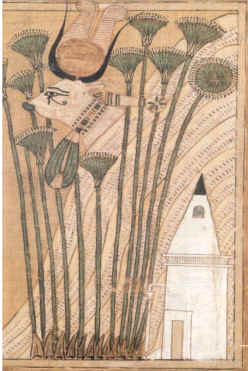
Fig. 5 Part
of a vignette to Spell 186 from the nineteenth dynasty papyrus of Ani. Hathor,
in the form of a cow wearing a menat
necklace, emerges from the Western Mountains into the papyrus of the Nile
Valley.
Spell 189, Spell for preventing a man from going upside-down and from eating faeces, also has a connection with music. After the deceased protests that he will not eat faeces, the gods ask him what he will live on. The deceased says that he will eat loaves that have been brought to him and he will; "…eat under that sycamore of Hathor, for I have placed my portions there for her minstrels." 42 Her minstrels would be her devotees who would make music in her honour; the portions that the deceased says he has given to them are probably the offerings of food he has made to the goddess to ensure her favour.
The sycamore that the deceased wishes to eat under when he reached the afterlife is also described in Spell 68. Here, a god tells the deceased that he may; "…live on bread on pure white emmer and beer of red barley of Hapy in the pure place; you shall sit under the branches of the tree of Hathor…" 43 which seems to be a close parallel to what is described in Spell 189, Hathor is often associated with the sycamore tree and the desire to sit under it was perhaps a desire for her protection.
Conclusion
It can be seen, then, that the function of these three goddesses in the Book of the Dead was to protect and guide the dead into the afterlife using the powers traditionally ascribed to them. In the case of Isis, this was her magic; for Isis and Nephthys together it was their intimate relationship with Osiris and their roles as protectors of Horus, both of whom the deceased wishes to be identified with in order to invoke the powers of the goddesses. In the case of Hathor it is her role as sky goddess and Mistress of the West, where the sun dies each evening, that made her important. In her destructive aspect, she is also the ideal goddess to repel the demons, which might beset the path of the deceased.
In order to discover how the ancient Egyptians conceived of these goddesses, it has also been necessary to understand Egyptian mythology and aspect of daily life. Mythology helps fill in the gaps left by the Book of the Dead, which is often cryptic, and the behavior of deities in many societies often mirrors that of ordinary people in daily life, which is the case here. Both of these things are a great aid in understanding how these goddesses function in the Book of the Dead. Their prominent place in the Book shows that they were extremely important to the ancient Egyptians, who felt that they were an essential part of the funerary cult, inseparable from the process of death as they were from every day life.
BIBLIOGRAPHY