 About
The 5th
Join Us!
History
Event Calendar
Uniform Guidelines
About
The 5th
Join Us!
History
Event Calendar
Uniform Guidelines
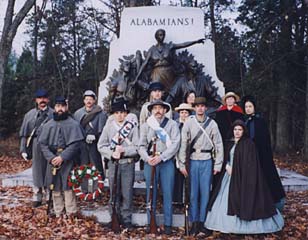
The 5th is a family oriented organization doing a primarily garrison type impression, although some members are campaigners and both styles of camp are accommodated and encouraged.
Both civilian and military reenactors are welcome, and have equal
voting rights on all unit matters. Due to a tendency in the hobby towards
political discord, the 5th Alabama at present has no defined rank structure.
All members take the field as privates, and roles of officers and NCO's
are switched off between qualified members who choose to take on that added
responsibility.
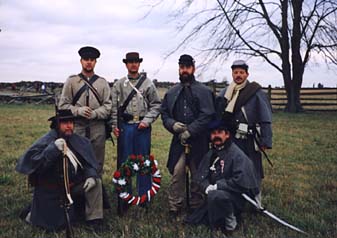
The battalion was assigned as artillerists through the winter of 1861, first during the Manassas campaign, then at "Cock Pit Point" above Evansport on the Potomac, where they spent Winter Quarters 1861/62. They were then marched to Fredericksburg in the spring of '62, and from there to Richmond. The battalion was placed in Archer's Brigade in June of 1862. They fought at Mechanicsville and Gaines' Mill, where the 5th lost their colors to the 2nd Maine, and Major Van De Graaf was wounded. The battalion suffered heavy casualties at these engagements. At 2nd Manassas the battalion was again heavily engaged, and lost yet another commander, Captain Thomas Bush. After the capture of Harpers Ferry the 5th remained on guard duty, as the rest of Archer's (A. P. Hill's Corp) marched to Sharpsburg. The battalion ended 1862 with the battle of Fredricksburg, where Major Van De Graaff was again wounded, albeit not seriously.
The battalion participated in the opening day of Gettysburg, acting as skirmishers for Heth's Division, Hill's corps. On July 3rd the battalion participated in Pickett's Charge, and lost another set of colors and suffered heavy casualties.
After Gettysburg, the battalion was assigned to provost guard for A. P. Hill's Corps for the remainder of the war. At the battle of the Wilderness in May, 1864, the 5th functioned both as provost and as fighting infantry. During the early morning of May 5th the battalion, still under Van De Graaff, was detatched from it's brigade and the men were deployed in line in the rear of Hill's corps. Such deployments, designed to cut down straggling, were a frequent experience for provost units. By late afternoon, Federal troops, in their last attack of the day, were attempting to exploit a gap that had opened between 2nd and 3rd corps. With all other units committed, A.P. Hill was forced to throw in his last reserve, the 5th Alabama Battalion, which had been guarding Federal prisoners. The 5th, down to 125 muskets, surged forward with a wild Rebel yell and, thanks mainly to surprise, sealed off the Federal penetration.
August 1864 strength returns for the ANV show the battalion as unattached and with a strength of 14 officers and 157 men. the returns for the following month show a loss of 6 men. Apparently, the unit spent the winter of '64-'65 west of Petersburg operating a recieving station for conscripts. One of the battalion's final tasks of the war was the recovery of the body of A.P. Hill, who had been killed at Petersburg on April 1st, 1865, while attempting to rejoin his corps after conferring with General Lee. The battalion surrendered 125 officers and men at Appomattox Courthouse.
Jackets: Jean cloth Richmond Depot Type II (belt loops and epaulettes) of nine button construction or jean wool frock coat.
Pants: Jean cloth or sattinette Richmond depot trousers, civilian trousers of period manufacture (less common) or captured Federal issue blue kersey trousers. Federal trousers should be kept to a minimum.
Hats: Civilian style slouch, confederate manufacture jean wool kepi or captured Federal issue (forage caps).
Shoes: Period style Brogans of either Confederate or Federal Manufacture, english import shoes, or infantry boots.
Shirts: Period civilian style or Federal issue.
Weapons: Enfield 1853, Springfield 1816, 1842 Smoothbore or rifle, Springfield 1855, 1861, 1863 rifles, CS Richmond Rifle. All weapons should be 3 band and have bayonet. No pistols, bowie knives, carbines, etc.
Accouterments: Cartridge box, Cap box, waist belt, canteen, haversack, bayonet scabbard. Items may be of Confederate or Federal manufacture. Gear should be compatible with chosen weapon and impression.
Eyewear: Must be of period style. No modern glasses.
Camping gear: Minimum of 1 period style wool blanket or coverlet and 1 gum blanket for campaign impression. Shelter half, additional blanket etc are also good ideas. If doing a garrison impression, dog tents or if needed, A tents are acceptable. As it is becoming policy of Johnson's 1st battalion to take the field in Heavy marching order, a bedroll or knapsack of period pattern is also highly recommended.