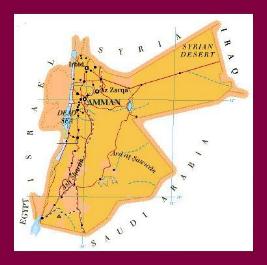
| itself with President Gamal Abd
al-Nasser of Egypt in an anti-Western alliance, and at
the same time announced their support for factions in
Jordan which were calling for the overthrow of the
government of King Hussein. The situation began to worsen
rapidly, and on 16 July King Hussein asked Britain for
military assistance. .....The advance elements of 16th
Independent Parachute Brigade Group, led by Brigadier
Pearson and consisting of headquarters and signals
personnel, arrived in Jordan on the following day, July
17. Such was the speed of their move that they arrived
before the Jordanian authorities had been appraised of
it. Over the next two days the brigade, less 1 PARA,
which remained in Cyprus, arrived and was complete by 20
July. Accompanying it was No 208 Squadron RAF, a
ground-attack unit equipped with Hawker Hunters. It was
also supported by the United States Air Force, whose
Globemaster aircraft carried out a major airlift of men
and equipment.
.....Based at the airfield at Amman, the brigade was
given three tasks, namely:
..........the security of Amman airfield, this being
the responsibility of 2 PARA;
..........the protection of King Hussein and members
of his government; and
..........the safeguarding of British residents in
Jordan.
The latter two tasks were carried out by a mobile
force formed by 3 PARA and No 1 (Guards) Independent
Parachute Company. On 7 August reinforcements arrived in
the form of 1 CAMERONIANS who arrived at Aqaba aboard HMS
Bulwark, a commando carrier. Subsequently, the brigade
was further strengthened by the arrival of 17th Field
Battery RA, which arrived two weeks later.
.....During the next few weeks the political situation
improved and the threat to King Hussein subsided. This
enabled units to carry out training and the brigade to
provide assistance to Jordanian hospitals and to the
500,000 refugees living in the country. King Hussein
himself paid a formal visit to the brigade, being
welcomed on his arrival by a guard of honour from 3 PARA.
At the end of September it was announced that British
forces would withdraw from Jordan, and the first elements
departed on 20 October. 16th Independent Parachute
Brigade Group departed by air between 25 and 29 October,
returning to Cyprus. Subsequently iy flew back to
England, leaving behind in Cyprus 1 PARA, which followed
it in March 1959.
|