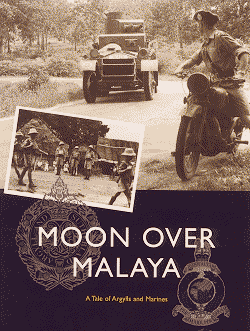
MOON OVER MALAYA
BY
Audrey Holmes McCormick and Jonathan Moffatt
The Stirling Observer September 1999
The Globe and Laurel magazine May-June 2000
Scottish FEPOW Bulletin November 1999
The Burma Star Association Magazine
MOON OVER MALAYA
BY
Audrey Holmes McCormick and Jonathan Moffatt
The Stirling Observer September 1999
The Globe and Laurel magazine May-June 2000
Scottish FEPOW Bulletin November 1999
The Burma Star Association Magazine
| A book telling this story of the Malayan Campaign the 2nd Argyll
and Sutherland Highlanders (The Old 93rd) and the Plymouth Argyll Royal
Marines has just been published in the Bicentenary year of the Battalion.
It has been successfully compiled from the memories of the now elderly
survivors and makes compulsive reading.
The Co-Authors Audrey Holmes McCormick and Jonathan Moffatt have to be congratulated for having so diligently collated information and anecdotes from so many sources and making a coherent and descriptive narrative. Their efforts interviewing Ex-POWs and gathering detail from Regimental Records has to be admired for its accuracy. In this narration the comradeship and togetherness shown by both Offices and Other Ranks is clearly depicted. The old saying "Once and Argyll always and Argyll" is aptly illustrated here in these remembrances. There is sadness and humor in this book and I recommend it to anyone interested in the regimental history Captain K. I. Mcleod |
| Last week saw the publication of the very unusual book on the history
of the 2nd Battalion of the Argyll and Sutherland Highlanders in Malay
during the second World War .
Why unusual? Well most such books are either written for the academic and can be totally unreadable or so low-key that they are almost useless. The volume bridges the gap completely. It to so full of well research information that it will instantly become a standard history of this campaign. At the same time the authors have talked with survivors throughout the world and brought to life the horrific experiences of the Argylls and of the Royal Marines - the Plymouth Argylls - who fought alongside our local Battalion against overwhelming numbers of better equipped Japanese. It covers the disastrous battle on the Slim River where nearly 400 Argylls out of a compliment of 576 were either killed or captured. The remnants of the Battalion fought a fierce rearguard action down the Malayan peninsula and were the last to cross the causeway onto the doomed Singapore island . it describes the massacre of 323 occupants of Alexandra hospital. It describes the various escapes and of the horror of life as a prisoner of war of the Japanese. It is not, however, all doom and gloom. There are various incidents of the irrepressible humor of the Jocks. To myself personally some of the most poignant passages are the descriptions of life after Malay as those men try to rebuild their lives, with, in many cases, little or no help from the British government. "Moon over Malaya" is named after a song composed by the Argylls. Jonathan Moffatt and Audrey McCormick's story is of the up most bravery and sheer determination of the 2nd Battalion "The Thin Red Line" of our local regiment. It comes at an appropriate time as 1999 sees the 200th anniversary of the founding of the 93rd which became the 2nd Battalion of the Argyll and Sutherland Highlanders. As many of these soldiers fade away it is also appropriate to knowledge once again how much we owe them. They certainly lived up to them motto of " Sans Peur"- with out fear. In all, one of the best military histories published in recent years and certainly one which is taking pride of place on my own bookshelves. Bob McCutcheon |
| "There can be few members of the Corps who have not heard the story
of the Plymouth Argylls. Much has been written of this epic story in the
past, but this must be the definitive version, named after a popular
song of the time, and it is likely to be the last to which any survivors
will be able to contribute. This is an era in which WW2 veterans
are setting their affairs in order, and writing down their experiences,
for which we must be grateful: it is the first time for some of those
in this saga that they have felt able to talk about the events of nearly
60 years ago. Highly detailed, with maps, photographs and based on
personal accounts, the book fills the reader with admiration for
the sheer will to live displayed, the concern for fellow men, and
the extent to which regimental morale and esprit de corps kept men going.
Amoebic dysentery, bacillary dysentery, hook worm, beriberi, ptomaine poisoning, ulcerated legs caused by leeches, malaria, dengue fever, jaundice, TB and throat polyps - this is just one man's personal list of problems. We are reminded of the suffering borne by the survivors for the rest of their lives, and the support they give each other, in the face of, for a long time, official indifference and lack of sympathy and understanding. In the words of one survivor: 'There isn't a day goes by but I think about that railway.' Perhaps the last word should go to an Argyll, Duncan Ferguson: 'As for what we fought for, well it wasn't for King and Country. And it wasn't for the CO. It was for the Regiment. Eric Moss once told the CO that. The CO said he believed that too.' Major Mark Bentinck RM |
|
This is war as it is rarely told, stripped of the flags, the trumpets, the glory headlines. The book is an anecdotal history of 2 A&SH later joined by remnants of the Royal Marines to form the Plymouth Argylls. It is the story of a Scots battalion which stood when others stumbled, which time and again was thrown against overwhelming odds to hold the line while other units regrouped to the rear. These men brought discipline and direction when all around was shame and muddle, until, reduced to a remanent they were finally shattered against a wall of enemy tanks. One is left astonished that even so highly disciplined a force could have endured so much. Altogether 220 Argylls and 17 officers were killed and 162 men and 12 officers were wounded. Most of the dead have no known graves. Many more died in prison camps. The Argylls were subsequently awarded six battle honours for their actions during the 70-day campaign. Many of the 30 surviving Argylls who tell their story to the authors are members and still active in our Association. |
|
This book, which is based on diligent research and many interviews of survivors, explains clearly who the 2nd Battalion were and their social backgrounds. It shows how a disparate group of men from Western Scotland and, indeed from Northern England, were welded into an effective fighting unit with an intense loyalty to the family that was the Regiment. Their commanding officer in Malaya, Lt. Colonel Ian McAllister Stewart MC [later Brigadier I.M. Stewart DSO OBE MC], from an old Scottish Highland military family, put the Battalion through an intensive course of training in physical fitness, weapon training and, especially fighting and survival in jungle areas. This training played a large part in the survival of those who fell into Japanese clutches when Singapore surrendered. The story includes the battles in North Malaya, the Slim River disaster and the retreat to Singapore. The final battle for Singapore, with the Royal Marines, the surrender and attempts to escape are all covered. The years of captivity are described, as in most of the book, by survivors personally in every day matter of fact terms without heroics. Most emerged with great credit in spite of their horrific experiences, ill health including rudimentary surgery. The book concludes with the stories of the survivors during the aftermath of repatriation and the post-war years. It is a tremendous tribute to the pre-war Regular Army and Marines and especially the effectiveness of the Regimental system. Sadly, post-war economics, social changes and endless cuts in the strength of the Services [especially to the Territorial Army] have done much to undermine the true value of the much admired Regimental family system." Lt. Colonel Cormack MBE MC BA |
|
This is a meticulously researched and scholarly work which is beautifully balanced by the human warmth that comes from the interviews and stories within. It details the exploits in Malaya of the 2nd Argyll and Sutherland Highlanders and the Royal Marines who chose to fight alongside them. Most of the latter were survivors of the sinking of HMS Prince of Wales and HMS Repulse. With typical humour they dubbed themselves the "Plymouth Argyles", a crib of the name of the nearest football team to the Marines' south coast base. Apart from an extensive index there is a Roll of Honour, and I would add a special hurrah for the list of military abbreviation which is, annoyingly, sometimes omitted from such books. Photographs of the period cover the men before and during their campaign, after the war and at reunions. The reason I find this book such a valuable addition to my bookshelf is that it doesn't talk down to the reader. Yes, the facts are all there but it is in the soldiers' own accounts that we are informed. We are given great insight into what it was like fighting in Malaya, good and bad events, being taken prisoner, POW experiences and, thankfully, survivors' stories. I am torn between recommending this book because it reflects the
men's devotion to duty and stoic humour, or the authors' skill in providing
a scholarly framework within which to publish their subjects' part in history.
|
Copyright © 1999 Coombe Publishing. All Rights Reserved