INFO PAGE

The following article and photos were provided by Gordon Seal, a fellow BCN member. Gordon collects German Bayonets, with a strong preference for dress models. ......NOTE......CLICK ON FEATURED PHOTOS FOR ADDITIONAL CLOSEUPS!!!!!

KURZES SEITENGEWEHR 98

The kS98 was developed on the 30th of April, 1901 as the official bayonet of the newly organized independent machine gun units. Its official designation was Seitengewehr fur Maschinengewehr-Schutzen (M.G.). The name was simplified in 1905 to Kurzes (short) Seitengewehr 98 or kS98.

The bayonet has a single edged sawback blade 254mm long with fullers. The crossguard has a swept back quillion and the upper pommel is shaped like an eagle's beak. The grips were originally made of compressed leather with a checkered pattern and were secured by three rivets. During the early part of WW1, a few were made with smooth wood grips secured by a pair of screw bolts. Scabbards were made of steel.

In 1908, the kS98 was issued to the Luftschiffertruppen (air ship troops) and used the unit mark "L" for Luftschiffer-Bataillon. In 1913, it was issued to the Fliegertruppen (airmen) and used the unit mark "F" for Flieger-Bataillon. In 1915, airship and flying officers were ordered to carry the kS98 in place of their swords. Many chose the plated dress versions that they purchased themselves.

In 1914, the following personnel also received the kS98:
- Scheinwerferzuge Mannschaften (searchlight personnel). "P" = Pioniere-Bataillon
- Telegraphentruppen. "T" = Telegraph-Abteilung.
- Fernsprech-Abteilungen (field Telephone units). "F" designation.
- Sanitatsmannschaften (medic & stretcher bearers). "S" = Sanitats-Kompagnie

The bayonet was also used by colonial troops in Africa with the following unit designations:
- "P.T.K." = Polizei-Truppe Kamerun (Cameroons)
- "Sch.D.O.A." = Schutztruppen fur Deutsch-Ostafrika (East Africa)
- "S.K." or "Sch.K." = Schutztruppen fur Kemerun
- "K.S." = Kaiserliche Schutztruppen (colonial protection forces)

Like most German bayonets, unofficial "dress" versions of the kS98 were produced by various firms. These were sold to soldiers to wear when off duty. They were available both with and without sawteeth and a variety of grip materials were used. These included checkered bakelite, plain and checkered wood, checkered horn and natural staghorn. They were secured by three rivets, two rivets and occasionally two screwbolts. Pommels and crossguards were often plated and occasionally blued or blackened. Blades varied in length from 200mm to 260mm, and are found with both wide and narrow fullers. Some blades were plated and others have a polished finish. Some of these can be found with elaborately engraved blades, and even engraved hilts. Sometimes they are found with Royal Cyphers, eagles and other insignia attached to the right grip plate.

In the summer of 1915, regimental officers were ordered to wear the S98/05 bayonet instead of their swords. Photographic evidence from this period suggests that this order was widely ignored. Officers preferred the more elegant kS98 bayonet and there are many photos showing it worn with a sword knot attached. Even King Ludwig of Bavaria wore a short blade kS98.

The kS98's influence on dress sidearms lasted throughout the Weimar period and into Hitler's Third Reich. kS98 style dress bayonets dating from WW2 are among the most common edged weapons available to the collector.

Bayonet1

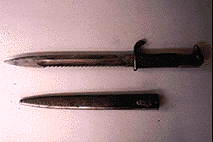
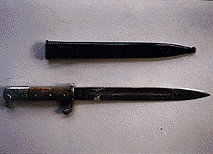
Bayonet #1 (Ron Reide Collection), is an official kS98 combat bayonet made at the Prussian arsenal at Erfurt in 1906 with their mark of a large crown over "ERFURT". The 250mm steel sawback blade is marked on the back edge with a crown over "W" over "06" and a smaller crown over script "B". The "W" is the cypher of Kaiser Wilhelm II of Prussia and the "B" is an inspection stamp. The 132mm steel hilt has inspection stamps above the press stud, on the release button, the back edge of the tang, and on the underside of the crossguard. The grips are black checkered compressed leather with cleaning slots and are held in place by three steel rivets. The reverse crossguard and upper reverse scabbard are marked, "K.S. 8652". This is the mark of the Kaiserliche Schutztruppen, who were protection forces stationed in German African colonies.
Bayonet2

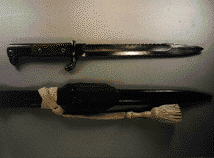
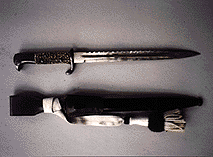
Bayonet #2 (Ron Reide Collection), is an official kS combat bayonet made by the firm of C.G. Haenel of Suhl in 1914 with their trademark stamped on the reverse blade ricasso. The 250mm steel sawback blade is marked on the back edge with a crowned script "L" over "14" and a smaller crown over script "R". The crowned "L" is the cypher of King Ludwig of Bavaria and the smaller crowned "R" is an inspection stamp. The 132mm hilt has inspection stamps above the press stud and features smooth walnut grips with screwbolts and cleaning slots. Wood grips were used on wartime produced bayonets. The black leather frog, with straight sides and pointed front is an early Bavarian type, and the knot is for the 1st Co.


Bayonet3

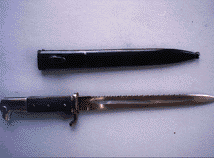
Bayonet #3 (Gordon Seal Collection), is a kS98 long blade (257mm blade, 132mm hilt) dress bayonet with sawback made by the firm of Carl Eickhorn. It is an early piece with their back-to-back squirrels over "C.E." logo on the blade ricasso. The black bakelite grips are fixed by three rivets. These were made before and during WW1 and were often worn by officers during the war when they were ordered to send their swords home.


Bayonet4

Bayonet #4 (Gordon Seal Collection), is an elaborate presentation style kS98 dress bayonet made by the firm of Weyersberg, Kirschbaum & Cie. during WW1 with their king and knight's head logo. The 260mm blade is beautifully engraved on both sides and the top edge. The obverse reads, "Kampf nur ist, Freude!" (Only Battle is Joy!), and "Ich grusse dich Schwert" (I salute you, Sword). The reverse reads, "Fr. i. gel. G. i. dritten Kriegsjahr 1916". The best guess on this is that the "Fr. stands for "frontdienst" and "gel" for geleit. "G" was the abbreviation for Garde units. Therefore, it reads, "Service at the front in the escort Guard in the 3rd war year 1916". The massive 128mm hilt is elaborately engraved with oak leaves and features smooth walnut grips held in place by three rivets.


Bayonet5

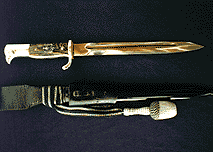
Bayonet #5 (Gordon Seal Collection), is a kS98 dress bayonet made by the firm of Alex Coppel with their scales logo on the reverse ricasso. The long, somewhat slender blade (267mm blade, 126mm hilt) has a natural polished finish and a sawback. The hilt is blued and features staghorn grips with large screwbolts. The knot is for the 9th Co. (attached to the 1st Battalion) of the Hauptkadettenstalt (major cadet preparatory institution) in Berlin-Lichterfeld. The inner tassels are a mix of red and black.


Bayonet6

Bayonet #6 (Gordon Seal Collection), is another Eickhorn manufactured dress bayonet from the Third Reich era. The 252mm plated blade has Eickhorn's squirrel and sword logo, that was used 1935-1941. The hilt measures 122mm and the staghorn grips are secured with two recessed rivets. Pinned to the right grip is a Nazi Wehrmacht eagle. The frog is a patent leather dress style and the green and silver knot identifies the owner as an Army NCO.


Please address any comments or inquiries regarding this article to Gordon Seal or Ron Reide. My thanks to both for allowing me to share this article.
Hosted by www.Geocities.ws

1