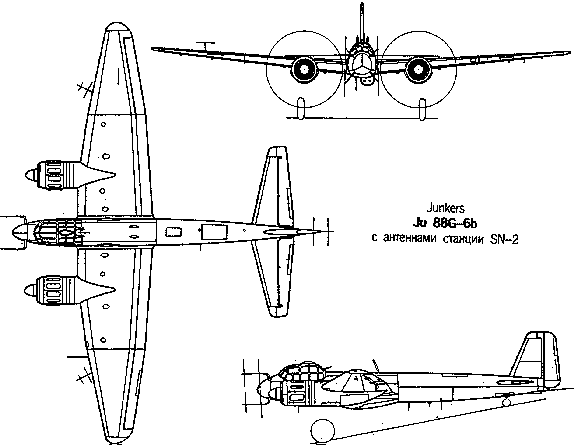
Origin: Junkers Flugzeug und Motorenwerke AG,
dispersed among 14 plants with subcontract or assembly by ATG, Opel,
Volkswagen and various French groups
Type: heavy fighter and nightfighter
Engine: (C-6) two 1,340hp Junkers Jumo 211J
12-cylinder inverted-vee liquid-cooled, (G-7) two 1,880hp Junkers
Jumo 213E 12-cylinder inverted-vee liquid-cooled
Armament: (C-6b) three 20mm MG FF and three MG 17
in nose and two 20mm MG 151/20 firing obliquely upward in
Schr�ge Musik installation, (G-7b) four MG 151/20 (200 rounds each)
firing forward from ventral fairing, two MG 151/20 in
Schr�ge Musik installation (200 rounds each) and defensive MG
131 (500 rounds) swivelling in rear roof, bomb loads (C-6b and G-7b)
nil
Speed: maximum speed (C-6b) 480km/h, (G-7b) (no
drop tank or flame-dampers) 643km/h
Climb: initial climb (C-6b) about 300m/minute, (G-7b)
500m/minute
Ceiling: service ceiling (C-6b) 9,900m, (G-7b)
8,800m
Range: (C-6b) 2,000km, (G-7b) 2,300km
Weight: empty (C-6b) 8,660kg, (G-7b) 9,100kg;
maximum loaded (C-6b) 12,485kg, (G-7b) 14,690kg
Wingspan: 20.13m
Length: 14.4m, (G-7) 16.5m
Height: 4.85m, (C-6) 5m
Crew: two
History: first flight (Ju 88C-0) July 1939, (Ju 88C-6)
mid-1942, (first G-series) early 1944, final deliveries only as
factories were overrun by Allies
Users: Bulgaria (briefly), Finland, Germany
(Luftwaffe), Hungary, Italy, Romania
Back to Junkers Ju 88C/G Page