Junkers Ju 87C
|
Hitler's ambitious Z-plan for the expansion of the Kriegsmarine
included the construction of four fleet carriers. These carriers, in
cooperation with battleships of the Bismarck or H class, would have
been able to challenge the overstretched Royal Navy's supremacy in the
North Atlantic sea routes. Thus there was a need to design and build
aircraft for the carriers. The famous
Messerschmitt Bf 109 had a carrier-borne version, the
Messerschmitt Me 109T, to provide air cover for the naval task
forces, and the Fieseler Fi 167 was built as a torpedo-attack aircraft.
Naturally there was also a need to develop a carrier-borne bomber
for airstrikes against hostile vessels. The most obvious method was to
convert the existing, reliable
Junkers Ju 87 for the new role. The converted carrier-borne attack aircraft was designated the Junkers Ju 87C. Basically it was a Ju 87B-1 with minor conversions. A device was fitted onto the landing gear for launching by catapult, and an arresting hook was added to the fuselage. The landing gear was stressed to help absorb the shock during landing. The unretractable landing gear was made jettisonable for emergency landing at sea. Armament was probably similar and comparable to that of Ju 87B. The wings could also be folded for better storage in the confined space in a carrier. The Ju 87C, embodying the basic and effective qualities of its land-based cousin, would have been an awesome weapon against any enemy ships without proper air cover. Construction of Germany's first carrier, KMS Graf Zeppelin, however, was halted in 1940, when it was 80 per cent complete. Work resumed on a revised design in 1942 but was finally abandoned in 1943. The project of Ju 87C died with the abandonment of the ill-fated carrier. |
 |
Technical data and/or diagram of Junkers Ju 87C. |
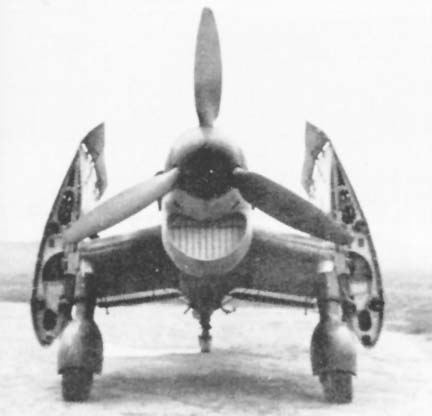 |
A frontal view of the Ju 87C demonstrating the folded wings that would have saved much storage space and allowed more aircarft to be carried. |
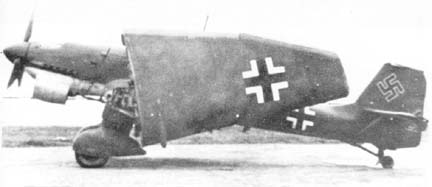 |
A side shot of the Ju 87C, again showing its folded wings. |
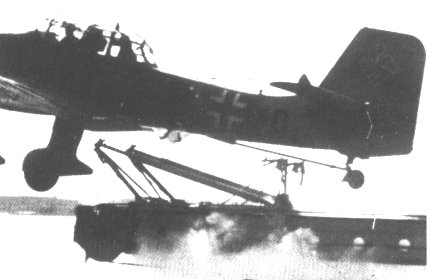 |
A Ju 87C being launched from a catapult. |