| Penobscot's Biographies - continued |
| Hosea B. Wardwell (1830 - 1913 ) |
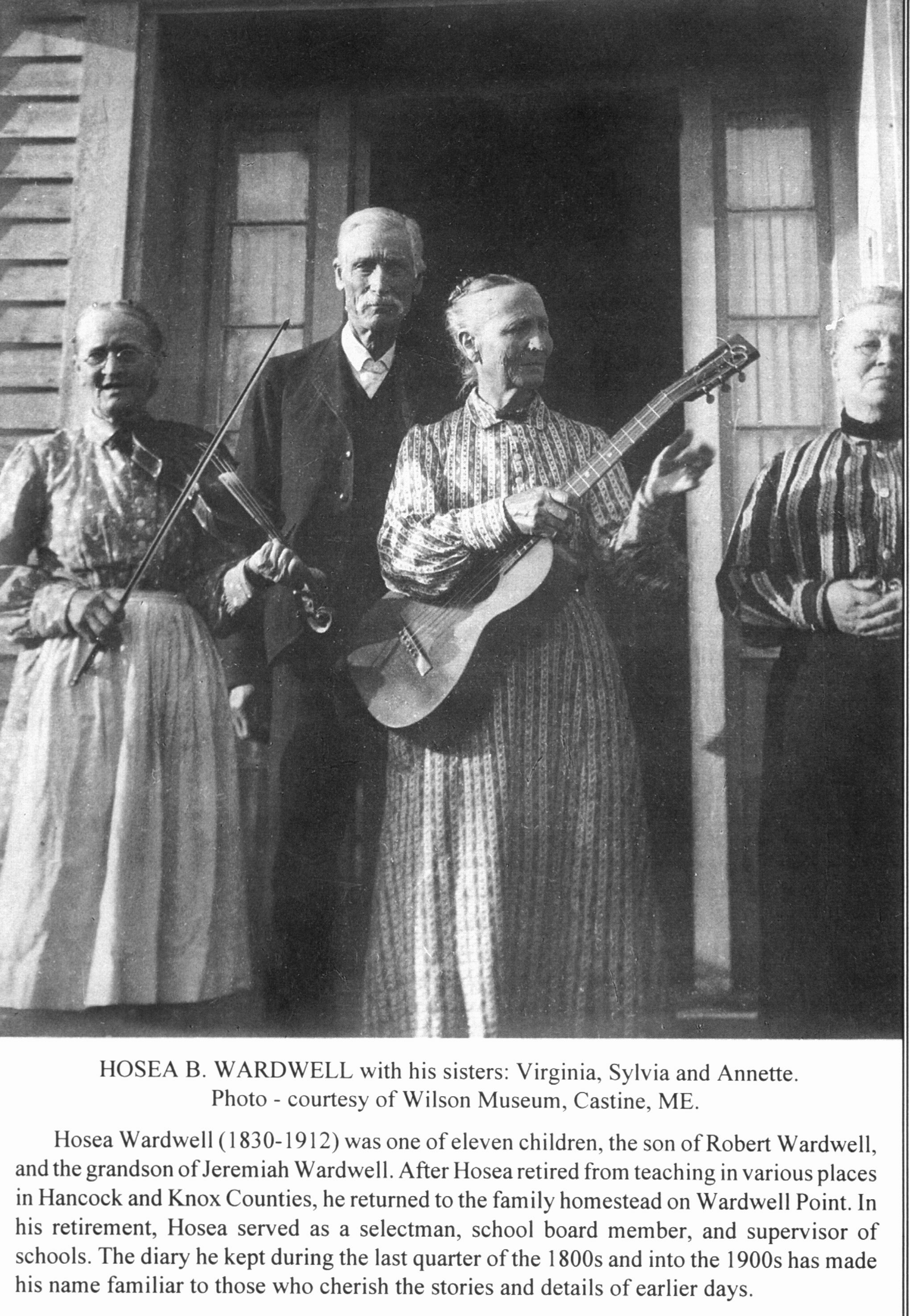
| Although not a doctor, and in no way connected with medicine, Hosea Wardwell , was indeed a professional man, self taught, Hosea contrubuted greatly to the development of Penobscot and well deserves a place in this publication. He was born in Penobscot, in 1830, the son of Robert Wardwell, and the grandson of Jeremiah Wardwell. He was one of eleven children born in this family. A school teacher by profession, and a farmer by occupation, he probably is better remembered as a historian. His most important legacy is what is known familiarly around the town of Penobscot as Hosea's Diary. In it is recorded not only many Public and private details concerning the history of the town but also many ledgens and catastrophic events of earlier days. He rcorded, in 1895, the number of coasters and other ships ( 109 ) that came up the Bagaduce River, past his house on Wardwell's Point to dock along the bay. He recorded the first rural free mail delivery (1903), the first telephone in town(1893), and his first ride in an automobile(1909). It is from this diary that George Wheeler extracted much information for his book, The History of Castine, Penobscot and Brooksville in 1875. It is also from the same diary that this publication is largely written. Hosea was one of three Penobscot citizens included in one of the maine bolumes of the "Biographical Review", published in Boston in 1891. The information contained in this review indicates that he taught in ten towns of Hancock and Knox Counties, and it also alludes to his experience as an educator on North Haven in the fall of 1874. After his retirement from teaching, he tended the homestead farm, raised sheep and served the town as a selectman, member of the school board and supervisor of schools. It was he who influenced town officials to establish a free high school, prior to the advent of Clark High School. In 1887, when Penobscot celebrated its centennial, it was Hosea Wardwell who was called upon to give the address on the history of the town. The address was, according to the Ellsworth American, both interesting and entertaining. The text was subsequently published by the Bucksport Clipper and the Bangor Historical Magazine. Hosea never married. He lived with his sisters on Wardwell's Point in the house he and his father, Robert, built. It still stands today. In the Ellsworth American of December 10, 1913, one finds the final record on the life of Hosea B. Wardwell. Hosea and his surviving spinster sister became ill and died within hours of each other, a fitting climax to a pleasent and lifelong companionship. He is buried on Wardwell's Point in the family plot, just a short distance from his home overlooking the Bagaduce River. Although Hosea's Diary has never been published, copies abound among old families of Penobscot and Castine. it is not known who possesses the original. There is however, no report in his diary of the Centennial; strange as it may seem. But one of the first items is a list of Penobscot men who fought in the Revolution. Were he around, he would no doubt be a founding member of the bi-centennial committee. Certainly he would be called upon to give an appropriate thought concerning the present education system. Hosea Wardwell, educator, farmer, patriot , public official, student and historian often concluded a passage in his diary similar to the following; " February 22, 1901, Washington's Birthday. Six below zero at sunrise. Hoisted the American Flag to honor both the nation and myself". Samual B. Condon (1876 - 1965 ) Born in 1876, the son of Benjamin and Abby Condon, S.B. Condon; or better known to his friends as Brainard, lived a long productive life until his death in 1965. As a lifelong resident of Penobscot, he is mostly remembered for his lumbering and other wood activities, although he was also a proprieter of a general store. These activities have been briefly referred to in previous chapters of this publication. But, in additon, he should also be remembered as a pioneer in the art of tree farming, for which he was reconized by the State of Maine in 1952. In this year, he was awarded the first Certificate of Membership in the Maine "Tree Farm" system and was further honored by having his 3000 acre forest dedicated as the states first "Tree Farm". The whine of a sawmill is usually a temporary thing. Normally, it lasts only as long as marketable timber stands within easy hauling distance. When it stop, the mill moves along leaving a pile of sawdust in the center of a ragged clearing that once had been a forest. But, Brainard's Mill was not portable. It was stationary and very old, formally serving as a grisk mill more than a century ago. He soon learned tht unless his methods of cutting timber changed, he could easily destroy the forests productivity for many decades, and therefore have no timber to convert to lumber. Thus, he resolved to cut in a new forest crop every few years. This decision was made years before selective cutting was generally considered to be forestry gospel, andmany more years before the average Maine lumberman saw its value. Due to the regular practice of selective cutting, Brainard's 3000 acres of spruce, balsam fir, white pine and hardwoods consistently yielded an annual average of 350,000 board feet of timber; 100 to 200 cords of pulpwood and 150 cords of fuel wood. Another 100 cords of undesirable hardwood was cut by fellow townsmen who utilized it as fuel. During the fifty years that Brainard operated his woods land, foresters from both state and federal governments visited the area to look and learn, rather than to advise. One was Gifford Pinchot, Chief Forester of the United States, who came 20 years after Brainards system of selective cutting began. He came to buy pulpwood, but remained to admire the standards that it produced. And so, on October 20, 1952, here in Penobscot, S.B Condon was reconized, lauded, and honored by officials of the State Forestry Department. At the ceremony, William Hilton, of Bangor, representing the Maine Forestry Products Industries, said Condon was to be highlycomplimented because of his courage and insite in practicing tree farming for many years. And, that basing his program on a long term proposition, resulting in small but consistant yields, kept the sawmill running constantly, which in turn provided labor for the community. He concluded his remarks by saying that timber lands are crop lands and must be held in trust. S.B. Condon is surely an early Pioneer who demonstrated this principal. |
 |
 |