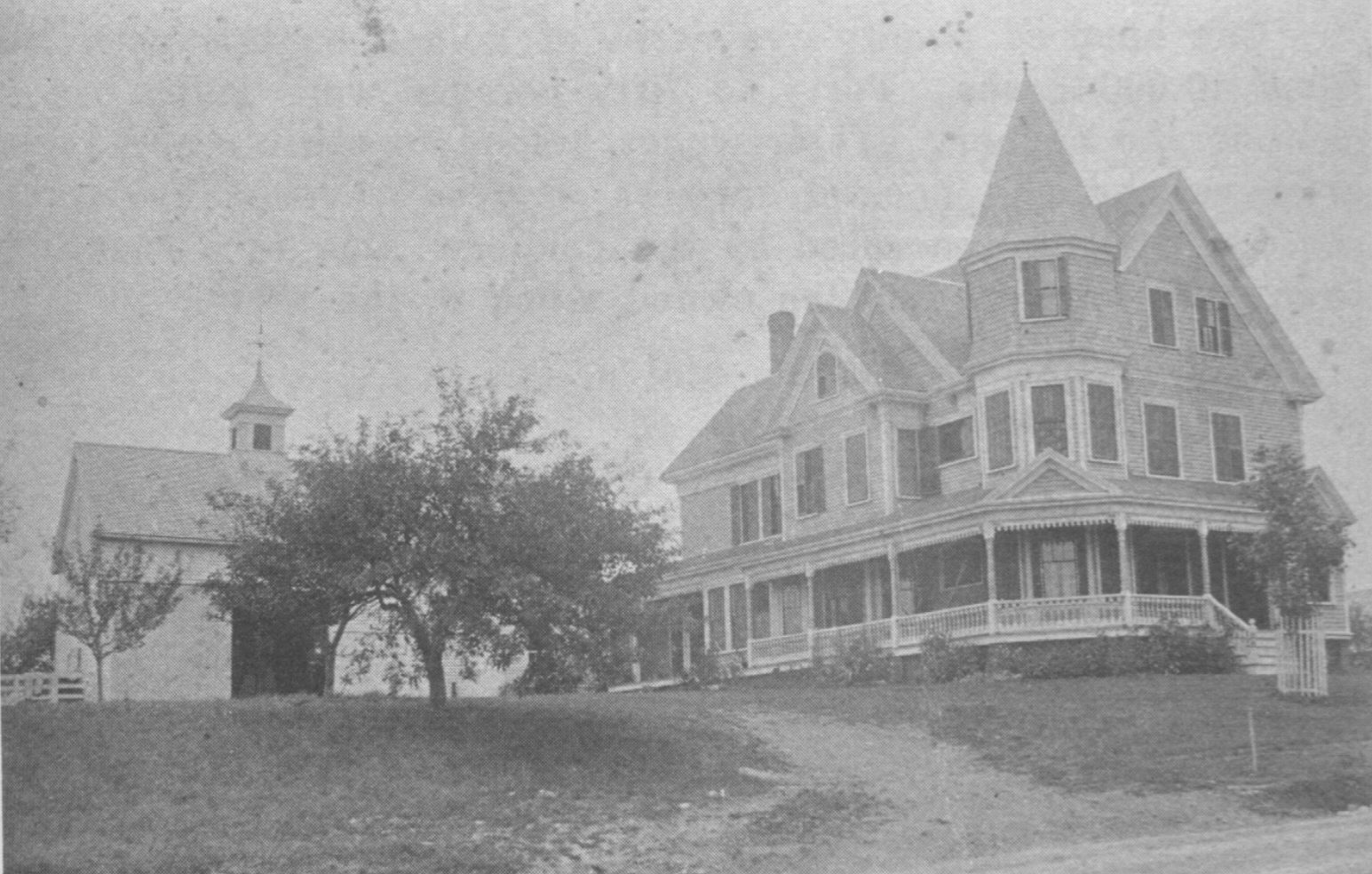
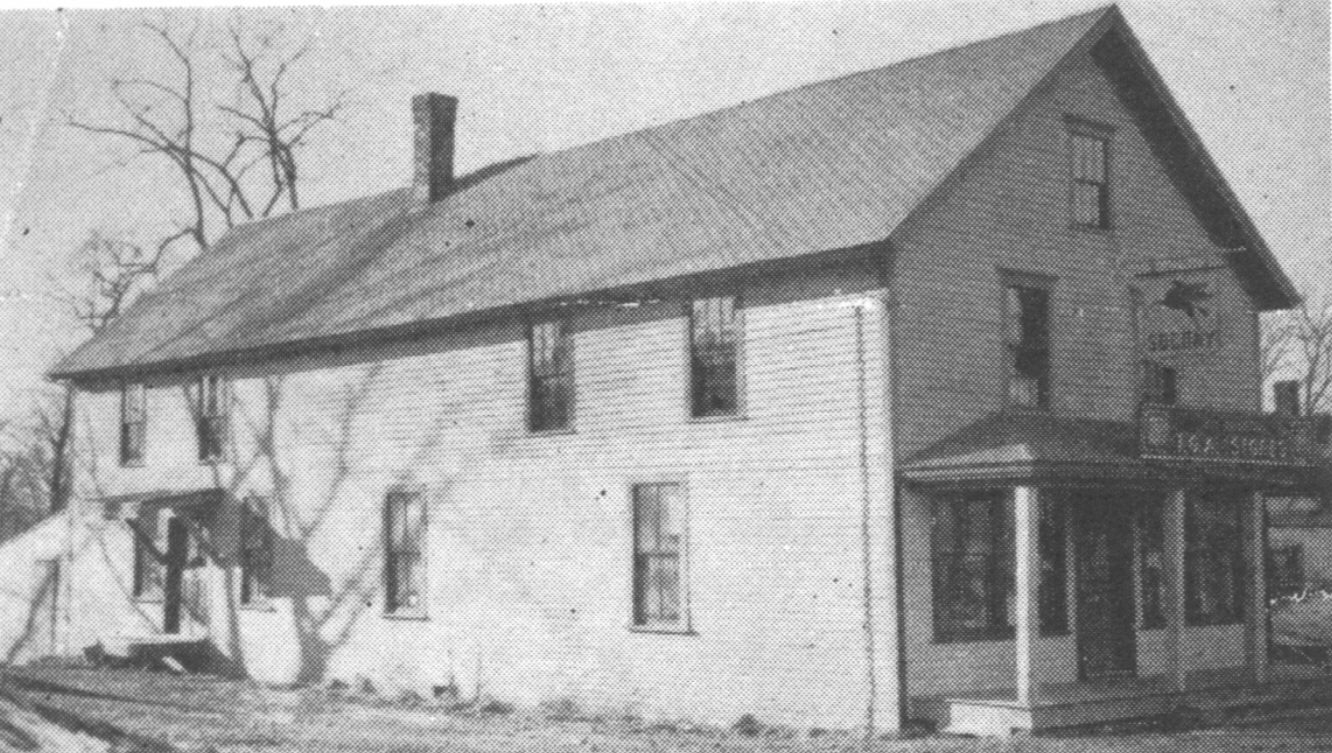
| Business Enterprises In the year 1880, three grisk mills were in operation in Penobscot between Peirce's Pond and Mill Creek. Forrest Grindle is said to be the first to enter this field of endevor. Many thousands of bushels of wheat were ground into flour, and many thousands of bushels of corn were made in meal as an end result of these mills. At the Bay, Ellery Varnum ran a well equipped general store and livery stable in 1880, as did Silas Mitchell who operated another general store. The Varnum store was located in what is now the present Penobscot Town Hall, and the Mitchell store was located near the corner of Routes 199 and 175. At the cove, Horace Perkins sold his store and inventory to Frank Miller, later to be owned and operated by Nora and Charles Hutchins. Thomas Mitchell and Son, Fred, Purchased the Horace Perkins home in 1900, converting it into a small hotel. Many a Travling salesmen can boast of eating a well rounded family dinner for $1. Both store and dwelling are still standing today. The store on the south side of Winslow's Stream is attached to the old Blueberry factory. The dwelling is slightly up the south hill, the first on the right. The Mitchell's also owned a blacksmith shop located on the north side of Winslow's Stream. It no longer exists, and the old blueberry factory overlaps the original site. A very successful knitting factory was located in South Penobscot. Mrs Abby Condon who has been described as a bright, ambitious and perservering woman became a pioneer of mitten knitting. Single handedly she conceived the idea of soliciting hand knitters who did the work in their own homes. The recruitment of knitters increased her business to the point where in one year, 15,000 dozen mittens were exported. Tons of yarn were shipped to her 1500 knitters located in Penobscot, Orland, Blue Hill, Surry, Bucksport, Castine and Brooksville. She paid the steamboat company the largest freight bill of anyone who did business on the Boston and Bangor route at that time. Mrs Condon built one of the finest homes in this section of maine from her profits. The home still stands today and is in excellent condition. The Condon's also owned and operated a general store which is still operated today and in its original building. The current proprietor is James S. Henry Jr., who aquired the ownership from Donald and Carolyn Blodgett, the previous owners for several decades. Corn Cannery With the passing of the coasting schooners, Maine farmers found it increasingly difficult to market their products. Forty or fifty years ago, the Maine farmer could sell his hay, grain, potatoes, apples and firewood right on the dock in his own town. These products were loaded aboard schooners and transported to Bangor, Portland, Boston and even New York. But, with the demise of schooners, coastal farmers were left " out on a limb". Particularly affected were the farmers located within Hancock County. To offset this economic hazard, a group of ambitous and energetic men led by William Wescott and Carroll Dunbar of North Brooksville, Lewis Blodgett of West Brooksville, Maynard Perkins and Elmer Fields of Penobscot , organized a cooperative corn canning plant at South Penobscot. Stock was sold to forty-four farmers and the sum of $12,000 was raised for the purchase of machinery. The machinery was installed in an old general store (formerly owned by Charles and Nora Hutchins) after which a boiler house and power plant was set up in the rear of the store. One hundred, twenty-five acres of golden bantam corn later filled 10,000 cases. Forty to fifty persons were given employment in the cannery. Their wages helped to stimulate the local economy and the coastal farmers enjoyed revenue from their share of profits generated by th cannery. Due to a successful first year, seventy families owned stock in the second year. The corn cannery later became a blueberry factory and was greatly enlarged to extend across Wonslow's Stream. This was the second blueberry factory in Penobscot. The first was located on the shore road in South Penobscot, and operated in the late 1920's and early 1930's. Peat Bog In the middle of the twentieth century, a new peat bog was discovered and developed. Spurred on by World War II which cut off European imports of peat, the new industry was initally operated by Fredrick Pierce and Ralph Wardwell of Castine. Located on Route 199, or the North Penobscot road, as many as sixty persons were employed to gather the peat, cure, dry and store it for exportation. Although very active for nearly two decades, it has been closed for many years, its machinery sold at auctions, and all that remains is a steel shell of a building. The building itself has since been sold and remains at the original location, now used for boat storage and repair. Ice Harvesting Before modern day refrigeration was even heard of, ice was a very neccessary product for the preservation of food and milk products. Once a year, usually in late January or early February at a time when the ice was the thickest, Ice was harvested from Pierce's Pond, Winslow's Stream and other sources where it could be obtained. The ice was cut into "cakes" about two feet square by huge band saws. If the winter was extremely frigid, the thickness of the ice would likewise be about two feet. The cakes of ice were then lifted out of the water with tongs, slid onto sleds drawn by horses and then carried to awaiting ice houses of individually owned homes. As the ice was stored, sawdust was poured around each cake to sufficently insulate it against the forthcomming summer heat. When th household ice box needed to be replenished, the sawdust was removed, the cake of ice lifted out of its position and cleanly washed with water. It was then cut into convenient sizes to accommodate the icebox. Since nearly everyone in town needed ice, the harvesting of this product made possible good seasonal employment. Wreath making and Christmas Trees The unspoiled environment of the Penobscot reigon is a natural home for the balsam fur tree. Because of a bountiful supply, its branches are used in the making of wreaths throughout the yule season. As a result, seasonal employment is made available. Harvesting begins around November 1st . Experience has proven that this is the season when the branches are the most aromatic, lustrous and filled with the greatest amount of moisture. These characteristics assure better quality, more attractive appearance and in actuality, extends the life of the wreath. Only the tips of branches are harvested and in so, prevent damage to the trees. This practice permits the tree to bear additional yields year after year. One such person in Penobscot who specialized in this endeavor was Carl Bridges. (1908 - 1986 ) Following his retirement from St. Regis paper mill in Bucksport, Carl decided to become a tree farmer during winter months, and a strawberry farmer in the summer. After consulting with the Agricultural Stabilization and Conservation service, The Cooperative Extension Service, and the Maine Forestry Department, he made the decision to convert his 100 acre natural stand of trees into cultured balsam fir trees. This not only provided a goodly supply of Balsam fir tips for wreaths, but also well shaped Christmas Trees. Through much effort the trees were thinned, weeded and pruned along with eliminating hard wood competition. Additional seedlings were planted, as many as several thousand constituting a single planting. After much tender loving care, these seedlings reached maturity as Christmas Trees up to seven years later. This method of rasing balsam fir not only resulted in a quality product and customer satisfaction, but helped to spread good will at a time of year when both should exist. |
 |
 |
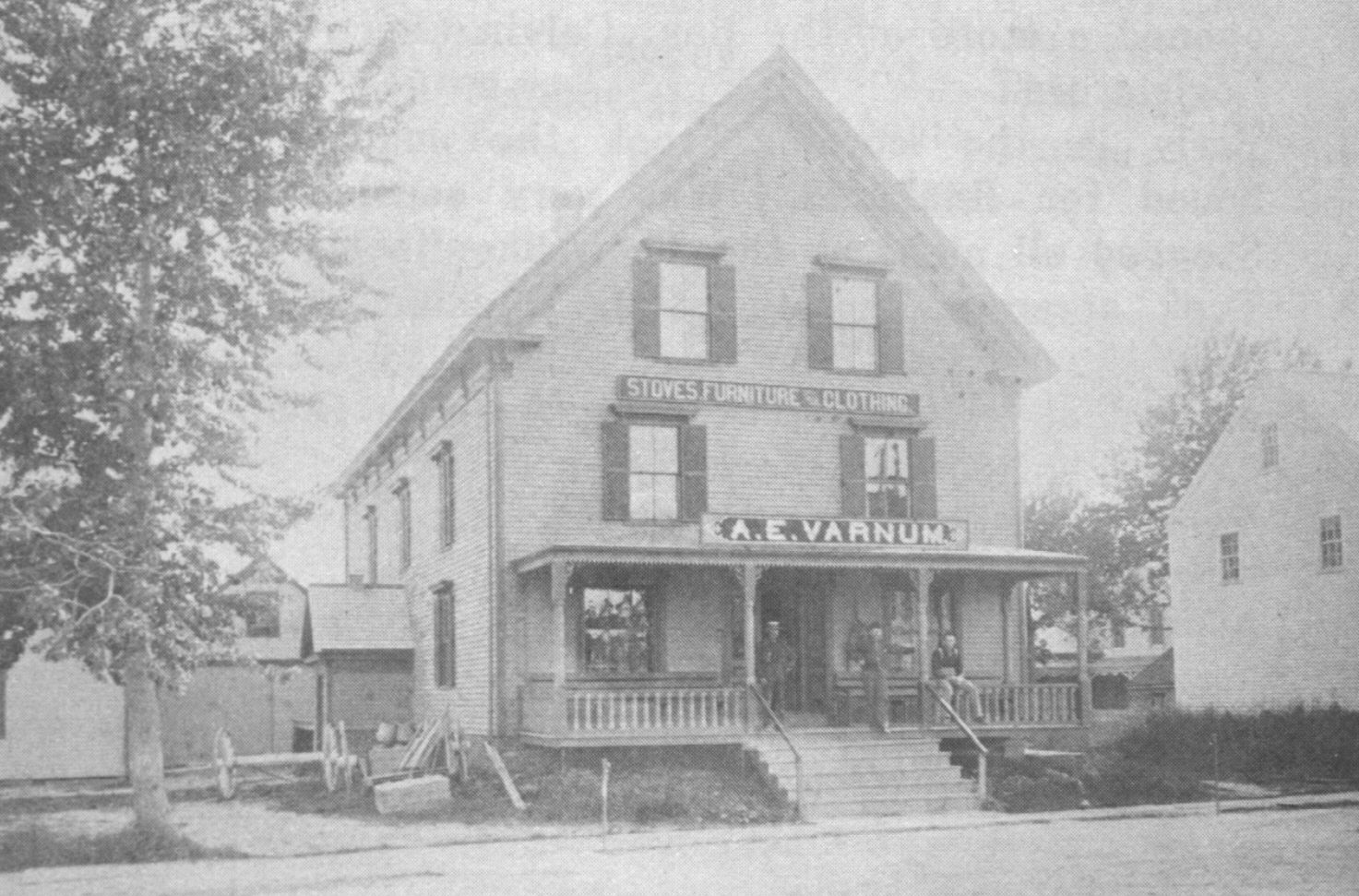 |
| A.E.Varnum |
| Condon's Store (Northern Bay Market) |