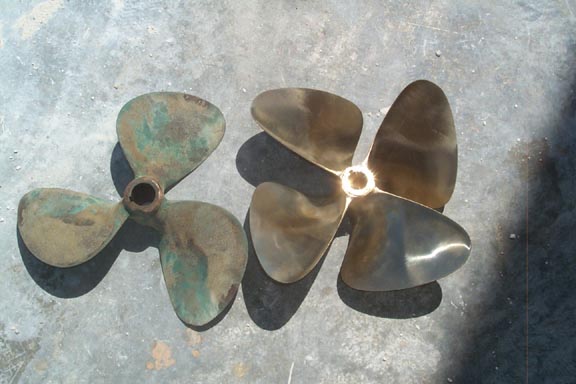
My old propeller, which came with the boat, was identified as a "Federal 13X12." This means the propeller is 13 inches in diameter with a 12 inch pitch. Pitch is the distance a propeller would travel through a solid - if it could. So, a 12" pitch propeller would travel 12" in one revolution.
I switched to a "OJ 12X13." I went down one inch in diameter but up one inch in pitch. Plus this propeller is cupped. Cupping the blade improves performance because the blades are able to hold better when operating in a cavitation condition. However, as you add pitch you increase the load on an engine and adding cupping adds additional load as if the pitch were increased further. This equals to a 150-300 drop in RPM at wide open throttle. NO BIG DEAL, you may say...... but you need to make sure that whatever propeller you install allows you to operate the boat within the recommended wide open throttle range. For example....if your engine has the recommended wide open throttle RPM range of 4,200 - 4,600 RPM then you must be able to reach that RPM. If you can not, then you MUST change propellers to reach the range. If you do not, then your engine will "lug" down. This will severely limit the life of an engine.
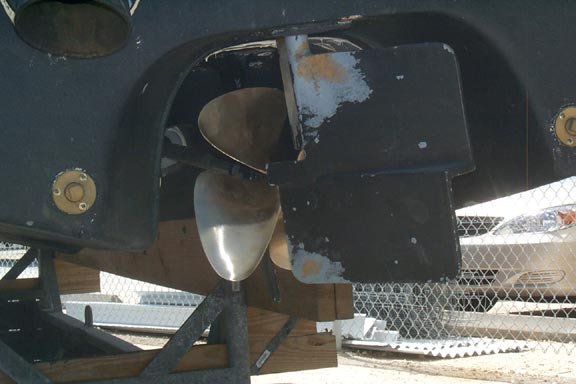
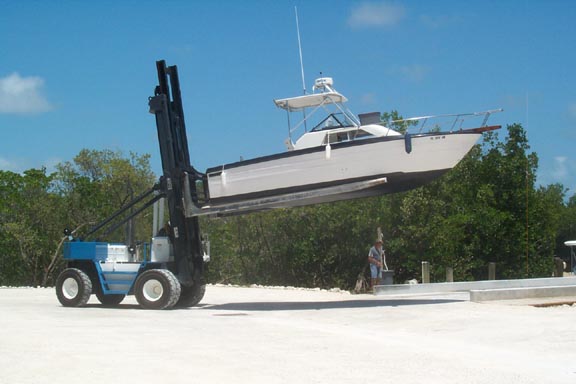
With all of this in mind, I increased the pitch of my prop and added cupping - thus limiting the cavitation effect but lowering my wide open throttle RPM.. Then, I also decreased my prop diameter by one inch to bring the wide open throttle RPM back up. On paper, the math says this should work, but then again, this is my boat and if anything will go wrong - it will. Here are two pictures of the new prop and the boat. More on this later after I get a few test drives completed.