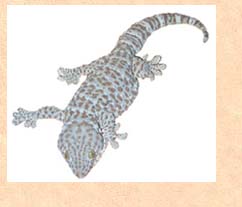
 This was my very first Tokay gecko. He was a lovely green color with a neat striped
tail, which he often left looped over the edge of my Sohmer piano, behind which he lived.
None of my Tokays have had names, being, as they are, something between a roommate and
a nocturnal extermination service that is rarely seen. I've only had one at a time, and
they have each been known simply as, "the gecko."
This was my very first Tokay gecko. He was a lovely green color with a neat striped
tail, which he often left looped over the edge of my Sohmer piano, behind which he lived.
None of my Tokays have had names, being, as they are, something between a roommate and
a nocturnal extermination service that is rarely seen. I've only had one at a time, and
they have each been known simply as, "the gecko."
The Tokay gecko is native to southeast Asia, where they commonly run freely in homes in rural areas because they feed on bothersome insects and small rodents, as well as other lizards. They are largest gecko and can reach lengths of 16", although captive Tokays are generally smaller. The Tokay has large eyes on top of either side of its head and large external ear openings and both senses are highly acute. Which doesn't really explain why my first gecko lived behind my piano. |
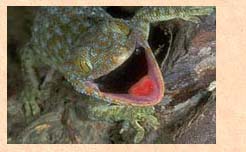 Tokays are known for their nasty temperament, biting the hand that feeds, cleans or
otherwise comes into anything resembling close proximity to them. Equipped with numerous
sharp little shark-like teeth and powerful jaws, they bite and hang on, letting go only if
and when it suits them. When they open their mouths, you can see right down their gullets
which, like this one, are always blood-red.
Tokays are known for their nasty temperament, biting the hand that feeds, cleans or
otherwise comes into anything resembling close proximity to them. Equipped with numerous
sharp little shark-like teeth and powerful jaws, they bite and hang on, letting go only if
and when it suits them. When they open their mouths, you can see right down their gullets
which, like this one, are always blood-red. |
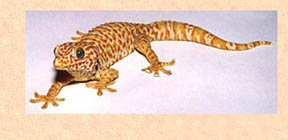 Tokays come in different markings. This is a beautiful albino, named Harold, who was
companion to my friend Mark. Despite the Tokay's reputation for aggression, Mark tamed Harold
so that he could be touched, picked up, and even held. Harold didn't seem to mind being touched
or picked up, but he always looked a little baffled as to why anyone would want to hold
him, and sometimes expressed his bafflement by turning around and gnawing on Mark's knuckles
just short of breaking the skin. (The gnaws were pretty painful, anyway, gauging from Mark's
reactions to them.)
Tokays come in different markings. This is a beautiful albino, named Harold, who was
companion to my friend Mark. Despite the Tokay's reputation for aggression, Mark tamed Harold
so that he could be touched, picked up, and even held. Harold didn't seem to mind being touched
or picked up, but he always looked a little baffled as to why anyone would want to hold
him, and sometimes expressed his bafflement by turning around and gnawing on Mark's knuckles
just short of breaking the skin. (The gnaws were pretty painful, anyway, gauging from Mark's
reactions to them.)
|
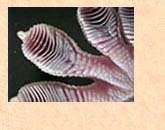 Tokays have little folds of skin, called lamellae, on the pads of their toes
which enable them to walk on vertical and overhead surfaces. These pads are
composed of microscopic layers that form-fit onto microscopic imperfections on a surface.
The grooves are so refined that the Tokay can travel up glass as easily as a tree trunk and
so strong that the Tokay can support its entire body weight on one toe.
Tokays have little folds of skin, called lamellae, on the pads of their toes
which enable them to walk on vertical and overhead surfaces. These pads are
composed of microscopic layers that form-fit onto microscopic imperfections on a surface.
The grooves are so refined that the Tokay can travel up glass as easily as a tree trunk and
so strong that the Tokay can support its entire body weight on one toe.
|
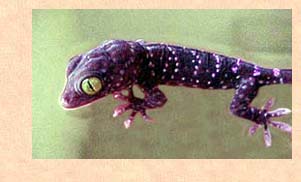 This is our new little gecko. He's a rather remarkable shade of purple with
pinkish-white spots, one of the most unusual sets of markings I have ever seen. As you can see from the
disproportionately-sized head, he is just a baby, about six inches long including tail. Since he has the run of the house and we're stuffing
him chock full of crickets and baby food, we're hoping he'll at least double in size.
This is our new little gecko. He's a rather remarkable shade of purple with
pinkish-white spots, one of the most unusual sets of markings I have ever seen. As you can see from the
disproportionately-sized head, he is just a baby, about six inches long including tail. Since he has the run of the house and we're stuffing
him chock full of crickets and baby food, we're hoping he'll at least double in size.This is the first time I've tried having a Tokay loose with a dog in the house. After her experiences with the neighbor's cat, Annie seems quite happy with leaving other creatures alone and has shown no interest whatsoever in the gecko even when held out for her inspection, which the pet shop employee was happy to do for us before we purchased him. It seems to be working out just fine. (Annie is an older dog, mellow, obedient, and very responsive to commands. I would not generally recommend letting a Tokay lose in your home if you have other pets!) |
| Tokays are named for their distinctive sound, which, to some folks, apparently sounds like "to-KAY," although it sounds more to me like "EH-urrr." They are the only gecko which is identifiable by their vocalizations, which include trills and several different kinds of barks. |
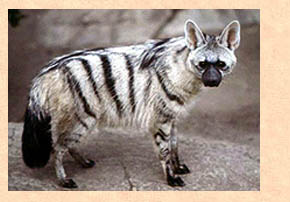 This is an aardwolf. Its name means "earth wolf" in the afrikaans language of its native
South Africa, although is related to the hyena and not the wolf. Aardwolves are carnivores
but their jaws and teeth are too weak to crush anything but insects. Termites are their
favorite food. The aardwolf is often mistaken for a striped hyena, having longer front legs than back
legs like the hyena, although it is considerably smaller. Being shy, quiet,
and nocturnal, aardwolves are rarely seen by humans. When threatened by other animals, the aardwolf raises a
ridge of fur which extends down the neck and back, similar to a cat, and emits a musky-smelling
fluid, like a skunk.
This is an aardwolf. Its name means "earth wolf" in the afrikaans language of its native
South Africa, although is related to the hyena and not the wolf. Aardwolves are carnivores
but their jaws and teeth are too weak to crush anything but insects. Termites are their
favorite food. The aardwolf is often mistaken for a striped hyena, having longer front legs than back
legs like the hyena, although it is considerably smaller. Being shy, quiet,
and nocturnal, aardwolves are rarely seen by humans. When threatened by other animals, the aardwolf raises a
ridge of fur which extends down the neck and back, similar to a cat, and emits a musky-smelling
fluid, like a skunk.
It is not a Tokay gecko, I just think it's interesting. |
 |
 |
