 |
| The following are some excerpts from Curtis Paynes book on "Howell's Texas Battery" While the American Civil War is second only to religion in the number of books written, the number of them relating to Oklahoma are few. This discrepancy led me to select it as my area of research. i quickly discovered why little has been written. Unlike the East, where the soldiers kept diaries, wrote letters and war correspondents wrote newspapter articles, the people in and around the Indian Territory did not or were not able to follow suit. The reasons were simple enough. The sher number of fighting men available in the East meant that if only a small percentage of them were to write, that many of their letters and diaries would survive the ravages of time and could become available as source material. The soldiers who comprised the troops in the Indian Nations were Indians, Blacks and white frontiersmen who were realtively less educated and writing was not as frequent. While it is true that many of the Indians were of mixed blood and did have formal educations, Indian custom dictated that you did not tell your own personal war experiences. Finally when you consider that from a strategic and tactical point of view, the fight in the Nations was of little or no consequence and therefore wasn't really considered important enough when the veterans were yet available to get their stories. This book was written with the intent of presenting to the reader a detailed account of a specific command within the confines of the Indian Nations. I began my research looking at the big picture. My primary source material started with the Official Records of the Union and Confederate Armies. From the battlefield reports I was able to glean the highlights of operations in the Indian Nations. From these reports I began to focus on a little mentioned but significant company of southern field artillery men, Howell's Texas Battery. The election of Abraham Lincoln was the last link in a chain of events leading to Southern secession. On December 20, 1860, South Carolina opened the floodgates when they passed an ordinance of secession by a vote of 169 to 0. Mississppi, Florida, Alabama, Georgia and Lousisiana, all quickly followed suit and by the end of January 1861 had all left the Union. The sentiments of most Southerners were expressed in a song, written during the secession convention in Jackson, Mississippi by Harry McCarthy. While attending the convention he noticed a flag of blue silk with one white star inspiring him to write the Bonnie Blue Flag. His new song was destined to become one of the most popular war songs in the South, second only to Dixie in its popularity. In the fifth verse Mr. McCarthy extends and invitation to Texas "Ye men of valor gather round the banner of the right, Texas and fair louisiana join us in the fight." On the First of February 1861, Texas accepted the challenge and by popular vote seceded from the Union. One consequence of that decision was the forming of an all but forgotten artillery company, its purpose, would be to serve the Indian Nations. CHAPTER TWO NEWTONIA While working at the No. 2 Position on his gun crew, Private William T. Gass, took notice of a shell passing within ten or fifteen feet over his head. (1) The shell passed harmlessly by but sitting at the ready a short distane to the rear of the guns stood the battery caissons prepared to move at a moments notice. Private Bill (William) Franklin, who had been assigned as the wheel driver on the third piece, was sitting on his horse when the three-inch percussion shell seen by Gass struck the horse on which Franklin was sitting. (2) The shell struck the horse in the shoulder, missing Franklin's leg by no more than two inches, entering the horse at an angle and between the rider's legs, exploding inside the animal, tearing out his entrails and coming out at the flank, mangling the other horse so badly in the hip that he had to be shot after the fight was over. The saddle on which Franklin was sitting was split into a dozen pieces and both of his legs from the knees up to his crotch were frightfully bruised, but surprisingly, he was not killed. Despite his wounds Franklin insisted on remaining at his post. Ignoring his close call he began the task of removing the harness from the dead and wounded horses. Once he was sure the battle was won he retired to the field hospital, which had been set up in Newtonia, half a mile in the rear, where the company doctor O. H. Caldwell dressed his wound. (1) The No. 2 man rammed the rounds down the barrel, and swabbed the barrel clean after each firing. (2) The wheel driver horse was the one nearest the caisson on the left or drivers side. CHAPTER FIVE THE CABIN CREEK CAMPAIGN Sometime in the spring of 64, Mrs. Frances Howell, wife of Sylvanus, learned the battery was without a banner. By this time Federal ships had affected a blockade of the Texas seacoast. The effectiveness of the blockade could be testified too by the inablility of Mrs. Howell to procure enough material, not even a "yard of silk or cotton bunting in all of North Texas to make a flag." Feeling it a shame that Bonham had not supplied their men with proper colors, she persuaded Mrs. C. C. Alexander to write her husband who was then in Houston to see if he might be able to obtain the bunting necessary to construct a proper flag for the company. He made the purchase in Eagle Pass, Old Mexico and had the fabric transported from that place by "Mexican Carts and mule wagons via Houston to Bonham. Upon receipt of the cloth Mrs. Howell and Mrs. Alexander Commenced constructing the new company flag."(3) (3) Gass Letter. |
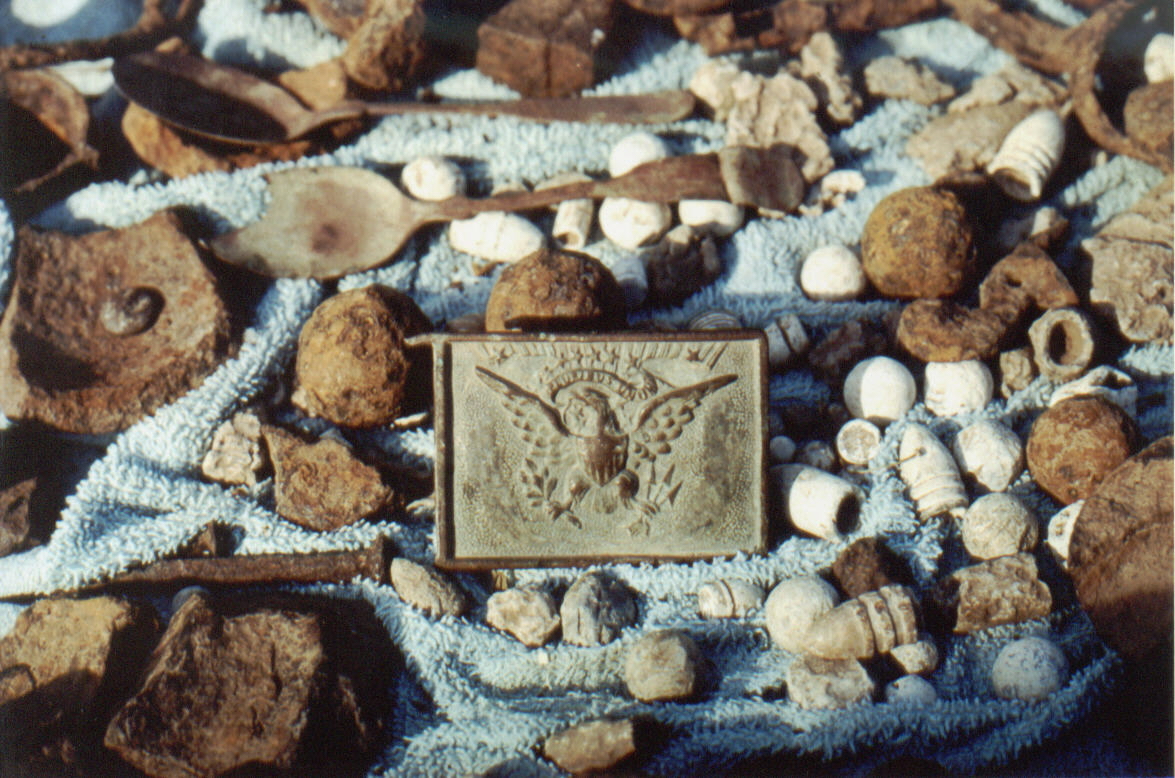 |
| Artifacts dug at Cabin Creek includes Officers Beltbuckle, various bullets and shell fragments. Stennett collection |