
Bridge on the Vecht
05/01/00
The weekend was for additional preparation and provisioning, as well as a visit to a fair in Nieuw Loosdrecht. There we listened to a group sing "California Dreamer," sounding just like an American group. This morning we departed for Weesp on the River Vecht. A small lock (the fee is f.6, 'f' being the abbreviation for guilders, I think from the word 'florens,' a predecessor to the gilder) raises us to the river's level. The down river route takes us past many house boats. These are not boats but floating houses, and have no motor or tiller. There are regular houses along the way, some with gardens in full flower, almost all with curtains wide open showing their comfortable looking interiors. Gardeners assure no flower remains whose wilt has taken over.
The small river admits of small barges and pleasure craft only, and we pass one or two of the former as we wind our way past the two working windmills just outside Weesp. What's most amazing about these are the ability of the top of the structure to turn to face the wind. They rotate on rails attached to the roof of the lower structure. All the windmills are quite large. Some are 20 meters high.
At one bridge we had a little difficulty. Both the red and green lights were on, meaning "Get ready." Only as we got close could we see a line of boats on the other side of the bridge, the first of them just coming through. I made for the large pilings on the side, got us close to one, but the second was too far away for us to use. As Peg slipped the rope over, the bow came to starboard, heading for a small row boat tied alongside the dock. It was too late for me to reverse, which would have put the bow further to starboard. We just touched the little boat, no damage except to our pride, as all the pedestrians and other boaters were watching us struggle. Once we got settle, Peg curtsied to the onlookers. Two lessons emerged. Once, I could have just stayed in the center of the river, avoiding the pilings altogether. Second, Peg could have let more line out until I was able to reach the same piling. With two lines on, we would have had more control. Perhaps a third lesson would be "go even slower."
Bridge on the Vecht
We passed a large barge under tow, filled with lumber, steered with a large tiller by a young man sitting on the trees. Along the way we calculated our speed, 9.3 kph (about 6 mph). The speed limit in most areas of the river is 9 kph, so we are about right. Our calculation is a rough one, as we counted the time it took for the boat to go one length. There are no distance markers on the river, nor on the chart.
Coming to the bridge in Weesp, waited in the middle of the river for it to open, then plowed past the VVV (tourist bureau) slips we were looking for. We made an about face, looked for a space that looked wide enough. This meant we had to get close. Then we noticed that the space width was labeled. We found one and had about one foot in width to spare. We arrived at a little before 1 p.m., so the 20 kilometer journey at 1200 rpm took about four hours! We could have done it faster on the bikes, and several in-line skaters passed us easily on the riverside path.
The town center, some six blocks wide by six long, is just two minutes away. The church spire, which in these small towns always marks the downtown area visibly from miles away, is nearly visible from the boat. The main street is lined with shops, there is a Super de Boer (a supermarket) a few blocks away across a small canal, where beer is about $.30 a bottle with the return.
Next to us is a family of five plus a cat on an 8 meter motor boat. At the end of the dock a large boat houses a couple. It occupies the only spot where it can fit, parallel to the dock. Across the river is a side-keeled sail boat, as well as other vessels. Passing boats wait just off our stern for the bridge to open; we can hear them reversing engines to slow or stop. The keeper operates two bridges and the lock, the last of which only operates during floods to keep unusually high waters out of the town. He uses a bicycle - what else? - to go from bridge to bridge, just a two miinute ride.
In front of the boat is a row of attractive, three story brick houses with
a gable and steep, tiled roofs. Across the bridge are a few houses,
and a restaurant, where they have wheat beer on tap. Never met a
wheat beer I liked and this one was no exception. Fortunately
it was Peggy's so I had some local brew while we watched the river traffic
from the warmth of the
bar, as the outdoor wicker was piled in a corner, waiting for the sun.
05/02/00
(Pro Vasp, long 'a')
The street market fills the main street. Bread shops, vegetable stands (we bought some spinach, very inexpensive), fish mongers, clothes, bike parts, and much more are available under the gray skies. We carried a few things back to the boat. After crossing the bridge we bicycle on the dike in the direction we will head as soon as the wind dies down.
This area is, like Loosdrecht, largely given to ranching. Land close to water, especially on reclaimed land, are prone to flooding and can be quite soggy. The conditions produce lots of grass and hay for cattle, sheep, goats, horses and the like. We also see a pot-bellied Vietnamese pig, I think they are so called, as well as roosters and chickens, and the occasional pig, the regular, bacon producing type.
05/03/00
The last two windy, cold but dry days have kept us moored in the Vecht.
Our next destination, a free mooring on the Randmeren, requires that we
cross a bit of the Ijsselmeer. The wind comes off the north sea and
would hit us broad side. The shallow sea, only about 12
feet deep, can easily produce four to six foot waves at a short frequency,
and we could be
dangerously rolled about.
We have talked to our neighbors, and they tried to make the trip yesterday, but their flat bottomed boat could not handle the waves at all. They advised us to wait for a calmer day. They have a boat of their own, but it is in for repairs or renovations at the moment, so they rented this boat. Boating is their main recreation, though Peg and I wonder how this can be recreation when you have to share a small boat with three children and a cat, especially in less than ideal weather.
The Dutch, however, are generally far less bothered by the weather than we are, both in their boating habits and in other outdoor activities. A couple with a young child in a 9 or 10 meter sail boat two slips from us spends hours sitting in the open cockpit reading the paper and playing. Today the wife was sitting in the cockpit with no shoes on. Since we had seen many people in short sleeves about town and could not ask them, we asked her if she wasn't cold.
This couple is in their 30's, I surmise, and he is hobbled by a sprained ankle. He gets around on crutches and did not harbor much thought of calling off their boating vacation after his little accident.
Two German couples came in. They came by to say hello. We invited them for a beer. They brought some to supplement ours and spent a few hours talking with us.
They take boating holidays often, and they shared some cruising tips with us. We talked a bit about immigration issues. There are many Turks in Germany, who work very hard. This particular group does not mind immigrants or anyone else as long as they work, and not a burden on the social welfare system.
05/05/00
Yesterday we biked to Muiden, a small fishing village with a marvelous castle. It is on the Ijselmeer, which was calm.
At the wind has died down, and the skies blue, we depart at 0830 for free docks about 12 kilometers away on the Randmeren, the collective name for the channel separating Flevoland from Holland to the south. Our brief voyage on the Ijselmeer is without event. A few boats anchor on the lee side of several of the small islands we pass. The weather is clear, with just a cooling breeze keeping us in long sleeves, outside under the clear blue skies, temperatures around 20 (68F). There are birds galore, and a fishing vessel or two. To our port (left) side, we see the shore of Flevoland, which rises but a few meters from the water, then flattening as if starched and ironed.
As we await the opening of the only lock we need to manage, a large barge passes us. He enters first, which is preferable, and we deal with the lock smoothly. His huge prop juts out of the water, and churns the water as we depart, but we are feel no effects. Likewise with the lowering of the water in the lock, that descended so quietly that I was getting impatient for the process to commence when the lock opened.
The anchorage we sought is just past the bridge. It is uninviting, as there are no docks. We head for free docks on the River Eem, just outside the tiny village of Eemdijke. We docked on the second effort. It turned out to be a little easier heading into the wind, as the current turns out to be minimal. The time is 1250. We covered the 15 km in about four hours, though our engine clock says only three have passed; we now know it is 25% off the pace.
The dike is just twenty meters away. Sheep and goats graze upon it. On the other side is a country lane which leads into Eemdijke in one direction, and Baarn in the other. To get to the road, you have to climb two short barb wired fences, which we do after lunch. Cattle and horse ranching occupy the locals who don't commute to larger towns. There is not much yet another example of a darling Dutch settlement. Later we find out that this village is populated by a high percentage of the very wealthy.
Many people, locals and passers through, are on their bicycles, as today is a national holiday celebrating VE (Victory in Europe, WWII). A dozen or more parked their bicycles in front of the only grocery store in town, which is more of a general store. The bicyclers bask in the sun at the outside tables, eating ice cream, another national pastime here as in most of Europe.
After our two minute tour of Cutesville, we head to Spakenburg. It is a larger town, another old fishing village whose harbor is crammed with wooded sail boats. Most of them were built around the turn of the last century. The streets are ablaze with bicycles moving orderly in the bike lanes, whose owners dismount as required in the pedestrian zone. The foot zone is crammed with people, the restaurants' and cafes' outdoor seating filled to capacity. Modern military vehicles are on display in the medium.

Fisherman with wooden boats in background.
Many of the older women wear a traditional costume. It consists of a dark floor length dress and a bonnet; over the shoulders they bend a stiff fabric, leaving a gap above the shoulders. We assumed that they don these outfits just on special occasions, but later discover that this is how they dress all the time. I gathered that these women belong to a Protestant sect common in the rural areas of this region.
At 2200 (10 pm), it is dark at last. Then fireworks light the horizon,
too far for us to hear, but both copious and beautiful.
05/06/00
After a restful night, we head again for the village to get a few things. Before we got far, my tire went flat. I removed the tube, and found a large gash that the previous owner had patched. The tube was not worth saving. Two women were happening by. I waved and they stopped. They did not know if there were any bike shops open, doubted it as many shops were closed due to the holiday, and there being only small towns nearby. One gave me a large patch, the other said it wouldn't last more than 15 km. I got the patch on and it leaked. They continued their journey, today hoping to make 125 km, less than their normal 225. Their legs looked up to the task!
Peg went into town. No bike shop, so she headed for Baarn, four or five kilometers away. By the time she got back, I had re-patched the old tube and it was holding air. She carried a possible replacement. The bike man said he needed to know the tire not the tube size. We returned to the shop, and he was still uncertain, as my tire is a now uncommon 27" and the tube was a 28. I decided it would probably work. I had, in the meantime, discovered that Peg's bike needed a front axle bolt. He offered us a used wheel. It was a bit rusty so he sold it for f. 5.00. I installed it in the park near the center of town while Peg checked our email at the library.
A couple in their 60's watched as I finished the repair, and we invited them for a beer. She is German born, he Dutch. They have a 9 meter sail boat in the nearby marina, and planned to cross the Atlantic with it about four years ago. However, her mother died and then she had her gall bladder removed. Now they feel they are too old to make the crossing, but they continue to sail. The offered to show us the palace of the Queen Mother, whose 90 something birthday was celebrated a week or two ago. The palace is large but otherwise unremarkable. The tree-lined boulevard facing it is much prettier.
We went to their boat for tea. They pulled out the charts and showed us many wonderful places to go in this region and in Friesland.
When we returned to our boat, our sailboat neighbors invited us for a beer. His name is Kees (pro Cas or Kas), her's Ada. He retired a month ago at age 56, after working 30 years for the electric company. He worked on the modern windmills which line the Randmeren. I think these mills pump water and produce electricity. She still works for the orchestra in Harleem, selling tickets and serving coffee.
Ada is drinking an Orange liquor. This sweet beverage comes out once a year at the Queen Mother's birthday. The Orange is the family name, being the same as that of William of Orange, whom the British Parliament invited to be the King of England in the mid 1600's, if memory serves.
We talked for an hour or two, then I decided to go to town. I was back a moment later, the same tire being flat; the repair lasted only about 15 km. I began to install the new tube when Kees came over with his pump. He offered some advice, then decided I was not Dutch enough to do the job well; he was right. He hopped on board and in twenty minutes, the new tube was installed, the tire filled, and Kees a happy man. And I learned a thing or two along the way, like you can get the tube on without using tools. Well, Kees can, anyway.
05/07/00
We arise to the sound of a cuckoo bird. I did not know they still existed. I know it was a cuckoo bird and not a clock as it was not on time, but I did not see it.
Kees (pro 'Cas' or 'Kas) and Ada came over after dinner. They offered lots of advice about places to go and things to do. We must go to Harderwijk (don't pronounce the 'j') which is our planned destination for tomorrow anyway, and stay at the marina next to the Dolfinarium. Kees says we must go see the 'flippers' (the dolphins) and the seals.
I asked Kees what people do to maintain their batteries during the winter if they are not near their boats. "Ah," he says, "this is a problem. You must know someone." Someone, a friend or worker, who will come aboard, charge the batteries, open and close things, start the engine, etc. He suggests that if the boat were near their place, he would do it for us. I am sure he would be very reliable. Peg then suggests that instead of us having to pay someone to care for the boat, or buy new batteries, we should just buy a new boat every year. I object, saying it takes too long to get to know a boat, as after a month full time on the boat, there are still several mysteries.
That apparently cues Peg and she tells Kees that there is a mysterious
valve on our boat, a small wheel in a cylinder about 2 liters in size.
Kees leaps up as if to say, "Yeah, a mystery, and I get to try to solve
it! In a moment he is looking at it, then saying, I must go in
the engine compartment, and where is the torch (flashlight)?
I guide him to the staircase of the
aft cabin, which like the one leading outside where the mystery valve
is, where you can look at this unit. He finds the copper tube
which leads from it, and using my handy mirror, follows it aft, as I did,
then says, "I know what it is. It is for fat!"
Fat?
Turns out he means 'grease.' In Dutch there is just 'fat.' This container is packed with grease, a ton of it, and then you turn this valve. This valve adjusts a plate, which squeezes grease into the tube. This tube apparently leads to the cutlass bearing, which sits at the point where the propeller shaft exits the boat. No grease and the bearing wears out. Kees sticks a screwdriver in an opening and it comes out with grease on it, supporting his theory.
They have two children. One daughter is married, and just sold her larger boat to buy a small boat for waterskiing, which they hitch behind their Jeep Wagoneer.
We talk until after 11 p.m. and expect to see them again in August, for then the Tall Ships, which we last saw in Aberdeen in August, 1997, arrive in Amsterdam. First they pass by Harleem, where Kees and his bride live, ten minutes from their 8.8 meter sailboat, the only boat they have owned for thirty years. Who knows how many days they have sat in that little cockpit, he with no shirt, she with her two piece, taking in the sun, fetching beers from the ice chest, cold until the ice disappears.
[I wrote about meeting our now good friends Kees and Ada for Sailnet.
See Sail Net - Where sailors get it
05/08/00
Depart our mooring, head into the Randmeren. Arrive 1230 after four pleasant hours in the sun and cool breezes, passing easily through the one large lock along the way. At the Haavenmaster's office we are given a spot, and we head down the narrow row, make a sharp left then a sharp right, a few meters later anther sharp right into the slip. The wrong slip. My last turn was not quite tight or perhaps fast enough and the wind caught the stern enough to push us to the next slip. I decided to just go in and decide from there the best course of action to get us to the proper slip. Peg thought there was enough room for us to just back the boat up past the first piling, then pull it to the next slip by going between he pilings. All without the engine. Her idea worked, after we figured out how to get the port side davit past the outer piling.
We go to town, just a minute away, buy some excellent fresh fish and other, provisions, shower (they are free here), and find train station. When we returned we found 15 large boats filled the marina. The occupants were all friends, apparently, as they were eating and drinking on one of the boats.
05/09-10/00
The 9th of May would have been my father's 87th birthday.
Naarden is about and hour and a half away from Harderwijk by train and a subsequent short bus ride. It is a well preserved fortified town, maybe the best in the country. The moat is still intact, and the houses look as they did hundreds of years ago. They all seem to have been restored and well cared for. It was conquered by the Spanish in 1572.
It's tiny, only about 10 minutes on foot from one end of the town to the other. This we know as we left our bikes behind. You can take them on trains. Given the f 20 round trip cost and the smallness of Naarden, we decided to leave them behind. Walking seems quite strange to us, after all the biking we have done, and to involve more effort.
Harderwijk, where we are moored, is a 12th century town. It was a member of the Hanseatic league and was also busy during the years of the Dutch East India Trading Company. It declined with the silting of the Zuiderzee, which is now gone, converted to land.
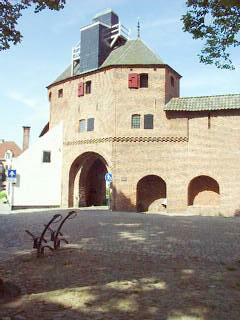
The old gate in Harderwijk
Harderwijk's movie theater, in Dutch called 'bioscope,' has classy, comfortably, cushy seats. On the seat backs there is a shelf for beverages and snacks, served from the bar in the same auditorium. Poshest movie theater I have even been in. Smoking is permitted. F. 18 to watch The Legend of Sleepy Hollow, which took place along the Hudson River, not far from where I grew up.
From our boat we hear sea lions or walrus bellowing in the Dolphinarium as we install the carpet on the aft deck. We bought it in town, and they kindly delivered it to the boat for us.
05/11-14/00
On the 11th we depart for Elberg. The 10-15 knot wind does not make our departure easier. As we back out it catches first the stern, which is ok since I want it to go in the wind's direction, but before we can get any speed up, it pushed the bow around too. After some gymnastics, we finally make it out. Then the steering pump on the outside steering station started to leak.
Elberg is a few miles and a few pleasant cruising hours away. It is a moated town with part of its defensive walls still intact. The main gate dates from 1592. Beyond it are narrow, cobble streets, a period church, and second gate featuring finely sculpted lions. On one end of town a small park overlooks lily pads floating gently in the moat.
On the 12th the steering pump is still leaking, and the reservoir empty. There are lots of repair yards in town, there must be lots of parts, and Vetus, the pumps's maker, is featured in all the chandlers. But no luck. Only one place had a seal close in size, but it was too big. The owner spoke no English but I gathered that there may be a seal to be had in Harderwijk. The owner-clerk did not make a call for me and I did not know how to ask to do so. On the way back to the boat, I t happened upon a repair shop. The owner looked at the pump and said in impeccable English that he could get a seal by Tuesday. He said sometimes the shaft is worn and that's why they leak, and if so, replace the pump as many other parts are probably worn too.
I went to Harderwijk by bus, a 45 minute wait for 25 minute ride, each way. Walked (no bikes on buses) to a chandlery (boat shop) about a mile and a half away, one I already had been to. No luck, same with place he suggested close by.
05/15/00
Seal, an outer one and easy to replace, arrives at 1300, only f 15 and it solves the problem. We decide to enjoy this town until tomorrow morning, and I draw and bike around town.
There is a group of what appear to be gypsies, well to do ones it appears, staying along the channel a minute from the main town entrance. Their 1960 wooden wagon is beautifully made, with a living area complete with cushy furniture. Their newish camper, tent, and cars are close. They put the horses on the nearby grass, enclosing the area with a rope they carry for this purpose.
Unseasonably warm weather continues, 10c above normal. We are moored on the west side so we get shade late in p.m. The tarp we bought in Harderwijk significantly reduces heat build-up inside the boat.
The dock we are tied to is in quiet a beautiful spot. The channel is about 25 meters wide. The road is nearby but traffic is not heavy, and the thick woods eliminate any noise. We have no electricity, and there is no water hook up nearby, but there is one at the harbor's end.
05/16-17/00
Head for Ketelmeer, which houses a museum filled with sunken ships found when they made Flevoland. One lock along the way, no problem, easy ropes to hand onto, 6 inch drop. We found the museum has been permanently closed. The harbor master tried to tell us so but no he did not speak English so we thought he was telling us to move the boat from the dock next to the lock . So we moved the boat to the other side of the small channel and only then found out about the museum. Left for Kampen. More beautiful weather if a bit hot in the sun. The new umbrella can't stay open in strong winds so at times we are exposed. After we enter the River Ijssel, we pass many very large barges and passenger ships.
We stopped in Kampen first on the river a marina. Peg walked in to see if we could stay. We could, but it was small, hard to get into and ugly. f13 or so. Went under the nearby big and modern bridge and just to port is a small "jacht haaven." Head in and it's a quiet pleasant spot, electricity but no water or toilets.
Kampen is another quaint town. Church from 1250-1300, stripped by the Protestants and so it remains. Canals in town. Large plaza with many enjoying a beverage. Row houses.
No harbor master comes, so no cost to us, though posted at f 1.3 per meter. Rain and cooler temps. There is just one boat with us in this tiny harbor across the street from the train and bus station.
To the town of Urk. It was an island fishing village in the Zuiderzee but the polder made it a just a good place for a light tower. This happened in 1942 when the Northeast Polder was drained. Winds of some 40 knots make the eyes drip profusely but we managed to see dozens of steep, tile-roofed two story houses and shops of the usual variety.
05/18-21/00
Zwolle is yet another quaint town, downstream from Kampen just off the Ijssel River. Wind gusts to 20 knots and scattered showers drove us indoors, the first time we have steered from the pilot house. You get there via the aptly named Zwolle-Ijssel Kanaal, an industrial waterway. There is a large lock just after you turn off the river. The Nieuwe Wetering River then comes quickly and is to starboard. After passing under several bridges, we arrived at the town's moorings. Ones with electricity and showers are dead ahead, but we turn sharp to starboard for a quaint (we need more quaint in our lives), quiet (that too), sheltered, shaded spot. We tie up gently against the pilings. Downtown is a stone's throw away.
Zwolle was also in the Hanseatic league. It rests upon two small islands in the river, and thus has natural defenses and easy access for shipping. Out the port windows we see a large, 16 or 17th century brick (what else) clock tower nearby, keeping accurate time and chiming on the hour and half hour.
One lane streets and narrow alleys harbor small shops. On the far side of town is a large, three spire gate. This we admire after the heavy showers of the day passed, which started just after we arrived.
There is drinking water in the harbor and later we move the boat so we
can fill up. A large barge, probably 30 meters long, is tied
up just in front of the spigot, and restricting our access.
I came in close as there was not much room ahead of the barge. Peg
thought we were going to scrape the barge and pushed us off, which put the
bow too far from shore. However, I was able to back us in.
On the morn of the 19th we visited the two large churches in town (if there is a church, Peg will go in). One was returned to the Catholic church by Napoleon. Between then and now it has been refurbished and decorated. They had to start nearly from scratch, as the Protestants stripped the place, something they loved to do but probably would not have admitted any pleasure in the act. Compared to the Protestant church, it is of course quite luxurious, but after all the monumental churches we saw in Rome, it is modest and puny in comparison. It's obvious where all the money was going.
Spent the rest of the day at the KPN, the former Dutch telephone monopoly. We went looking for a telephone line so we could send email. Peg told the salesman our problem in getting an internet capable phone (you have to have a bank account). He made a phone call and said if we paid a deposit of f. 1000 they would set up an account for us and we could then buy an internet capable phone. It took all day to do as we had to take the money to the post office, deposit it there (paying f 17.50 for the privilege), then wait for approvals and for the issuance of the phone number. In the meantime, the salesman and the technician were very helpful in explaining how to use the phone and how to connect it to our modem (our infrared connection isn't working so we had to buy a cable). By the evening, I was able to send email, but not without the usual initial blockades.
On the 20th, a couple in a 20 meter barge arrived. He was on the boat, she in the dinghy which she used as a tug boat to start, stop and steer the boat. She is holding on to two lines attached to the stern, on the port and starboard sides. There is a very short bridge at one end of the harbor. They took the barge right up to it and then stopped the boat, backed it up, moved it sideways with a little help from his long pole. I watched in amazement as they managed this feat of boat handling. Never did figure out why they did it this way. Perhaps the barge's engine is not working.
On the 21st we headed to nearby Zwartesluice. 'Zwarte' means blackwater. It refers to a section of the canal we are on. 'Sluice' means lock. There is indeed a lock in Zwarte, home to 1200 boats and about that many people. The tiny town is but a five minute walk from the harbor and the same time to traverse the town.
The three-speed Tonto, so named because she always wants to go to town, and his companion the Lone Ranger, took us to town (I told you so) and beyond to Genemujden. To get to this small village you have to take a two minute ferry ride. If I recall correctly, this ferry as most of this size are powered by a diesel engine but guided across the channel with a cable. Easy steering!
There are several restaurants in town. We tried the Indo-Chinese
restaurant, which featured both Chinese and Indo-Chinese cuisine.
We ordered a Rijstafel. 'Rijs' is rice and 'tafel' is table.
We weren't altogether sure what was to come. The waitress spoke
English, as did the petite Oriental hostess, but they did not know the
English words for many of the items included with the dinner. Two huge
platters arrived, with pork, chicken, beef, all in hot and/or sweet sauces,
a kind of pancake/noodle that reminded of a wanton, only it was not eep
fried, and a few vegetables. We opted for noodles instead of
rice. The meats were
tenderly done, except one, that appeared to have been dry roasted;
it was my favorite, spicy and almost crunchy. f50 plus beverages.
05/22-23/00
There are six or seven houses 1 km from where we tied up along the banks of the Ambergracht, the small canal (there is a large, commercial one) leading from Zwartesluice. Cows, water birds, cuckoos, fish, and reeds are our immediate neighbors.
Across the bridge and to the right takes you to Giethorn. I bet Disney
got more than a few ideas from this place. Hobbit houses with
thatched roofs. The reeds harvested along the Ambergracht are
dried in nearby barns. Most house here have thatched roofs, their
curvy surfaces trimmed softly around windows and a roof joins.
Small canals everywhere, wide
enough for two canoes, which they rent with and without electric motors.
Wooden bridges arch over them in convenient places. Small windmills,
probably to pump water out of the yards. Flowers, hedges, thick,
weedless lawns. Tall trees filling in with leaves, shimmering
in the late afternoon sun. Every yard out of Home and Garden.
And certainly every resident just sweetness and light, like Esther in
Dicken's Bleak House.
I'd guess than no more than a few thousand people live here, swarmed by tourists during the season. Such a gorgeous place we moved the boat here on the 23rd just so we could take another ride through town without having to fight the wind to get here on the bikes.
Later we crossed the lake, entering the Watergracht, another canal. There are two moorings near the entrance. Both are empty except for us and one other boat, and isolated, for there is nothing but forest, reed, marsh and water between these sites and the nearest settlement. And certainly every resident just sweetness and light.
05/24/00
The harbor is in town center, sturdy 17th and 18th century looking brick houses facing it. One sluice protects the town. A bricked entrance about 7 meters high permits the passage of one boat of our size. A wooden side keel sailboat under power glides by as I look upon the paying day passengers below.
There are many such day passenger ships in Holland, and larger motorized ones as well. These, serve beverages and in some cases meals. One we saw was powered by two 750 horse power Volvo stern drive engines. It was odd to see such a large boat with the stern drives protruding from the rear.
The town's church was built by and for Protestants, so it was boring from
the get go. The first brick was laid in 1609. The
building was at first a simple rectangle. By 1662, it had
been enlarged and changed into a Greek cross. A model ship from
1677 hangs from the ceiling, a gift from the Skipper's Gild.
There is a memorial stone to one Taco Kuipen who in 1810 founded a medical
insurance fund. For 2.5 cents a week you could receive a benefit
of up to 40 cents a week. They should have hung a bell in his
memory. We could have called it the Taco Bell.
The church was renovated in 1999 at a cost of f. 3 million.
05/26-29/00
The Turf Route takes us through a section of Friesland where peat (turf in Dutch) was harvested and used for fuel. You pay a single fee of f. 25 ($10) for the entire route which pays for the opening of all bridges and lock passages. The first lock's operator explained this to us in very good English.
All locks are manually operated. It is quite a chore, and passages takes about 30 minutes. The gates are pushed shut using long wooden poles with metal hooks on the end. Then the paddles are manually cranked, the lock fills. You can see why they don't do it this way any longer.
The canal winds through picturesque pastures and under a few bridges. When we arrive in Oudeberkoop, we make a sharp right after the bridge into a smaller canal taking us into town. The harbor can hold about 12 boats. There is electricity only at the far end and only for one boat. The slip is available and we take it.
The rain, and especially the wind, keeps us pinned in here for the until the 29th. The wind speed must have been around 50 knots. As we can only back out of here, and the passage tiny, we decide not to attempt it.
The town has a beautiful brick (they are all brick so far) church from the 12th century. The end opposite the steeple is particularly interesting. Four small buttress support it, jutting out about 1 to 1.5 meters. Between are two smoothly arched windows. The roof line extending down from the peek curves out as if bowed from strain, but it may be how it was designed. Sitting under the towering trees and above the gravestones in grey with black lettering, the effect is enchanting, soothing. The church is enclosed in a short, brick wall.
Otherwise the tiny town is unremarkable except for the fair. Here they offer samples of cheese, bread, and pastries to those who pay the entry fee. One evening a man and woman sang Irish ballads in English. We listened from the boat, the brick walls from the cow barn on one side and some sort of old factory on the other reverberating the music.
On the 29th we backed the boat out, pulling it with the ropes. Peg worked her way to the sailboat that jutted out a bit, as I pulled the boat along from an ancient and crumbling brick wall. Then we were able to back the boat into an empty slip (which the Dutch call a box). Soon we are at sluice 2, watching the young man operate the lock. He was new at this summer job, so it took a bit longer for him than for the man at the first lock. He told us that the unusually high winds caused significant damage in south Holland.
Afterwards we encountered our first 'zelfbediening' bridge. This is a self service bridge. We tied the boat next to it, I hopped off and released the chain from a lever, and then the lever itself. You push the bridge until it is open all the way. There is no way to hold it in place other than by hand, so Peg does that while I pilot the boat through the narrow opening.
We stopped in Maring. There is only one other boat at the town's free mooring. This is not surprising. We have seen only two other boats all day. Ron and Joke (pro. Yoka) came over for wine and beer after dinner. They live near Utrecht. He is 50 ish, she 40 ish. Together they have no children, but he has two from a previous marriage. He works for a road equipment manufacturer. They rented this boat for their holiday.
05/30/00
While waiting for the bridge keeper to bicycle from the previous bridge, I maneuvered to the side so we could shut the engine down. It was taking her far too long to come from the previous bridge she opened for us, so I thought something had happened to her. Of course, just as I came along side, she arrived. We grounded gently and we heard something clunk against the bottom of the boat. We later noticed a slight vibration in the helm.
A short while later we took a ride through the adjacent forest. It's just us, the birds and Little Red Riding Hood. She's riding ahead of us, unaware of the Big Bad Wolf, for she sits to rest at a bench as we ride by. Dirt path. Gentle rays of light riding gently to the softly carpeted floor. Birds. An occasional rabbit in a meadow. A heath - bogs, for peat's sake. With tiny lavender colored flowers. A few small Hansel and Gretel houses. No ginger bread, no bread crumbs. A post man on a bike.
Up the canal to lock 3. Just as we arrived, the keeper came to tell us that he had to leave to go to his second job; this one does not pay enough. He apologizes but he says he can not be late or he will lose his factory position. We spend the night in the lock, one house to port, another to starboard, and no cafe, bar, restaurant. It rained. No matter. Two 12 or 13 year old boys caught fish in the lock, shouting with delight at every success, and there were at least a dozen.
05/31/00
The one lane canal through town takes you under five bridges and one lock. One bridge keeper, a young woman working a summer job, is fishing from the first bridge with her back to us. She does not hear our horn. I had to tap her on the shoulder. This is the last of the old fashioned locks and we are off the turf route.
On the far side of town, which consists of maybe 4-5 streets on each side of the canal, we found the free 'passentenjaaven,' (docking places for passers through). There are about a dozen boats. At the nearby VVV (tourist bureau) I ask if there is a boat mechanic in town who can take at look at our slightly vibrating prop shaft. No there isn't one, but they gave me several numbers of mechanics from other towns. When I returned to the boat, I saw a boat in the air. A crane was sitting next to it while a man prepared to weld a pinhole leak. No one spoke English.
Later a young boy, maybe 10 or 11, happened by and said hello. Everyone says hello to everyone else in the countryside. They often say "Hoi," the equivalent of 'hi.' Peg asked him about school, and then told him about our problem. She said her father is a boat mechanic and that one of the people working on the boat is her step-brother. This led to them hauling the boat out for us. The boss said that the locals do most of their own repairs and he just hauls the boats out for them. He thinks that the shaft is bent and that is needs to be put on the lathe, but he can not do it. The prop is not bent. I cannot imagine how the light grounding and tiny bump caused the shaft to bend. In talking to the boy's mother, Peg discovers that the boy is a girl. The girl explains that she does not like having her hair long and when it's short, she looks like a boy.
We hang around the tiny, typically cute town until June 2.
It has a surprisingly good selection of shops and a street market along
the canal. We replenish supplies and add 10 liters of fuel from
the 5 liter tank, carrying the container back and forth to the Texaco.
The gauge has rather quickly reached 'empty.' We hope it is
not accurate. We have only gone 250 kilometers and since we carry
250 liters, that would mean only 1 kilometer per liter.
