Valetta
Mdina
08/02/99
Malta
Arturo, my host, kindly drove me to Pozallo to catch the ferry.
The agency that sold me the ticket told me to go to the office in town.
It took a bit of convincing to get Arturo to drive there instead of directly
to the port. Once there he treated me to driving the wrong way on one
lane alleys and running stop signs. Only because the driver of a large
truck was paying attention did I avoid being severely injured.
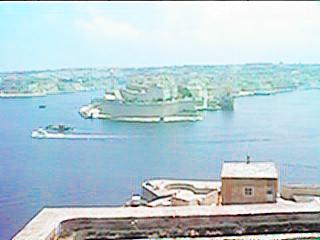
The harbor in Valetta, Malta
For reasons I never learned, VirtuFerries took passengers to the port
from their office, rather than having passengers go directly to the port.
Maybe this applied only to people taking the package tour. About
ten people were waiting in the van, placed for maximum discomfort in the
hot sun. The driver did whatever drivers do in Italy when they could
be transporting people. I did not want to wait in the sun, so
I stood about fifteen yards away. He pulled away without me.
I pounced on him before he got away. He said he'd be right back,
saying "Dopo, dopo." (After, after.) While I waited I enjoyed
the splendid, shaded view of the port and the Mediterranean splayed to all
points south. He returned ten minutes later and transported just me
to the port. I guess Italians are worried about getting left
behind, or maybe they just like the feeling of being crushed and roasted;
there must be a reason why they all sat there, squeezed together, sweating
in the sun.
After a passport check, I boarded the catamaran, which departed at the
time scheduled. Seating is airplane style. There are seat
belts only for the passengers in the front row. You cannot go
outside. Fortunately the cabin is air conditioned, and the a.c. is
strong enough to keep you cool. The windows became fogged and
splashed by the sea as we got underway, limiting visibility and pushing me
toward seasickness. I managed to see just enough of the horizon
to avoid becoming ill. In the past I have found going by slow
ferry to be much more enjoyable. You can go outside for
fresh air, there is more room to walk around, you can visit the bar, and the
like, but the ferry takes twice as long. Of course, you can
get seasick on a ferry. I did once, despite seeing the horizon,
on the route from Scotland to Ireland. The waves were huge, and we
were free falling between them.
As we enter the port you can see portions of the harbor in Valetta, Malta's
capital. Many historical figures, from Ulysses to St. Paul to Napoleon, have
enjoyed this view.
After clearing customs, we got on the tour bus. There were
two buses and I was told to get on the bus for the tour in English.
However, most of the tourists were Italians, and only two were Americans
besides me, and they spoke Italian, so the guide dropped English after about
twenty minutes. The bus dropped us off outside the old town,
a pedestrian only area. Local passengers boarded very brightly
painted buses, of 1950-early 60's vintage. Some of them (the buses,
not the passengers) have tail fins that look like 1959 Chevrolets!
Many Maltese, our guide explained, speak English but most of the time
they speak Maltese. The language came from the Phoenician, with significant
Italian (she said 'Latin') and Arabic influence. All the street
and shop signs are in English, and they drive on the left like the in the
U.K. The population is mostly Catholic.
St. John's Cathedral (1573) is the major architectural attraction.
It is in the Baroque style. Every inch of the interior walls is intricately
carved, except where there are paintings or emblems. The floor is marble.
The museum has two excellent Caravaggio's, but I did not have time to go
in.
We walked through the narrow old street to a fine vista of the harbor
and surrounding countryside. The harbor opens directly onto the sea.
The basin is large and is easily navigated. Large ships and buildings
dominate part of the harbor, but the overall beauty has not been destroyed.
It is in part for this and the other harbors (two in Valetta alone) that
the British defended Malta, then a British colony, so vigorously in WWII.
Also, Malta's location between the coast of North Africa and Sicily made
it strategically important, allowing a base for attacking ships attempting
the passage through the Mediterranean. Malta became independent after
the war. It remained in the Commonwealth until the 1960's or 1970's.
On the way to Mdina (meaning 'Fortified City' in Arabic), the guide told
us that the local building stone is calciferous and easy to work.
The temperature can reach 40c (100F) in the summer. It can be
rainy in the winter, with temperatures of about 10C (45F). Prices
for hotels plummet in the winter. She told me that I could rent
an apartment in the winter for about $75 a month. I asked her twice
to see if I heard right. I still don't believe it. The Maltese
make a liquor from prickly pears, which are abundant and now nearly ready
to pick.
We stopped for lunch in the countryside between Valetta and Mdina.
They served buffet style. The food was Italian. The choices included
an excellent antipasto selection, veggies (including broccoli with big,
white beans), fish and beef. Everything was very good, especially considering
how inexpensive the tour is. I sat across from a young couple from
Palermo who spoke no English. They were not very talkative. I
asked them the names of things and they responded but never initiated any
conversation. I asked if unemployment was high in Palermo.
She said officially yes, about 15% I recall her answer being, but many of
them were working under the table.
After lunch we completed the short trip to Mdina. Mdina has
a beautiful stone main gate. Walls encircle the city of 50,000.
I felt like I was about to enter a village in the Holy Land.
Mdina is made entirely of stone, a beige, ok, a khaki color, which is altogether
harmonious with the desert-like landscape. The town is full of
balconies, for which the Arabs are well known. The cathedral
is well worth a visit. The marble floors have chiaroscuro portraits,
or other topics, made from marble, and then inset. These are skillfully done
and not commonly seen.
The afternoon has quickly passed. There is much that we have not
seen on Malta, and the other five islands have not even had a mention.
Onto the catamaran, and one final view of the beautiful harbor before spray
covers the windows and nausea returns to haunt.
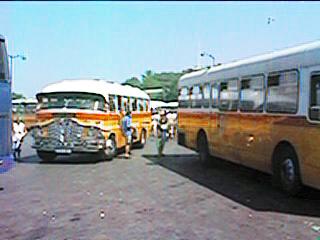
Late 1950's vintage buses