September 2001
Summer’s heat left as if the turning of the calendar hit some mighty switch. Blue skies mixed to patchy gray. Water fell softly from above. Quickly inside came the canvas shading the roof. Down came the wind scoops suspended above the hatches. No longer are we forever searching for shade.
Today we left Poincy where we left the boat for a few days, heading towards Paris, still on the Marne. We stopped after only about an hour on the river. Meaux (pronounced Moe) joins the ever-expanding list of picturesque towns with moorings in the center. On the bridge street market vendors offer fruits, vegetables, olives, fish and shellfish, meats and a variety of soft goods from shoes to hats.
In Nogent sur Marne Chantal came for the day that turned sunny. It was just a 30-minute train ride for her, and a ten-minute walk down the steep hill leading from the train station. A short tunnel joins the Marne and the Seine via a canalized portion of the Marne. Shortly the outskirts of Paris line the banks. The Seine joins the Marne not far away. There we head upstream on the Seine, shortly leaving the graffiti soaked bridges behind Chantal and I became friends through the conversation classes I attended in Paris at the American Cathedral.
It was a varied boating day for her. She got to see huge barges, go through some locks, see the joint of these two important rivers, and dock by a restaurant in the forest. She must have been tired from all the talking she did.
We moored for the night at a crumbling little dock next to a riverside restaurant about 20 km. south of Paris in a tiny town called Ris Orange. The restaurant advertised in the Navicarte (the inland waterway charts). In the photograph you could see the dock. Peg called to see if the dock was still usable. They didn’t know. I guess they didn’t want to look out the window. Chantal says no one wants to tell you anything unless they have to. This way if you have a problem, you can’t blame them. At least the meal was fabulous, at least my entree (‘entrée in Europe means the first dish, which in the US we often call the appetizer) was. It was an eggplant dish. They termed it caviar but there were no fish eggs.
Chantal took a 10:00 p.m. train that arrives in Paris in 30 minutes. By boat it’s a day’s journey.
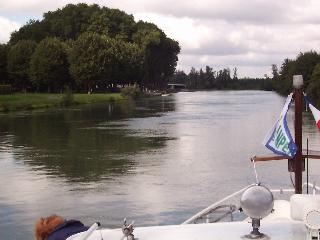
The next day’s sunrise again reveals the beautiful and very clean part of the Seine. The waterway is quite wide here, with trees covering the hills on both sides. There are quite a few very expensive homes.
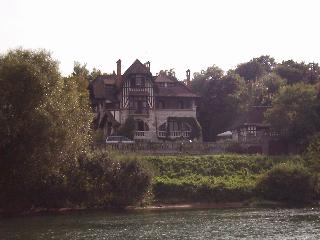
Early 20th century mansion along the Seine
On Sept 8 we are in Charterette, docked at a little private dock that welcomes passing boats for free for 48 hours, including water and electricity.
Peg writes:
We're across the river from the locks, which are quite large on the Seine, so we can watch the barges go through. We've found the easiest way to get thru the locks is to wait for a barge going our way and slip in behind them. Almost eliminates waiting! The locks are large enough to accommodate six barges at once, and there are not usually more than two locking through together.
We are on our way to Migennes, where we have decided to take the boat out of the water for the winter. We had originally intended to go back up the Marne towards Nancy once we had reached Meaux. But we changed our mind. We're heading for Joe Parfitt's place - comes recommended by two, perhaps three, independent sources. He's English. Very centrally located, so we can postpone deciding where we want to go next year until next spring! He's on the intersection of the Canals de Bourgogne and Nivernais. We're on our way there now, just to check it out, then we'll cruise to the end of the navigable Seine and back to Migennes. We want to be ready to paint, varnish, etc...
On September 11th we are entering a huge lock outside Maroilles sur Seine when the phone rings. Peg’s sister called to tell us about the World Trade Center Bombing. I couldn’t believe my ears, of course. Sounded like a ‘War of the Worlds” story. The news of the bombing filled hours on the BBC (a.m. 648, 198 medium wave, and various short wave frequencies). We stayed in Maroilles for lunch, in Bray sur Seine that night. There’s a mooring on the swift water, a minute or two on bicycle from the downtown. It’s next to a park filled with huge lime trees (not fruit limes but some other lime tree) whose canopy must spread at 100 feet in height. It was difficult to enjoy the spot as learned the full extent of the damage in New York City. Off came our US flag, to conceal ourselves from the stray terrorist looking for a target. Not likely to be any, but less so with the flag hidden away.
Bray Sur Seine
Nogent sur Seine is our next destination on the way to the end of the navigable Seine, some 20 kilometers beyond the town. A short way from Bray we come upon the next lock. We telephone and try the VHF. No one answers. Several people are around the lock looking busy but they pay us no mind.
This is a difficult spot to wait in the river. On our right is the ‘barrage’ (dam), water falling swiftly over into the main but non-navigable channel on that side. Broken stakes poke the water’s surface about 15 yards from shore, warning you not to wander into the main channel. Steep banks stand on the left. There is no place to tie up except just behind the lock gates. So there I head. As I come in, I notice too late the eddy that spins off the falls. The current pushed the stern about and in a moment we were crosswise in front of the gates. The opening to the lock is just wide enough to allow us to turn around by hand. Still no one has appeared but now Peg can get off the boat while I hold the lines. There is nothing to tie unto. Peg finds the keeper, who confirms that the telephone number and VHF channel are correct. He just wasn’t paying any attention to them.
9/12
At Nogent the Seine runs swiftly, especially as we pass the dam through which the river passes under a large milling operation. The canalized portion is wide enough for two barges, barely, and too narrow and swift to allow them to pass one another safely. A small lock, entirely manual, allows access to the mooring in the town’s center. You must pass the town’s second river diversion, which sends the river through a second unnavigable channel. The falls roar muffles whatever little noise the town’s traffic generates.
The town’s church is an ugly, odd affair. They squared off the apse to add a Renaissance (15th or 16th century) style section. From the outside at the main door you see on one side a Gothic structure next to this newer section. Somehow the gothic gargoyles just don’t go with the plainer Renaissance façade. On the inside, to the left of the main altar as you look at it, some arches had been covered up and others added on to make the entrance into the newer section
The town’s museum is free. It’s an incredible bargain. Pottery and jewelry dating to the 6th century BCE is well displayed. Graves from the Celtic period found in the area showed some fine metal belts, gold or bronze. Several graves contained a male and two females, two facing one direction, the third the other. The bodies in some graves were sitting up.
Also on exhibit was a sizable collection of the work of the artist Sacha Chimkevitch. Never heard of him until now. He is called the Jazz artist for the many drawings of jazz artists, both musicians and singers. I liked his work but describing it is difficult. He uses pencils, crayons, pen and ink, watercolors too, I think. I don’t recall any oil or acrylic work. The figures are highly stylized. Sacha lives in Paris and may have trained there as well, for they show some of his student works so you could see where he started.
We learn that the last 20 kilometers we hoped to see is choked with weeds, thus cut off from boat traffic. On the 14th we return to Bray. With the current running about 2 mph, I am unable to stop the boat at the dock before the current pushes out the stern. I underestimated its strength. I turned around, leaving Peg on the dock, and came in against the current, turning in the current and docking without difficulty.
Bray is a tiny town, a charming, narrow one-way street serving as the main drag. The old church merits attention in the Navicarte. A street carnival with rides, games and food started Saturday night the 15th. You can get Barbe de Papa, literally ‘Father’s Beard.’ In English it is called ‘cotton candy.’ We went over after dining to find the carnival closed for dinner at 8 p.m., reopening at 9!
There is a street flea market starting early on Saturday morning through Sunday evening. The market is mostly used items. Some of the offerings were quite expensive looking, dinner services and various drinking glass sets in particular. The occasional drizzles didn’t run anyone off, least of all the sausage grill cart. It’s aroma wafted all the way to the boat.
Between the street market and the carnival, it was quite the event for the area’s teenagers, who must number around 100. Most of them showed up for the rides, whose loud music’s beat lasted until midnight. Well past my bedtime.
Sept 16-30, 2001