Nederlands, June 2000
06/02-08/00
Dokkum
These days pass pleasantly, quietly in the countryside and in the small
villages of Akkrum, Princehof, Opeinded and Burgum. We spent
two days in the latter, where the husband of the harbormaster was helpful.
He found a bike path map for us and made us a copy, lent us books with photos
of the region, and told us about good places to go next. The
marina is well equipped. The electricity is continuous, unlike
some where you must put f.1 in for 1000 kilowatts of electricity; you never
know when you will use your allotment. The town is nearby and you can
get most anything you want, including the omni-present smoked mackerel, a
real treat.
We had some wonderfully fresh trout for dinner one evening. Another
I made a pizza on the stove, using a frying pan with a lid to bake the quick
bread crust I made. It turned out amazingly well, not only considering
that there was no over, but I had no mozzarella.
On the way to Akkrum the canal passes over a major highway, the second
one we have traversed. It was quite odd to look down upon the cars
that tunneled beneath us, and we became even more aware of how slowly we
move. In town we bought fuel, only 121 liters, spending the night
near a wellequipped campground with many other boats. Today we saw
more boats by far than we had seen since we left Loosdrecht. The numbers
of boats are accounted for by the great weather this being a three-day holiday
weekend. Tons of sailboats crisscrossed our
bow. We marveled at how adept they were at calculating our speed
relative to theirs, even when they had to take their own hard tacking into
account.
The mechanic at the fuel dock said he did not think our shaft was bent
and suggested tightening the bolts more. I had already done so but
did not know how tight they should be. This seemed to have resolved
the problem except a tiny drip, which soon disappeared.
On the 6th we departed for Dokkum, arriving three hours later.
If it had not been for our new friend, the harbormaster's husband, we would
not have come here, thinking the bridges were too low for our 2.75 meters.
We could we not stand upright at the outside steering station as we crept
under even the tallest span of each bridge. The ANWB chart noted that
the shortest bridge was 2.85 meters.
The canal passes just on the edge of the old section of Dokkum, which
was an octagonal defensive fortification. We tied to the bank.
Overhead towers a windmill built in 1849. A windmill also crowns
the next point.
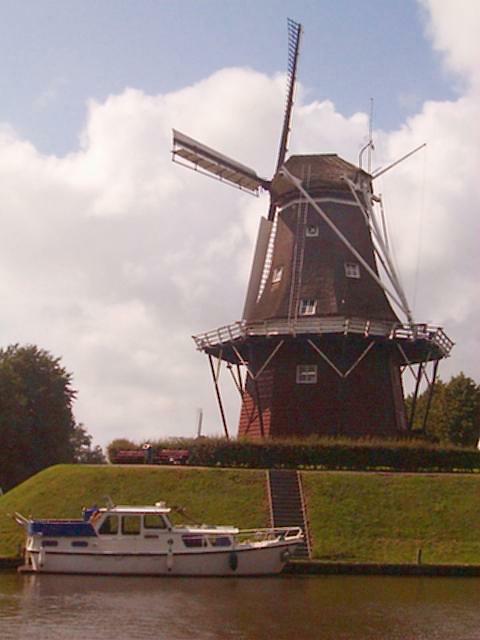
Carprice in Dokkum
Once we climbed the steep stairs to the windmill, carrying the bikes,
it was just a few minutes ride to the town center, on brick streets lined
with small but tall, steep roofed older brick houses. Cafes
line the canal, patrons enjoying kafee mit appelgabak (coffee with apple
pie, usually topped with whipped cream, 'slagroom' in Dutch). Shops
line steep streets. Shoppers busily cram the by-ways and narrower
side streets and alleys. Older boats line the inner harbor, brick
row houses towering above. Everything looks sharp and tidy.
This is my favorite town so far.
We spend two quiet nights for free in what could not be a better spot
if you didn't mind the steep climb, no electricity, water spigot for the
water tank, or showers.
Leeuwarden
06/09-12/00
Leeuwarden is the largest place we've been to on the boat: 120,000 live
here. Apart from a few neat buildings, canals, neat boats, the
pleasant spot we moored in and lots of street activity, shopping, and some
outdoor cafes, there is not a lot to say for it. Oh, there is a movie
theater. Oh, and many narrow streets and alleys crammed with buildings
that I could wander in for days.
Our mooring is just 100 meters from the Leaning Tower of Way North Pisa.
It's unremarkable other than it's off about a meter at the top.
From there it's just a minute to downtown. In the center of a
wide plaza there is what looks like an old train station or harbor master's
office, perhaps from the 17th or 18th century. Nearby a gothic revival
church (from the late 1800's) is worth a look. Some canals are
lined with commercial buildings from the same general period.
Obviously Leeuwarden was an important town when shipping reigned.
As the capital of Friesland, it still is. Too bad it is the dirtiest
city we have seen since Utrecht, mostly because the trash receptacles are
not emptied often enough. After the hyper-cleanliness of the
Friesland countryside, it's particularly noticeable.
This is a place for us to get things done. The library's Internet
connections are fast and cheap, about f. 2.50 ($1.20) an hour.
We find an electronics shop with a reasonably priced invertor (converting
12 volt to 220); the knowledgeable clerk they told us that our computer
battery is no longer made. I used my new and inexpensive battery
operated drill to remove the corroded bolts from the water filler, and found
a chandlery with the proper kind of hose to connect the filler with the
cooling system's expansion tank.
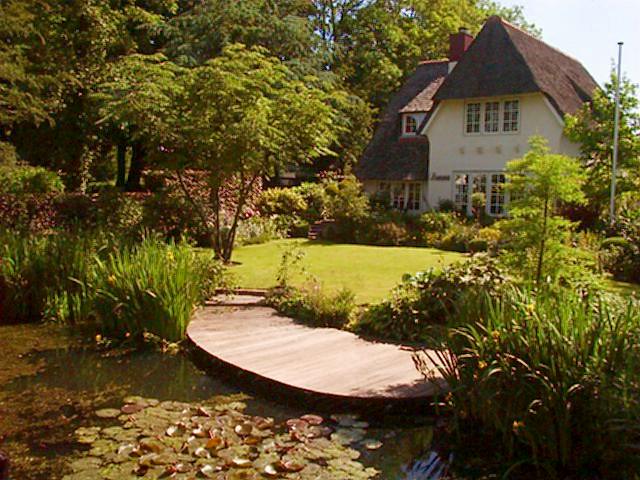
Returning from a long bike ride to several small villages, we wandered
across an attractive house with an impressive thatched rood and fabulous
front garden in full bloom.
Thatched roof in Leeuwarden
06/13-17/00
Franeker
Tom and Bonnie, friends from the U.S., join us for the trip to the coastal
town of Harlingen, with a stop in Franeker along the way. The
weather gods are with us today, though you can sense their uncertainty in
the distance. Coming from Leeuwarden, you turn to starboard just
as you arrive to tie up in the canal leading into downtown Franeker.
Franeker was founded in 1417. In 1585 Nederland's second university
was founded here We stumbled across a tiny building, one of my
favorites in the "Tiny Building in a Picturesque Small Village" class.
Hobbits once lived in it, I am sure, and perched on their tiptoes to see
out the tiny top floor windows. The town hall is trimmed with
white brick (I think they are brick), topped by an intricate tower.
The Planetarium Eise Eisinga is a must see. We biked from
Harlingen 8 km each way a few days later just to see it. Mr.
Eisinga built the planetarium in his spare time between 1774 and 1781.
It represents the movement of the planets around the sun and through the
signs of the zodiac. The mechanism looks like a big clock, and
is powered by weights that hang in the family's main closet on the ground
floor. Located on the second floor, the wooden works has thousands
of pegs attached to the gears and wheels. It still accurately shows
the location of the earth relative to the sun and the other planets up to
Saturn; the planets beyond were not yet discovered. It has never
needed repair.
Mr. Eisinga was not a scholar but a master wool dyer. A well
respected, well to do and concerned citizen, he commenced this project to
counter fears that the world was about to end. He wanted to show
that, contrary to the fears of a sizable number, the planets were not about
to collide.
Harlingen
There's nothing remarkable about the approach to Harlingen from Franeker,
but that's about all that isn't remarkable about this small village.
Three bridges meet at the canal junction in the center of town, as opposed
to the main channel on the north side. The ANWB almanac says
they all open. Ten minutes later someone comes to open the one bridge
they still use. The bridge tender (brugwatcher) explains that
the canal through the center of town has been partly filled in, and the other
just closed off. He gives us his mobile number (incorrectly,
as we later find) so we can call him when we are ready to go under the bridge
he opened for us; forward from here the canal is closed. Where we can
dock after going under the hand-cranked bridge is just a minute away, along
a steep bank. Blue stanchions here, as elsewhere, provide electricity
if you feed it for f. 1 per kilowatt. There is neither fresh
water nor toilets. The mooring costs f. 10 per night, collected
by the harbormaster immaculately dressed in a very nautical navy blue suit.
His English is good enough to give us the bridge keepers correct phone number.
Behind us is a 20-meter or so steel motor barge (no side keels) with a
very small pilothouse. Only a very slender person could walk through
its door comfortably. A couple is sanding and painting their
boat, but chat to us nonetheless. They just bought this boat,
built in 1920 but re-powered much later, judging by the throaty sound of
the engine. The interior is their next project. He
is a cook on a side-keeled sailing yacht.
Harlingen has is been and still is an important fishing village and shipping
port. Many large fishing vessels call this town home.
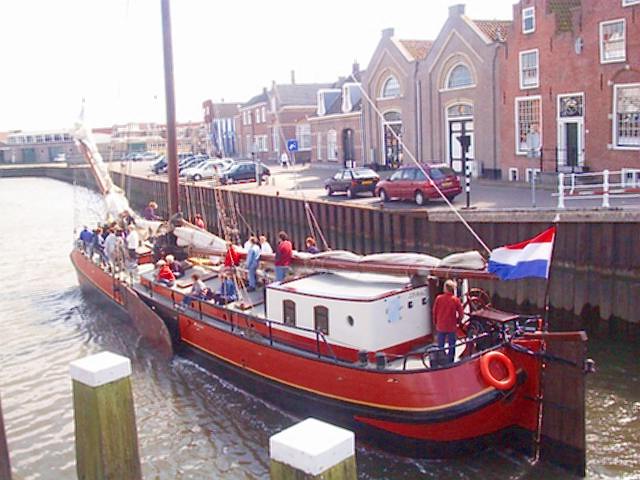
Two large ships ferry passengers to islands about 25 kilometers away from
near the harbor entrance. The harbor also shelters many - I saw at
least a dozen – 25-meter or so side keeled sailing yachts that take some 15-30
passengers on weeklong excursions.
Sidekeeled cruise ship in Harlingen
The harbor is a pleasant place to watch all the activity.
We sample the desserts at the pannenkoeken (pancake) restaurant.
Be prepared for a whipped cream and sugar, insulin spiking, sleep inducing
experience. If it's cold outside the large pancake stove top,
filled with round holes from which they make the pancake balls (they are
not flat pancakes) will quickly warm you up.
Today is an outdoor market day and the air is filled with the aromas of
aging cheeses, freshly smoked and fried fish and Vietnamese egg rolls.
We bought some cheese with an aroma powerful enough to leap tall buildings
in a single bound.
The streets are thick with shops, and on the main street you can get most
anything along the disused canal. The buildings are in the traditional
Dutch style, with many fine examples built by successful merchants of centuries
ago. A few of them still have hooks hanging from the top of the
tall structure. Cargo was hauled to the attic using these hooks,
a pulley and rope.
This was such a pleasant town, and the weather so good, that we stayed
here several days. On the 17th we moved to a marina since the bridges
do not open on Sundays.
06/18/2000
The Wadenzee to Maakum
Winds were calm enough under mostly clear skies to make the passage from
Harlingen to Maakum in the often choppy, shallow Wadenzee. As
the tide was in - the range appears to be less than a meter - we had to pass
through the Harlingen lock (not necessary during low tide). Then it's
past the ferry's dock and into the short channel leading to open water.
The force 3 winds kicked up about a twofoot chop on the beam, enough to
bounce us around for the next 2 hours. However, in case either
of us bounced into the air and into the water, we had plenty of company no
doubt willing and able to fish us out. Sailboats of every size and description
were coming from the direction of Maakum on the high tide, most of them under
sail; we were the only power boat for most of the trip. I don't
know why, but most of them stayed to our starboard side. Perhaps the
depth is a bit greater there, which at low tide may only reach 1.5 meters
in the narrow, well-marked channel. We are about a kilometer
off the coast. On each side of the channel there are drying spots
during low tide.
About 12 kilometers down the coast is the large lock that passes through
the dike dividing the Wadenzee from the Isjelmeer. We had to
wait a cycle as the lock was jammed full of boats; there must have been 50.
Tying up to wait was a bit of a fuss. The dolphins were the size of
Mount Vernon, the pilings taken from sequoia forests. Peg could not
reach around them to tie us off, there were no cleats, plus the stiff wind
was blowing us off. By the time we got this sorted out and took
a deep breath, the lock was opening. In the mean time, another
boat tied up near us to wait, just taking a line off the bow and letting
the boat head into the wind. Much easier.
About 20 boats came into the lock with us. The water moved gently,
and soon we were completing the final 4 km into Maakum. An old
but now mechanized lock stands between the canal and us. This
is the smallest lock I've ever been in, not much more then 15 meters long
and maybe 5 meters wide. Perhaps a dinghy could have fit in with
us, but we were alone. People waiting for the bridge watched
us do a fine job of handling the boat. A friendly, bald man translated
a phrase or two for us. Since there was a bar right there not 2 meters
away, I told him we'd come back and join him for a beer.
After we found a spot under the shade not 5 minutes later, that's exactly
what we did. He teaches special education at a nearby university, she
a nurse. Both spoke great English. They have a boat, something
old in the tenmeter range. I forget what else we talked about.
The beer was too good, and I may have had more than one. The sun warmed
us as we sat in wicker chairs on the main street.
Of town, what terms can I use that I haven't used already?
Small. Picturesque. Steep, tiled roofed brick houses
17-19th centuries. Quiet. Canal in the center.
Outdoor cafes filled to the brim. Enough charm to make a cobra
sleep in your lap. The world's oldest active Delft factory one minute
from the boat.
A few boats tie up near us, competing for the shade.
Ducks and coots surround the boat. A coot climbs on the swim
platform with sticks and reeds. I threw the nesting material
off about three times before she gave up. Later we saw her, or
some old coot just like her, going down the canal in a floating nest, arranging
her new home. Someone get this girl a mortgage so she can afford
a proper place! There are several the villagers have constructed
of straw, some with tile roofs, complete with wooden handicapped coot access
ramps. Everyone should get one for the old coot in his life.
The delft factory provides a video in Dutch, English and French, perhaps
other languages as well. It explains the process of producing the famous
ceramics. Delft is a city in the Nederlands and there may be factories
there also claiming to be the oldest. This factory produces delft tiles
and pottery, however, as well as other pieces, perhaps some of in a non-delft
style (not sure), and some modern ones. The process begins with
the removal of clay from the local soils, to which is added clay from France.
The end product is cream colored, or maybe white. Then the clay
is cut into tile or thrown on a potter's wheel. They make a pattern
using a stencil using some sort of dust, maybe charcoal, then each item is
hand painted. This factory uses Chinese paint dyes, as they have
from the beginning. The dyes are a trade secret. Some of the
28 employees must know it, I suppose, but perhaps the family that has owned
and operated the country since its inception centuries ago has managed to
keep the information hidden all this time.
06/19/2000
Arum's hotel
We bike to the tiny town of Arum through the smooth countryside.
In Arum is a hotel with a bar and restaurant. The owner was sitting
outside with several people having morning coffee in the sun and brought
us cappuccinos. She told us that she got a business degree,
and then looked very carefully for a business opportunity before she settled
on this place. It had been in disuse for some 50 years.
After much bureaucratic haggling and lots of money she opened the place
a year ago. Peg found the rooms large and attractive.
There is a stage on the second floor use for local productions, music and
theater I imagine. I hope she gets lots of traffic through town,
as there can't be more than a few thousand residents here, not enough to
support her. Herberg 'de Gekroonde Leew, Sytzamaweg 8822 VB Arum
05 17 641 223 [email protected]. I recall that the
rooms are about f. 70.
06/20-25/2000
Bolsward
After a night moored out we came to Bolsward, at 9500 people the sixth
largest town in Friesland. Founded in 713 (pottery finds dating
to 300 B.C.E.), Bolsward has a handsome town hall (1617) at the junction
of two canals. The Martini Church dates from 1446, the Broerekerk,
once a Grey Friars monastery, around the same time. In 1980 it
was partially burned. Only the walls remain, a skeleton.
St. Francis Church has beautifully arched ceilings, a good drawing challenge.
We are tied up just two minutes from town center (f 1 per meter, electricity,
showers and toilets soon to be ready) so getting there is easy on the bikes.
We stayed here five days as we arrived, by pure chance, at the start of the
Hay Harvest Festival. They elect a queen who parades through town in
a horse-drawn carriage. There are street musicians night and day; fireworks
and an international folk dance show, horse jumping competition, go kart
races, horse drawn buggy contest and so on. My favorites
were the Ukrainians, who performed marvelous folk dance accompanied by their
own 56 piece orchestra.
 Ukraine singers near town hall in Bolsward
On the 22nd we went to dinner at Restaurant It Y'Thuske, Peg's choice
for her birthday. Excellent fish, good wine. f. 140 including
a fantastic coffee service at the end, on the house. That was after
Peg offered to make them gumbo. They were not busy that evening and
the wife very friendly, so she and Peg got to talking. Turns
out her husband, the chef of a one-man show, wanted to try Cajun food.
Peg makes an excellent gumbo so she offered to cook lunch for them if they
had time before we left. We showed up at 11 a.m. Sunday. Peg
and Appie chopped and stirred while Corie and I chatted, her two children
clung to her. She's blond, blue eyed and tall; her husband is
blond, blue eyed and tall, her kids blond and blue eyes, probably one day
to be tall: I must be in Nederlands.
Cows are revered in Bolsward as in all Friesland. For the
festival, plaster Elsies float in the canals, hang above them on metal frames,
another glued to the side of a building's window. A festive
five days, a good time had by all.
06/26-29/2000
Sneek
Up the lazy canal under about 6 bridges each charging f 2.5.
Just before Sneek (pronounced 'Snake') we had to wait almost an hour while
the bridge keeper had a dinner break (4:20 - 5:20 p.m.). The Dutch
eat early but not usually this early. We docked along the canal
with the other waiting boats, using our stakes for the first time, as there
are no posts to tie to. I swam, also a first. The
water finally felt warm enough and the sun strong. Not quite Florida,
but good enough.
We head into Sneek's canals, to the marvelous gate and footbridge.
Handsome houses and shops galore populate the pedestrian zone. Otherwise,
Sneek was less interesting than we had hoped, given it is such a popular
destination among boaters.
Too, Peg's bike was stolen and had to buy her another one; we have resumed
locking them. The harbormaster heard about it from our neighbors, Gerard
& Philly, and expressed his dismay at the thieves in his hometown.
I invited Gerard & Philly (she loves baseball so this is a nickname)
for a beer as they smiled readily, said hello, thanked me for helping them
dock, and spoke English. He was injured on the job and has a disability
pension. Both are in their late 50's but she has to work another
5 years. In April they bought for f.100,000 the 12-13 meter,
20 ton fishing boat built in 1946. It was amateurishly converted
to a liveaboard. He will completely redo the interior down to the
plumbing and wiring (single wire was used). The hull is full
of dents and rough paint, but I don't think they plan to do much with it.
They live near Zwolle and invited us to come and see them there.
06/30/2000
Douie Egbert, Joure
Through the canals to Joure. Home of Douwe (pro Dooie) Egbert, he
of the famous coffee label, born and started his company here in the 1700's.
The boat is two minutes to town center (all the facilities in the harbor
to starboard, no electricity on the canal). The town is not much
more than two minutes long by one wide on Peg's "new" 5 speed but I find
it more charming than Sneek, despite the latter's fabulous gate.
The neat museum includes old Dooie's house: one room on the main floor,
small second room in the peak, connected to another house of same size;
not more than 700 square feet. Gorgeous collection of pipes and clocks
live in another building. This town was noted for its clock making
and brass works, and both crafts are on display.
Thus ends our second month of cruising the Nederlands. I am
in love with the countryside despite the frequent fragrant visits from Elsie:
the windmills, the steep roofs - thatched or tiled - the towns' canals, the
tiny locks, the slow pace, the sweet, kind, friendly, intelligent people
always ready with a hello and a smile. The Frisians can't bake bread
worth a damn, but they sure can smoke a mackerel and marinate a steak.
The sate is unforgettable. This whole trip will be unforgettable,
not least all the tall, blue eyed, good-looking blondes.