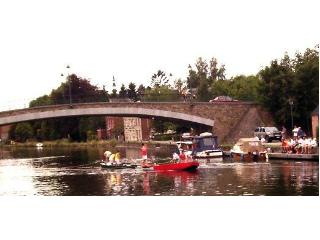
July 2001
We left Roermond on the 12th of July.
From our quiet spot just south of Maastricht, on a lake just off the Maas,
we entered Belgium on the 13th, paying 42 Belgian franc (About $1) permit
fee at the first lock; this fee allows you to navigate in Wallonnie, the
French speaking part of Belgium, for one year. It was but a few
hours until we passed the statute marking the rejoining of the canal with
the river, just outside Liege. I had seen this junction many
times from the nearby highway, trying to imagine what it would be like to
cruise by it on our own boat. Now I know what it feels like:
a milestone at last passed after many years anticipation, an arrival, a graduation,
a coming of age.
The Meuse aka the Maas passes through the center of Liege aka Luik.
We are in Belgium’s Walloon region. Wallonnie is the French speaking
part – the other is Flemish, which is Dutch with only slight variation
– and is also the poorer part these days, having once been a heavily industrialized
region with enormous coalmines. Now most of her old brick factories
lay silent along rivers, remnants of the industrial revolution, here and
there giant coal slag heaps form treeless mountains. We visited
a coal mine some years ago, riding the elevator deep into the hillside.
Rails carried narrow gauge cars to the surface. Minors dug in narrow
veins in the dark dampness.
Not far from the city’s clean and quiet marina is Liege’s pedestrian zone.
Formed of the narrow streets of the oldest extant part of the city, it dates
to the middle ages, days of its principality; only its sister Luxembourg
retains its independence. From the little shops and cafes you
can get the rice pies and the waffles for which the region is justifiably
famous. Peg’s distant cousin, Irene, who died in her 70’s about
five years ago, made both in her boulangerie/passtiserie. A rice pie
is made from unpasteurized milk, rice, sugar and I think a bit of cinnamon.
It rests in a heavy pie shell. Waffles from this area are fruit
filled, usually cherries, apples or pineapples. The Belgian waffles
you see in the States with all the whipped cream is also served here, although
the waffles are thinner.
On the 14th we arrived in Huy, staying in the marina just outside town, a
short bike ride that took us down a brief but steep hill. This
was our first notice that we were no longer biking in Flatland.
Huy is a tourist’s town. Its narrow streets are car-free.
You can walk past all the little shops in less than an hour walking on cobbled
stone. The structures are what I only know to call the Belgian style.
Most are red brick but stone is also used. The buildings are rectangular
and usually three stories high. Wooden shutters frame lacy white curtains.
The steeples in Belgium are different from elsewhere. Just before
they come to a point the bulge out, not so far as to make the German/Austrian
onion dome but enough so you know you are not in France, say.
Peg’s cousin Arlette and her husband Dani joined us on the 15th for a ride
in the river. They had never been on a boat like this.
They were surprised how quiet and relaxing it was for them to sit on the
deck in the pleasant summer weather. Somehow they were expecting
something noisy and smelly.
Thus far boating in Belgium is easy. The locks are enormous in
both length and breadth, but tying off is easy with one exception about which
we were told, and the rises are not turbulent. Beauty is not the reason
for traversing these waters. However, I was not disappointed,
in fact somewhat pleased, as I had heard such unpleasantries that the final
product exceeded expectations.
07/16-20/01
Namur is on the junction of the Meuse and the Sambre. Inhabitation
dates from at least 300 B.C.E. The Romans had a settlement here
as can be seen in the Museum of Archeology What makes this spot
important is the junction of the two rivers. This led to the construction
of the citadel in the early Middle Ages, around 1100 if memory serves.
It sits on a cliff rising some 100 meters above the river; we walked to the
top in about 20 minutes. The town expanded on the opposite bank
and here you find all manner of shops and pedestrian zones just a minute
from the boat (no facilities for boaters). We tied up for several days
to visit the town and resolve our email difficulties; the computer will no
longer dial out properly.
We walked along the Meuse one evening, taking a look at the marina on the
far bank. Before us as if in a bad dream came Phil on his collapsible
bicycle, the very Phil we had gotten rid of in Haarlem back in May.
We exchanged stories, he gave us a large piece of Edam and we each went our
ways, promising to avoid one another more carefully in the future.
We thought of Phil everyday for more than a week, though. We had Edam
every which way. Plain with knackerbrat (wassa), melted on bread,
in an omelet. We even had an Edam stuffed Edam. We could
have used it for ballast but I wasn’t sure the steel would hold up.
Don’t get me started!
07/21-23/01
The Sambre is quite lovely at points between Namur and the French border,
but the area around Charleroi is not one of them. In this city
are many old factories still in operation, and there is a metal recycling
plant on the river. Large barges stop to unload their huge loads
of metal. We passed or traveled with several of these barges
We stayed the night on the river in the middle of town. There
was just one other boat, three men in a leeboard sailboat. They
had the only good spot, where there was a break in the railings.
Even though there are railings and bollards for at least ½ kilometer
along the river, the rails are so high you have to risk limb to get off the
boat. We felt isolated, vulnerable to Visigoths; why should the Vandals
get all the bad press?
On the 22nd we came to Lobbes and had to stop. The town had requisitioned
the river. No traffic could pass for an unstated period of time.
This was the day for the canoe joust. Oh lucky us!
This joust consisted of two young men perched on the aft portions of special
built canoes. The stern was extended to allow for a slender platform
some 10 feet in length. These two young men, no older than say
the mid-20’s, each carried long poles, on the end of which was a kind of
boxing glove used the push the other off his boat. Three or four other
young men in each boat would paddle the boats toward one another, guided
by ropes that were strung across the river. When they were within reach
of one another, the jousters tried to knock one another into the water.
About 1/3 the time one of the two would fall in. Most of the rest of
the time they both fell in. The joust repeated until one side
accumulated enough points to win. Then out came the next team.
This went on for about five hours. Fifteen minutes would have
sufficed. Meanwhile I visited the church on top the hill
dating from Charlemagne’s time.
Water jourst on the Sambre in Belgium
On the 23rd we crossed into France at Jaumont. There is no border check.
The VNF (Voie Navigable Francais, the French waterway authority) has provided
docks, water and electricity, all free in various places in France, this
being one of them. Most docks don’t have these facilities; few have
toilets and even fewer showers. You pay an annual fee depending on the area
of your boat. In our case it cost about $200 It’s
a good deal if you use your boat as much as we do.
The town center is just a minute away across a bridge and up a steep but
short hill. Peg wanders about and finds an attractive little
restaurant, which serves lunch starting at 62 francs, about $8.
A barge carrying a British flag, named the Nidd, moored not long after we
arrived. We made room for them at the dock. Soon
we were chatting with the very friendly couple. Paul is 42 and
Sally 50 years old. They were both trainers for the British government.
I hoped it was for some James Bond spy agency but if it was, they didn’t
let on; but they wouldn’t, would they? Paul worked for social
security and at one point worked for the fraud squad. Most of his customers
were people who collected unemployment and also held down a job. Neither
the unemployment benefit nor the job paid much but between them they could
do all right, or at least scrape by. Some of his customers were
small businesses who participated in or organized frauds.
The next day we all went to lunch at the little restaurant Peg found.
It was the most fabulous meal I have had in France. I ordered
the pork provencale, which included the appetizer bar. The latter
included a variety of marvelous veggie dishes, including garlic mushrooms,
Russian salad, beats and what not. None of the items were just
plain or out of the can. The sauce with the main course was easily
the best provencale ever. It was strong with red peppers blended
in; it’s called a piperade. I’d had a piperade in the Basque
region of France and didn’t know it could be found also in Provence.
Maybe it isn’t traditional. Peg had a flaky pastry salmony thing
for the starter. Her main consisted of two fish, three or four
langoustines, some mussels and a few other creatures, all in a fabulous sauce.
All for 62 francs each, which is about $9.00!
Fools we were we didn’t keep the name of the restaurant. But
we know how to find it.
07/26-30/01
On July 26 we left Jaumont, the border town on the French side, enjoying
in near solitude the canal and its locks. Mostly we’ve seen Dutch boats,
nary a French one to date, and not many of these. We stopped in Berilmont.
We tried mooring behind the Nidd but we grounded lightly. Instead
we tied up across the canal, itself divided by a small peninsula. Behind
us are Bob and Bobbie, another British couple, who run a hotel barge on their
boat. The unremarkable town is entirely uphill, the path taking
you between the houses that line the canal.
A remote control device operates the locks in this canal section. It
refused to work several times. You can call VNF personnel using
a telephone that dials using a push button next to a speaker.
They were usually there within 10 minutes. Until about 10-15
years ago the lockkeepers lived at the locks. Some of the houses
are still beautifully maintained and in the summer artistically decorated
with flowers. These and the gorgeous scenery make this portion of our
journey exquisite, and the main reason we came to this area.
Why hardly anyone else does is amazing.
On the 27th we went to Landricies. The mooring is just past the
lock and includes water and electricity, as do most all VNF docks.
It is in the middle of this farming town of 8,000, across the street from
an animal feed silo; this offers no annoyance whatsoever. Many small
rodents live next to it, scurrying along the docks as cats patrol the area.
Across the bridge there is a fritture, a place where you buy fries along
with other, mostly deep-fried food. There is a bakery close by
as well. Just two minutes away there is a Champion, a sizable
grocery store with the most fabulous baguette I’ve ever had; it’s crunchy
and covered with poppy seeds. And fortunately for us, just at the mooring
is a chandlery run by an ex-Navy man and his wife.
Our engine is still misbehaving, emitting too much smoke and seeming to misfire.
The mechanic talked to Mercedes and they told him if the valves were adjusted
properly, the only other culprit would be the fuel. He adjusted
the valves to no avail so out came 200 liters of the cheap red diesel from
Belgium, at $1.20 a gallon as opposed to $3.75. He lent me his
pump to help remove the fuel, and his hand truck so I could walk to the Champion
to buy diesel fuel. The missing and smoking improved almost immediately.
Apparently we got some water in the fuel in Holland; at one point in Holland
the engine would barely idle. I know where the fuel came from,
since we only bought it once. The mechanic also replaced a copper
fuel line about to break, and the glow plug switch that had failed, causing
cold starting difficulties.
Paul and Sally arrived. Over the next several days we became
quite chummy, meeting them daily for beverages. We talked for
hours. Their last boat was a narrow boat. These are boats only
built in the UK. They are up to 70 feet long. All are seven
and a half feet wide. There are several canals for which they
were built to haul coal, I think. Now they are used strictly
for pleasure, often beautifully decorated.
A main problem facing boaters in the UK is vandalism. Kids untie
the boats, steal things and throw rocks from bridges. Paul said
he finally bought a slingshot and it was effective in preventing the rock
throwing. Our image of the super polite British kid suffered
greatly.
Their current boat was also used for coal hauling. They have a photo
of it, named the Nidd since its construction in 1934, when it was just a
flat barge without a pilothouse, a tiller on the rear. It was
built for a certain canal so that it would fill the lock from end to end
and side to side, allowing the maximum storage.
Paul sailed the boat across the Channel. This we found quite
surprising as the boat has less than a meter in draft and otherwise obviously
made for canals, not open water. They hired a captain to go with
him. This captain is or was in the Royal Navy and had access
to the best weather forecasts. He determined the time to go and
also advised Paul how to prepare the boat. The crossing took
31 hours, as they did not cross at Dover but from further north.
If his boat can make it, so can ours. They told us we could stay
around London inexpensively, other than St. Margaret, which is near the London
Tower. Thus we could afford to live in or near London, which would
otherwise be unaffordable. We would have to bring the boat up
to British standards, which Paul suggested should not be too difficult providing
the inspector has an ounce or two or reason in his little head.
Gasp!
Officaldom appeared on the docks to inspect, select or reject the boaters.
These were the River Police. The dreaded, the feared.
They came to us last. There were six of them for the serious
task of checking boats that can go all of 15 k.p.h. to make a speedy getaway
with tons of illegal cargo! This is more people than the Paris
police send to gang wars.
“Papers, please.”
We produced the documents the broker gave us, hopeful that these and the
advice we were given were adequate. Our hopes were soon dashed.
The Head told us we needed a piece of paper with our boat number on it.
A registration. Peg explained that registration is not required
in Holland. He said you have to register it if you come into
France. This was not what the VNF, the ANPEI (the association
of inland water pleasure boaters in France which we joined) and many Dutch
friends told us. The Head told us to go look at what the Dutchies behind
us had so we would know what to get. Then he and the Five Mute
Helpers left.
The Dutch couple behind us to showed us their paperwork, which consisted
of a single small page with the boat name and number typed on it on a ANWB
(a sort of automobile association that also does some things for boaters)
form. It had expired in 1998. The Dutchman said that
he told the Head that he would get a new one when he came back next year.
That was satisfactory. I concluded that the River Police were
there to see that you knew you were supposed to have this paper in case you
ever came back. Nonetheless for the next several days we tried
to figure out how to get one. The ANWB only provides this for
Dutch citizens. We could document the vessel in the US, but this
is a hassle for us, as we have to get a bill of sale signed by the previous
owner before a notary in the US Consulate in Amsterdam.
The Small Ships Register in the UK also provides a piece of paper for £20
or so for five years. You need to be a UK citizen.
We also talked about telecommunications. These are a constant
source of amusement if you are a hardy sort. They use their mobile
phone for text messages from the UK. These you type on the phone’s
keypad, a labor of love at best. All the messages are short,
naturally. Most mobile phone service providers allow 20-25 messages
per month. After that, you pay. Paul and Sally’s problem resulted
from the phone not being able to receive messages from the UK.
This being a primary purpose of the phone, the problem was significant.
SFR blamed the UK network, but other French providers allowed the service
to the UK. So one day Paul went with us to look at mobile phones.
Our problems were a bit more serious. The KPN-Siemens phone could
be unblocked after our one-year contract was over. They sent us a code,
which did not work. KPN told us we had to send the phone in to
be unlocked as there was a software problem. This is a problem
for people without a return address. Willem vanderLaan ([email protected]),
whom we had contacted last November so we could prepay our monthly service
charge of about $8.00 (that’s another story) returned from vacation two weeks
after we were no longer able to use the phone. He told us that
Siemens would call us instead, as he knew we had no convenient way to receive
mail. But they wouldn’t call for another 2-3 weeks!
He called back a few days later to tell us that Customer Service agreed to
buy us a new phone. We were amazed and only worried that they
would not reimburse us or if they did it would be only after a long delay
and many phone calls. We went with Paul to look at phones.
We found one and it was the only one that came with all the cables and software.
The other phones did not come with and you had to buy them separately, not
at the phone store, but at a computer store. The telephone store
man in the tiny town called the two local computer stores and neither had
the necessary materials but would not have them for a week or two.
So we ended up with the most expensive phone there, about $500, and it was
a Siemens, which was not the brand we wanted.
In Huy we bought a Toshiba Satellite that was on sale for about $1100, the
best price we had seen for a new computer. After we got the new
phone and new computer, we still could not connect. Many dollars
later, someone at ATT Globalnet determined that the dialup network setting
did not have the correct user i.d. After I corrected it, we were able
to connect.
While in Belgium we got a new telephone account. In Belgium you can
pay with a credit card, while in France and Nederlands you can’t.
Although we would be in France and have to pay roaming charges, we might
not have been able to get a provider without opening a bank account.
For this you need legal permission to be in France – a residency permit –,
which are hard to obtain. The other option is to put a large
amount of cash in a bank account. Some banks will then open an account
for you.
When we left Paris we took with us a mobile phone we found in the apartment.
It is the recharge type, which cannot be used for Internet access not outside
France. So now we have three phones, two of which work, the other at
about $225 sitting useless on a shelf.