07/02/00
The Sneekermeer
We are on the move until we find a beautiful mooring on the Sneekermeer,
one of many lakes in the area. Before us sailboats and motor yachts
of all descriptions cruise back and forth under partly cloudy skies.
A few meters away another mooring holds three or four boats in the shade
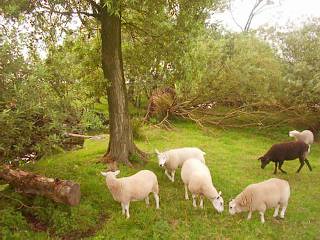
of a small, wooded area. Sheep graze just behind us.
This is a free mooring, no services except trash removal.
Sheep on the Sneekermer
near Sheep Dip Path
Some eight or so kilometers away lies the small village of Terhorne.
We bike there via Sheep Dip Path. We weren't sure it would take us
to a road but in the end it did. After going through brambles
and other obstacles, keeping the lake to our left, we came to a small marina.
We had to cross a rickety wooden bridge and then take a self-service, battery
operated ferry across 3 or 4 meters of water. The ferry took
us to a restaurant filled with customers seated outdoors, eating lunch or
having a beverage under the sun. Just after that is the road.
The bike path borders the lake, then up and down short canals as there are
no bridges. After several of these we head for the road and into Terhorne,
to find that Terhorne is nothing special.
07/03-08/00
Heerenveen
Heerenveen is another canal-divided town with lots of shops and neat buildings.
Mooring in town is either on the old canal that runs through the center of
town, or the by-pass canal that lies just on the edge of town. We chose
the later as from the old canal we can not continue through town due to low
bridges, and would have had to retrace our steps for several kilometers.
After buying necessaries we moved the boat outside of town; our first mooring
is amongst a group of modern apartment buildings. The tree-lined area
we are now on attracts many other over-nighters. Quiet, calm,
just a field with cows across the way.
From the 4th - 8th we’re in Echtenerbrug just off a lake called the Tjeukemeer.
It has just two streets but sports it's own choir. They gave a free
performance one evening. As we walked by they sang their first song.
"Deep in the Heart of Texas" rolled out of the small warehouse where they
offered coffee along with American, Dutch and Fries musical favorites.
The group tours the region during the summer. It is composed
entirely of people who live in town or nearby. Over the next
few days I ran into several of them. One ran a store cum post office, another
the campground where we did our laundry, a third collected the nightly fee
from the boats along the canal.
We biked to several nearby towns. The path took us past a windmill
converted to a house in the middle of a small woods. You could
only get there by bike. Cars must park a half-mile away.
We also biked to Lemmer, a popular port town on the Ijsselmeer, its marinas
filled with boats. The 'pasentenhaven' was surprisingly empty.
Peg's 10 year-old cousin Sandrin arrived on the 8th for a week on the boat.
After her parents left we moored on the island in the Tjeukemeer in high
winds. It's a tiny island populated by birds. We have just
one neighbor on our side of the island. It's a Prince of Denmark
kind of night, wind and rain, clouds racing late into the night, evil and
destruction on the horizon.
07/09-10/00
Woudsend and Heeg
On the 9th we arrived in Woudsend, again in strong winds. We
could not find any spots along the dock past the bridge, which would have
allowed us easy access to town. We had to turn around, head back
through the bridge. The only spots available allowed no access
to town, unless you were willing to hack your way through the reeds.
The next day we arrived in Heeg. In the passantenhaven off the
Heeger Meer (a lake), heading here and then there looking for a spot we could
get into easily in the wind, a young man told us to tie up parallel to the
docks where normally you would be perpendicular. This made landing
easy, though he helped us anyway. Nearby is the small town, composed
of just a few streets, so packed with charm I can hardly stand it.
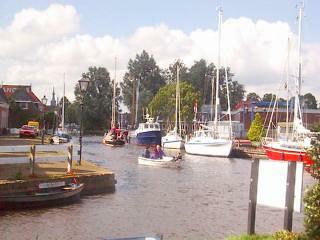 The canal in downtown Heeg
Many side-keeled cruise ships bring their passengers here. Watching
them maneuver in the high winds provided hours of entertainment.
The same young man who helped us in often assisted these ships dock and depart,
using his inboard dinghy like a towboat. In one case the boat
he was pushing hit a docked boat, becoming pinned to it. A smaller
side keeled vessel helped pull the larger one off. Smaller boats
hit pilings and other boats throughout the day.
07/11-13/00
Workum and Hineloopen
Workum is a long town. It's main street stretches on for more
than a kilometer, I reckon, and we are moored just outside town (f 1.3 per
night, no elec, rest room, no showers). From here it's a short
distance to Hindeloopen and Stavoren, a major port on the Ijsselmeer.
A marvelous windmill lies in the direction of the coast, just behind the
dike. A little farther on we came across Kaasmakerij (Kaas is
‘chesse’, makerij is ‘maker’)De Nylander. They offer tours, which we
enjoyed after our return from Stavoren. The wife speaks a belabored
English, the husband no more, so the tour was in Dutch, as was the video.
The methods they employ are not unusual. The pour the creamy
milk from their cows into a large stainless steel vat with a paddle in the
middle. They add the starter bacteria and the gelling agent.
Three days later they have cheese. They age it in a refrigerated
room after the cheese is drained then coated with plastic.
Hindeloopen is protected by a lock upon which rests a statue of a woman wearing
a long dress and a cone shaped hat. She looks to sea.
A Dutchman explained it all to me, as the inscription was in Dutch.
This wealthy woman lived in the early 1800's. Hindeloopen was
prospering in fishing and trade. She hired a sea captain to scour the
world to bring her the richest cargo in the world. The statue
shows her waiting eagerly for his return. When he made it back to port,
the ship was filled with grain. She screamed that this was not
the richest cargo in the world, and had the grain dumped in the harbor.
Wiser locals told her that she should not discard the cargo as she might
not always be wealthy. Whereupon, she removed her gold ring, threw
it in the water, saying, "I'll not be poor unless that ring comes back to
me." Sometime later while eating a fish she found the ring inside.
The grain sprouted and they had to close the harbor. She became
a poor woman.
There. Never throw food away. Nor a ring.
The town's current harbor is further inland than it used to be, not due to
the mythical grain but to a storm that flooded the town. There
are remnants still in the water. The town is noted for its gorgeous
harbor, beautiful traditional buildings, and a store that sells high quality
ships models, some wooden, some of glass, both inside bottles or otherwise.
Stavoren is not quite as impressive and much smaller. The cafe
alongside the harbor, of a type called 'brown cafe' because of the wooden
interior, has some wonderful pencil drawings of boats and ropes and other
boaty things. Also some wonderful appelgabak mit slagroom .
We spent the night of the 13th on a relatively large island in the Heegermeer.
It has several wooded areas. Birds visit by the thousand, but there are surprisingly
few rabbits, some black and white. This is an excellent
spot to moor, protected from the prevailing winds, allowing a bit of exploration,
plenty of peace and quiet, and lots of sailboats to watch playing in the
lake.
07/14-15/00
We say goodbye to Friesland, sadly. We'll miss the endless natural
beauty, countless picturesque villages, peaceful pastures, men wearing wooden
shoes, the endearing architecture, the friendly, industrious people.
We've seen this province intimately, thoroughly, only as a boat at its pace
would allow.
07/16/00
Through the Lemmersluis, Lelystad's museums
The Lemmersluis, in Lemmer, naturally enough, drops boats some 6 meters (19
1/2' feet) to the level of the canal that passes through Flevoland.
The lock operator assured our lines were looped around the ropes rather than
the bollards. About ten minutes later we were in the canal.
In a few hours along the drab canal we came to Emmelord. Rain fell
just as we arrived. We squeezed in a space just a bit larger
than our boat. We got the last spot on the quay just a few minutes
from town center. (free, shower and toilet, no elec)
Emmelord is one of the larger towns in Flevoland. Since Flevoland
is not very old, its towns are not terribly interesting, but the shopping
is good. Sandrin’s parents arrive later. Sandrin tricks
them into buying her something. Allan brought us four loaves of Belgium
bread, much better than what they make in Friesland, and about 12 bottles
of Leffe, a mighty fine Belgium beer. Since our freezer barely
fits two ice cube trays, we have no idea what to do with all this bread;
I only asked for one loaf. But I think I know where to put the
beer!
The bus goes to Lelystad, where we visit the Ships Museum. The
Ships Museum is next to the Nieuwland Museum, neither of them easy to get
to as bus service is limited as today is Sunday. We end up walking
the last two kilometers through a modest neighborhood.
The former displays a Roman boat from the 2nd or 3rd century, and many Dutch
ones from the 12th century on. All sank in the Zuider Zee, which
is now this land. Farmers, construction workers and others find these
boats and associated objects, including Roman era glass, pottery, etc., as
they dig. Outside, students build a replica of a wooden ship called
The Seven Provinces. It sailed in 16th or 17th century, I think.
Its length is about 25 meters. The main draw of the museum is
the Battavia, another replica. It sank in Australian waters
on its maiden voyage, due to a navigation error that took it onto the reefs.
The replica is now visiting Australia for the Olympics. It was
shipped there and not sailed. An employee explained that getting
the 75 crew members they need and paying for the insurance are obstacles
they could not overcome.
The Nieuwland Museum, among the best museums we've visited, describes the
draining and building of Flevoland and similar projects elsewhere.
They provide a booklet in English that explains the exhibits in sequence.
Cornelius Lely was an engineer after whom Lelystad is named. In 1891
he put forward a plan to enclose and partially drain the Zuider Zee.
The first phase of the project began in 1927, with the building of the Ijsselmeer
Barrier Dam. The last polder was formed in 1968, bringing the total
reclamation to 165,000 hectares.
The rationale for the making of the polders seemed to be economic.
There was much poverty in the fishing villages along the Zuider Zee.
This some believed resulted from over-fishing. With the draining
of the land, these and others from other parts of the Nederlands worked first
in the construction of the polder, then the villages, and finally on the
farms. Today most of Flevoland is devoted to farming and ranching.
They did not say, but perhaps the polders allowed excess population in other
parts of the Nederlands to spread out. Displaced fisherman and
others who labored on the project received land as partial compensation for
their contribution. Thus, if you buy this line of thinking, poverty
was reduced among the now former fishing villages.
The museum tells about water management in the Nederlands, home of the best
hydraulic engineers in the world. Exhibits begin with the
movement of ice, portraying the shape of the Nederlands over the past 10,000
years. In the last ice age, Nederlands was not covered, as the ice
sheets did not extend beyond Denmark and Northern German. The earliest
description of flooding is by Plinius, circa 60 A.D. The exhibits
then chronicle the major modern floods, starting in 1776. A video
shows fabulous film from the 1953 floods. You see people sitting
on roofs, canoeing past houses, cows drowning.
In 1987 the Dutch installed a fully automatic flood warning system.
Information is supplied by 100 stations linked by computers. These
replace the old telegraph and even older cannon shot warning systems.
In the 16th century, the area north of Amsterdam had many lakes. Some
were the result of peat cutting. The increasing numbers of such
lakes threatened towns in the area, leading to the first draining projects.
The resulting dry land was then used for corn, which was scarce. As
the price of corn then fell because of increased production, the pressure
to drain the lakes lessened.
Windmills for grinding corn were the basis for those used to pump water.
Steam power replaced wind power Now diesel and electric pumps
do the job.
07/17-18/00
Where the Sun Don't Shine
From Emmelord we went to a campground-harbor in an area called the Voosterbos.
'Bos' means woods. The forest is so thick at points that it's
dark even in the daylight. If someone tells me to put it where the
sun don't shine, I'll know exactly where they want their sharp, rusty object
delivered.
Our bikes took us on several rides through these enchanting forests, home
to Snow White and Rapunzel, I am sure. The Fairy Godmother also
lives here, with her immense collection of children's teeth.
I looked and looked for her cash stash to no avail.
07/19-20/00
Gerard and Philly in Zwolle
Zwolle is worth a second visit, as this time we got some photos.
The main town gate is a stunning, multi-spired brick structure. Gerard
and Philly, whom we met in Sneek, came to see us at the dock the evening
of the 19th. They invited us to move our boat next to theirs
about four kilometers away, which we did the following afternoon.
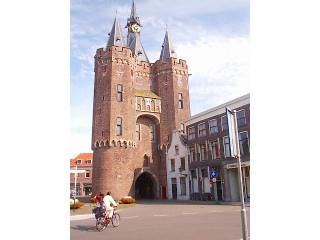 A main gate in Zwolle
They chose a gorgeous spot on a small lake (no mooring charges, no services)
about four kilometers up the Zwarte Water (Black Water, and it is almost
black), feeling isolated and in nature yet only ten minutes by bike from
the edge of town. Their 12-meter converted fishing boat was tied
to the bank, held in place by large stakes.
Both love to cook but Philly still works so Gerard does most of the cooking.
He was working on a Bolognese sauce when we arrived, but he came out to help
us tie up. Good thing. He had an anchor line off the rear
of his boat, and I wasn't sure of the depth in front, so we had little room
to maneuver. The wind was blowing us off his boat so Peg was
having difficulty pulling us in.
While we waited for Philly I rode to the bluff overlooking the river.
Large barges and pleasure craft make their way in the narrow river.
Trees line the way on one side, fields on the other.
Gerard was a truck driver who spent most of his time in Italy.
He likes to prepare Italian dishes. His sauce was good, the steak tender,
the wine French, the evening a long, delightful conversation. The next
evening I made paella with shrimp, chicken and Dutch sausage. More
French wine. Too much French wine. Lekka, lekka!
(something like, "Mighty fine.")
Gerard offered to take care of our boat during the winter. They
will be in a nearby marina where he will redo his boat. The marina
has covered space that he recommenced we use while they install some opening
windows on our boat. He drove us to see the owner the next day,
who will forward us an estimate for the windows. The indoor space
for the boat will cost f. 2000, much higher than the f 800 we have seen for
uncovered, in the water slips.
07/21-25/00
Devanter and Zutphen
Once you pass the lock in Zwolle you enter the Ijssel River.
We calculated the current at 6-7 kph. At 1700 rpm we are making only
8 kph, sucking fuel as we inch upstream. Some boats going downstream
stay on our starboard side in the curves, rather than the normal side, to
take further advantage of the current, which runs higher on the outside.
The WaterAlmanak and several people we have met say that the only place to
tie up is outside Devanter and that's where we head. Unfortunately
it's 2.5 kilometers from town. Since we are having guests, a
daughter of our friend Bob and her 27 children (or so it sometimes seemed),
this makes the marina inconvenient. On the other hand, it's quite
beautiful.
So is Devanter. Its high church tower, a few hundred steps up,
offers a great view of the town and countryside. Too bad it was
closed when we arrived. The rest of the town oozes charm with
its large squares, decorated windows, and typical Dutch architecture except
the exterior decor is fancier than most places. There's a fine
carving of Erasmus and some angels near the Grote Kerk (Big Church: note
'Kerk' appears as 'Kirk' in Gaelic, or it may be spelled Kerk as well, not
sure. Thus my last name means Church of Patrick).
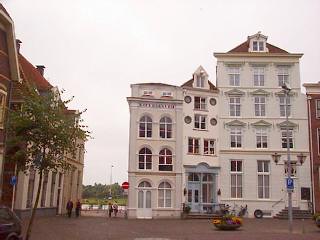 Building on the square in Deventer
Our guests are a musical family. They took us to a party put
on by some resident Americans, who are also musicians. Abby,
Lew , Shana (14) and Darvon (age 9, not her real name, she just needed a
dose or two) sang, played flue, guitar and saxophone. Their rendition
of "Boogie Woogie Bugle Boy" and "God Bless the Child," by Chicago (I think
I got that right) were quite charming. As was "Summertime."
I don't know the author of this slow, lazy, bluesy sounding song.
I liked Zutphen even more than Devanter, although the harbor is tiny, affording
us less than 10 meters to make the turn into a slip, which was half occupied
by another boat. The harbormaster said don't worry, there's room.
He was right. We just had to nudge the other boat out of the
way with our bow. Fortunately the wind was down or it would have
been more a ricochet than a nudge.
This town has a gorgeous old wall and gate, romantic when seen illuminated
at night, and an attractive pedestrian shopping zone. Of course,
the usual architecture but somehow different. More alleys, maybe,
or particularly well executed structures. I don't know.
Just like the place. Fuel dock on the river.
07/26-31/00
Doesberg, Wageningen, Wijk bij Duursted
On our way into Devanter the other day a small motorboat passed us, and then
fell suddenly behind. His engine died. We went back to
tie him onto our boat after we realized his predicament. His wife was
new to boating and lost two fenders as she tied them incorrectly.
He worked on the boat as we struggled upstream, finding water in the diesel.
He drained the water separator and the engine started. We let
their boat go, but had to rescue him again when the engine stopped after
a few minutes. We towed them to the harbor. He's
a diesel mechanic, he said, and had the engine running well the next day.
The Ijssel has several locks on it. One is the Driel. On
one side is a modern, high tech dam, on the other, the large lock.
It fulfilled the Dutch maxim, "It always rains in the locks."
Our rain jackets offered only partial protection.
Doesberg's harbor is near the cement plant, but that's the only ugly thing
about this town. The main plaza holds a typical large brick 'kerk.'
From the main plaza springs a pedestrian shopping zone and other typical
streets. It's worth a day's stay.
Wageningen's our next stop. It lies off the Nederrijn, which
is the Rhine's name in the Nederlands. The junction of the Ijssel
and the Nederrijn can be tricky when the current is high - it can get faster
than it is now during rainy periods. The Ijssel can push you
into the bank as you turn onto the Nederrijn; keep a wide berth.
As we made the turn, our necks nearly snapped with the acceleration, as we
went from 7-8 kph to nearly 20! It's a relief to have the current going
your way after more than 100 kilometers going against it.
Just as you enter Wageningen's attractive harbor you tie up at the 'melden
steiger,' the dock where you tie up to talk to the harbormaster.
He was waiting for us, helped us in, and had us a 'box' (slip) in no time.
I think it cost about f. 1 per meter. Toilet, showers, water, electricity.
The town is less than ten minutes by bike, along the dike protecting the
town lying four or so meters below. The centrum (center) is just two
minutes further, containing the usual shopping enveloped by delightful surroundings.
'The Rose' served us some fine Indian cuisine one evening.
From here we biked the dike to Wageningse Berg, a forest just outside Wageningen.
You can go for miles through dirt paths in deep forests, home to a wide variety
of folk take characters . We nearly encountered several, including
the seven dwarfes, but they cleverly hid each time just as we were about
to glimpse them. I'm sure they watched us as eating our lunch sitting
on a bench green with moss.
The forest climbs to one of Nederland's few mountains, maybe 300 km at the
peak. Bring your oxygen! Ski enthusiasts descend on artificial
snow during winter's gloom.
On the 30th we zoom at 15 kph to Wijk bij Duursted. The town's
old windmill turns as we enter the village on the bicycle from our haven
about 1 km outside town. It's open for tours during the town
festival. The festival includes a gathering of old motorized
boats in the downtown's tiny harbor. Several times a day over
the weekend the boats depart in a burst of horns, a cloud of smoke and a
'Hi O Silver!"
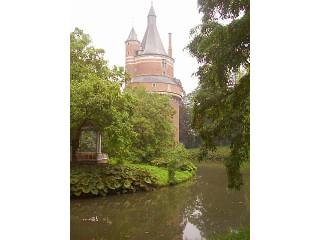 Castle in Wijkbijduursted
This is home to a fine though petite castle, partially intact, surrounded
by a moat and trees. As I sat sketching, two young men, in their late
teens, belched, smoked and worse, a rare display of ill manners in the homeland
of the shy and considerate. They wouldn't even let me join in.
We rode the bikes under threatening clouds to a nearby town.
Their windmill was turning and they offered a guided tour. Our
55ish guide has volunteered many hours restoring this mill, which unlike
the one in Wijk bij Duursted, actually grinds flour on weekends and special
events. He showed us all the gears and the brake, which
he used to stop the giant wings so we could look at them up close.
On the 31st it's Culemborg for a too short visit. Its fabulous
buildings cannot be missed. The style is typical but the collection
is in unusually fine condition.