August 2001 (Northern France including the Champagne
region)
August 1-9, 2001
From the 1st through the 7th of August we dealt with various mechanical
problems and visited every day with Sally and Paul. We took the
boat down the canal to Gard on the 3rd for three days but then returned to
Landricies when the engine would barely start when cold. Herve installed
a new glow plug switch and an adjustable timer after coming to the boat to
determine the problem.
While in Gard we rode our bikes to Tupigny, a gorgeous, hilly ride on the
way there. On the way back we took the towpath along the canal.
Tupigny is typical of the little towns in the area. There is a
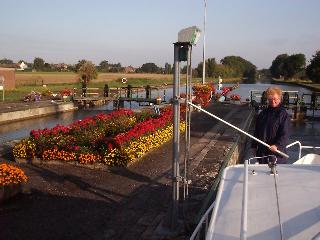
small WWI monument, a few streets, flowers everywhere –on the streets, the
houses, the buildings, even the locks – a few shops, the Mairie (the Mayor’s
office/town hall) and assorted houses wedged among tree-filled hills.
Starting from Landricies on the 8th, we passed through 50 locks to get to
Tergnier on the 9th, a 50-kilometer/30 mile journey. Gard starts a series
of semi-automatic locks. The gates open automatically,
sometimes activated by a motion detector, others timed from lock to lock.
Our chart tells us that the lock at Gard is keeper-controlled, so we waited
for a lockkeeper. It was ten minutes before one came. He
explained that once you are ready you pull on one of two metal poles.
One has a sign that says take a bath or something while the other is red,
an emergency stop activator. There are 7 more locks of this style, each
less than a kilometer or so apart. Then lockkeepers man some of the
locks, additional automatic ones thrown in here and there. Each
lock is type-identified on the chart. The locks empty gently,
and there is little turbulence as you enter and leave.
We found Paul and Sally moored in Venerolles, just as you enter a section
where the locks become manual; a lockkeeper accompanies you the entire way,
albeit not the same one. We leave Paul and Sally behind waiting
a fax and a renewal of a prescription. Their location is downwind
of the rendering plant’s unpleasant odor, so we prefer to move on. In
addition we want to reach St. Quentin, a convenient place to meet up with
John and Ann, coming up from Paris in a few days. St. Quentin
is only 60 kilometers by boat but it will take us about a day and a half to
get there.
Along the way we pass through valleys snuggled between low hills, none more
than say a hundred meters, perhaps two, above the canal. Some
areas are wooded, there are reeds and grasses along the canal.
We see birds of wide variety, including one type of crane, gray in color.
When it spreads its wings it reminds more of a pterodactyl than a modern bird.
We got a good look at a rodent in the water. It looked like a
cross between something in the beaver family (Wally perhaps) and the rat
family. They seem to live along the banks near the water line.
I’ve seen them scurry into holes they’ve burrowed. This one I
name Fred. Fred may be a river otter.
Houses along the canal are mostly of stone and brick, though a few are stuccoed.
In Vadencourt we stopped for the night, us alone tied to the newly installed
bollards. There is a small hill on our port, dozens of birds flying
above its thick coat of trees. To starboard behind a line of trees
is a creek that feeds off the canal. The town is invisible from
the boat but is just five minutes by bike. A memorial recalls
WWI dead. Here as everywhere we have been in France it is quite peaceful.
We’ve encountered little commercial traffic on the canal.
On the 9th we pass through the last of the manual locks. The
semi-automatic ones are faster largely because you don’t have to wait for
the lockkeeper to walk around the lock operating the gates paddles that let
the water in. Cranking the locks and paddles involves no great physical
effort
The canal, dateing from the mid 1800’s, passes over the road and the Oise
River as well. Ponds flank the canal, giving us views of lily
pads and fisherman through the brush and trees below us.
Fields on either side, some fallow and golden, recall a van Gogh landscape,
nestled before hills and between towns. Cows munch much everywhere
you look, sometimes sharing with horses. More than a few back
yards shelter chickens, the occasional duck, and enough geese to fois gras
the entire province. Fishermen sit on platforms, umbrellas open against
the elements, their several poles sitting, sitting, sitting in the water.
Nary a caster amongst the lot.
We stayed the night on the outskirts of Tergnier, which seems to exist mostly
for all the rail traffic that passes here on the way to the Ruhr valley in
Germany. On one side sit several of the countless fishermen, on
the other it’s us and some raspberry bushes. We see nary a soul nor
hear a sound the entire evening after the fishermen left, except for the
odd couple on the other side of the canal.
I refer not to the couple taking a walk, but their two dogs.
One was a bouncy Rotweiler type, chewing on a ball which he places at his
master’s feet, retrieving it with such enthusiasm that all four feet go straight
up as he waits the next throw. The other is a two toned poddle/Lasha
Apso . Its fur is brown except for its head and tail, which were white.
It looked like the dog had her fur frosted at some Chez Pierre.
Caprice in Tergniers
08/10-31/01
St. Quentin is our next stop. John and Ann, who live six months of
each year in Paris, will join us for several days. They will arrive
on the 10th. The canal from Tergnier is unremarkable, especially as
you approach St. Quentin, except for a small, wooded island in St. Simon,
at the junction of the Canal de la Somme and the Canal de St. Quentin.
The marina is easy to get into and clean, set in from the canal so there
is no wake from the few passing barges. There is a gas station
across the street. I haul one of our four jerry cans back
and forth so many times I made friends with the attendant. Finding fuel
docks is difficult in France so one is well advised to stock up whenever it
is convenient. It is illegal to use red diesel. It
is dyed red to distinguish it from the heavily taxed fuel. The
former at 2.5 francs/liter ($1.50 per gallon) is less than half the price
of the latter.
St. Quentin has a notable Hotel de Ville (City Hall). It is gothic
in style, dating from the 15th century, I think. Peg says that
it is rare for anything but a church to be built in this style.
A small female figure, apparently masturbating, is carved at just above eye
height, so I guess it was never meant to be a church. The pedestrian
zone in the area around the Hotel makes the ride up the steep but short hill
worthwhile.
The next day we moved the boat near the train station and shortly Peg returned
with John and Ann. They wheeled a box with the microwave John
found for us. He finds all kinds of appliances, furniture and
other useful items on the streets of Paris. The microwave is in top-notch
condition, maybe less than a year old.
With John and Ann on board we return to the little island on St. Simon.
A French boater guides us in. He works for the VNF, the inland
waterway authority. He keeps Peg busy for an hour or two with
details about where to stay and what to see. Otherwise the evening
is quiet except for our hours of conversation, dark except for the candles
we burn. Stars fill the skies and we watch satellites streaking
across the night sky.
Here as elsewhere there are few annoying insects, except the ever-present
spider weaving for his living. His name is Fred. He
had many wives and children, all named Fred. Everyone must have
a name.
Ann’s father had a boat of more or less our size when she was a child.
She hated it in part because she felt claustrophobic. Fortunately
she found ours pleasant. She boated around NYC, and remembered
Hell’s Gate, which can be quite rough and it known also for its powerful currents.
It was used as an example in my Power Squadron courses for the effect of
tide and current. Here there is neither tide nor current, and
nary a wave to upset the dinner cart.
After a few days of hot weather, John and Ann departed from Chauny.
The rail station is less than ten minutes from the ‘port du plaisance’ (marina)
on the Canal Lateral a l’Oise (the canal which runs lateral to the Oise river).
We returned to Terngnier to spend a day or two with Paul and Sally.
Now the weather has become rather warm and Terngnier offers shade in the afternoon.
Paul is able to mimic several British accents besides his own native Liverpoolian.
He did a Aberdeen (in the north of Scotland), a Yorkshire and an Indian especially
well. We roared at the last of these. Paul told a child’s
joke about a mouse, which cannot be communicated in writing, which also left
us rolling on the floor. I think for it to work you need a British
accent.
Paul and Sally are vegetarians. She made a vegetarian chili
using beef flavored TVP (texturized vegetable protein made from soy) that
even Peggy liked. She brought over a ‘pudding.’ We were
expecting that gelatinous stuff but no, ‘pudding’ is British for desert.
Peg and I enjoy Paul and Sally not only for their sense of humor but also
because it’s so much fun to learn how other English speakers pronounce the
language and use different terms from the American.
Paul and Sally do not rinse their dishes. They wipe them dry with
a dishtowel and put them away, soap residue and all. We’ve come
to know several Brits and they all do the same. Paul explained
that it was a waste of water to rinse the dishes, even when they were on land
with plenty of water. They never notice a soap taste.
Upon their return from the boulangerie one afternoon, they were quite surprised
to see their bow half way across the canal, Peg and I trying frantically to
pull it back in. A passing barge had pulled the stakes (‘pin’ in British
parlance) loose. A frantic shout from Peg got me out of the aft
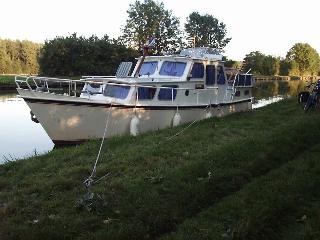
cabin, Peg climbed on the Nidd while I threw her a line. I had to remind
her to tie the line to the boat. Holding the line and pulling
without tying on normally works on our boat. But on a boat this
heavy, I’d just pull her into the water.
Peg in the St. Quentin/Terngnier lock
On the 17th we said goodbye to our friends, stopping in Chauny to get fuel.
A truck comes to the east side of the canal only, and runs a hose down to
the boat. Some trucks will only come if you buy 500 liters, but this
one had only a 100-liter minimum. The office is just across the street.
There is also a marina across the way whose finger piers jut into the canal.
The fee is about 70 ff per night, plus 10 ff to take a shower. That’s
a $1.50, three times what one costs in Holland, while the nightly fee is 20-40%
higher.
We ride about town on our bikes, crossing the bridge into the small centre
ville (town center). The streets are lined with the usual small shops:
hair dressers, apparel, shoes, cafes and restaurants. All these
towns have churches, of course, though less than 10% of the population actually
attend. The one in this town does merit attention in our Navicarte,
the annotated chart we use to find our way along the canals and rivers.
On the 18th we stay the night in the most beautiful spot we have yet found.
We are on Le Canal de l’ Oise a l’Aisne at Guny Lock 2. Just behind
us is the old lockkeepers house, beautifully painted, with potted flowers
galore. On the right and left there is nothing but forest.
Nary a car passed over the 3- meter wide canal the entire night.
Again the sky is filled with stars, dancing slowly to a symphony of silence.
This canal is quite narrow, perhaps only 20 meters (60 feet) at points and
about 2 meters in depth at most. Trees hang over the banks, some
having fallen in, further narrowing the passage. We passed only
a few barges along the way, fortunately without difficulty. The
banks are in need of repair in many places. I think that the cost compared
to the commercial viability of the canal is delaying or preventing much needed
maintenance.
On the 21st we arrive in Reims. The marina is just 500 meters
from the famous and magnificent Cathedral. The pedestrian zone
is less than 10 minutes away by foot. Unfortunately a busy bridge
enters the center ville just over our heads. The traffic noise
mars an otherwise excellent location.
08/21-31/01
David from Dallas joined us on the 23rd for the next five days. We
stayed in Eparnay, the capital of the Champagne region, located on the River
Marne. All three of us had been here, Peg and I several times,
so we skipped the champagne tours and didn’t even spend time in the town.
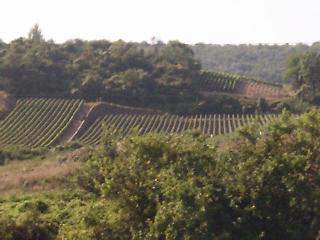
The point of us being in the area is the hilly countryside filled with vineyards.
There is hardly a more beautiful inland boat passage to be found anywhere,
a magic in passing so many thousands of rows so perfectly aligned that there
are rows on the diagonal which become visible as you pass. Where
there are no grapes there is corn, where there is no corn, there are sunflowers
whose still small and blank faces look at you blindly. ‘Sunflower’ in
French is tournesol, literally “turn to the sun.”
Countryside in the Champagne region near Chateaux
Thierry
The countryside locks are often beautiful, mostly operated by lockkeepers.
The locks have been so gentle that we began to hold on only with boat hooks.
Then one lock was so turbulent that Peg could not hold on. The
bow swung to the other side of the lock, banging against the side.
Nothing was bent, our only loss a bit of paint. Oh well, time to paint
anyway.
On the 28th we arrive in Poincy. Our original plans would not
have brought us this far south this year. However, the Canal de
la Somme is closed due to flood damage this past spring. Thus
we are within 60 kilometers of Paris.
Poincy is a tiny town with a marina holding about 25 boats. Fortunately
we called ahead to reserve a spot, as all the slips were taken except one.
They didn’t take our name but distinguished us from another boat whose owner
called by our length. A fail proof system, no?
The club is protected from the river traffic, minimal though it is, by a
tiny island that splits the Marne. The current keeps the waters
clean. Ducks and geese visit the boats, the little ones sitting
on a piece of lumber used to keep flotsam off the boats.
The weather cools a bit at last, for it has been hot since before Reims,
forcing us to drape the boat with canvas and make for shade in the afternoon,
when interior temperatures reach the mid-90’s.
The marina is eccentrically decorated by an old gypsy wagon and a metal
building that holds the sanitary facilities. A man of few words
cares for the place, pensioned from his job and here only compensated by
the club’s members with free lodging. We can safely leave the
boat while we go to Paris, just 30 minutes on the train. Quiet
Man takes us to the station, the train into the noise of Paris.
The tour company we did some work for in March, April, June and July has
several meetings a year for its tour leaders. If you come from out of
town, they arrange and pay for a hotel, and treat you to dinner.
Dinner was at a place called La Barge. It was indeed a barge,
tied to the bank of the Seine. Puffed pastry shells filled with
clams, mussels, shrimp and crab, provided the main course. It
was all the wine you wanted. We were too stuffed and the music
too loud for us to stay for desert. We saw a few people we knew.
One was Lynn went with Peg on the latter’s first tour. Their group
was 60 in number, necessitating two buses and two tour directors.
Lynn is a widow, one of a string we’ve met in France whose French husbands
died young. Perhaps there is the making of a syndrome or a detective
novel in this. Anyway, like most tour directors, Lynn is outgoing,
friendly and ready to take charge at a moment’s notice.
end