| BACKGROUND |
| In 1982, under the overall guidance of the ICAO
Review of the General Concept of Separation Panel
(RGCSP), several States initiated a series of
comprehensive work programs to examine the feasibility of
reducing the vertical separation minimum above FL 290
from 600m (2,000 ft) to 300m (1,000 ft). Studies were
made by member states of EUROCONTROL (France, Germany,
the Kingdom of the Netherlands, and the United Kingdom -
in an extensive co-operative venture which was
coordinated by the EUROCONTROL Agency), Canada, Japan,
the former Union of the Soviet Socialist Republics
(USSR), and the United States of America (USA). |
| GENERAL |
| The primary objectives of these studies was to
decide whether a global implementation of the Reduced
Vertical Separation Minimum (RVSM) : |
a) would satisfy predetermined
safety standards;
b) would be technically and operationally feasible,
and
c) would provide a positive Benefit to Cost ratio.
|
| For this reason on 99.10.01., JAA Administrative
& Guidance Material Section One: General Part 3:
Temporary Guidance Leaflet No.6: Revision 1 is published. |
| FLIGHT PLANNING |
| During flight planning the flight crew should
pay particular attention to conditions that may affect
operation in RVSM airspace. |
| These include, but may not be limited to: |
- verifying that the airframe is
approved for RVSM operations;
- reported and forecast weather on
the route of flight;
- minimum equipment requirements
pertaining to height keeping and alerting
systems: and
- any airframe or operating
restriction related to RVSM approval.
|
| |
PRE-FLIGHT PROCEDURES AT THE
A/C
FOR EACH FLIGHT |
| The following actions should be accomplished
during the pre-flight procedure: |
- review technical logs and forms to
determine the condition of equipment required for
flight in the RVSM airspace. Ensure that
maintenance action has been taken to correct
defects to required equipment;
- during the external inspection of
aircraft, particular attention should be paid to
the condition of static sources and the condition
of the fuselage skin near each static source and
any other component that affects altimetry system
accuracy. This check may be accomplished by a
qualified and authorised person other than the
pilot (e.g. a flight engineer or ground
engineer);
- before take-off, the aircraft
altimeters should be set to the QNH of the
airfield and should display a known altitude,
within the limits specified in the aircraft
operating manuals. The two primary altimeters
should also agree within limits specified by the
aircraft operating manual. An alternative
procedure using QFE may also be used. Any
required functioning checks of altitude
indicating systems should be performed.
Note. The maximum value for these
checks cited in operating manuals should not
exceed 23m (75ft).
- before take-off, equipment
required for flight in RVSM airspace should be
operative, and any indications of malfunction
should be resolved.
|
| |
| PROCEDURES PRIOR TO RVSM
AIRSPACE ENTRY |
| The following equipment should be operating
normally at entry into RVSM airspace: |
- Two primary altitude measurement
systems.
- One automatic altitude-control
system.
- One altitude-alerting device.
Note: Dual equipment
requirements for altitude-control systems will be
established by regional agreement after an
evaluation of criteria such as mean time between
failures, length of flight segments and
availability of direct pilot-controller
communications and radar surveillance.
- Operating Transponder. An
operating transponder may not be required for
entry into all designated RVSM airspace. The
operator should determine the requirement for an
operational transponder in each RVSM area where
operations are intended. The operator should also
determine the transponder requirements for
transition areas next to RVSM airspace.
|
| Should any of the required equipment fail prior
to the aircraft entering RVSM airspace, the pilot should
request a new clearance to avoid entering this airspace; |
| |
| IN-FLIGHT PROCEDURES |
| The following practices should be incorporated
into 8ight crew training and procedures: |
- Flight crew will need to comply
with any aircraft operating restrictions, if
required for the specific aircraft group, e.g.
limits on indicated Mach number, given in the
RVSM airworthiness approval.
- Emphasis should be placed on
promptly setting the sub-scale on all primary and
stand-by altimeters to 1013.2 (hPa) 29.92 in.Hg
when passing the transition altitude, and
rechecking for proper altimeter setting when
reaching the initial cleared flight level;
- In level cruise it is essential
that the aircraft is flown at the cleared flight
level. This requires that particular care is
taken to ensure that ATC clearances are fully
understood and followed. The aircraft should not
intentionally depart from cleared flight level
without a positive clearance from ATC unless the
crew are conducting contingency or emergency
manoeuvres;
- When changing levels, the aircraft
should not be allowed to overshoot or undershoot
the cleared flight level by more than 45 m (150
ft);
Note: It is recommended
that the level off be accomplished using the
altitude capture feature of the automatic
altitude-control system, if installed.
- An automatic altitude-control
system should be operative and engaged during
level cruise, except when circumstances such as
the need to re-trim the aircraft or turbulence
require disengagement. In any event, adherence to
cruise altitude should be done by reference to
one of the two primary altimeters. Following loss
of the automatic height keeping function, any
consequential restrictions will need to be
observed.
- Ensure that the altitude-alerting
system is operative;
- At intervals of approximately one
hour, cross-checks between the primary altimeters
should be made. A minimum of two will need to
agree within ±60 m (200 ft). Failure to meet
this condition will require that the altimetry
system be reported as defective and notified to
ATC:
(1) The usual scan of
flight deck instruments should suffice for
altimeter cross-checking on most flights.
(2) Before entering RVSM
airspace, the initial altimeter cross check of
primary and stand-by altimeters should be
recorded
Note: Some systems may
make use of automatic altimeter comparators.
- In normal operations, the
altimetry system being used to control the
aircraft should be selected for the input to the
altitude reporting transponder transmitting
information to ATC.
- If the pilot is advised in real
time that the aircraft has been identified by a
height- monitoring system as exhibiting a TVE
greater than ±90 m (±300 ft) and/or an ASE
greater than ±75 m (±245 ft) then the pilot
should follow established regional procedures to
protect the safe operation of the aircraft. This
assumes that the monitoring system will identify
the TVE or ASE within the set limits for
accuracy.
- If the pilot is notified by ATC of
an assigned altitude deviation which exceeds
±90m (±300ft) then the pilot should take action
to return to cleared flight level as quickly as
possible.
|
| |
| Contingency procedures after
entering RVSM airspace |
| The pilot should notify ATC of contingencies
(equipment failures, weather) which affect the ability to
maintain the cleared flight level, and co-ordinate a plan
of action appropriate to the airspace concerned. Detailed
guidance on contingency procedures are contained in the
relevant publications dealing with the airspace. |
| Examples of equipment failures which should be
notified to ATC: |
- failure of all automatic
altitude-control systems aboard the aircraft;
- loss of redundancy of altimetry
systems;
- loss of thrust on an engine
necessitating descent; or
- any other equipment failure
affecting the ability to maintain cleared flight
level;
|
| The pilot should notify ATC when encountering
greater than moderate turbulence. |
| If unable to notify ATC and obtain an ATC
clearance prior to deviating from the cleared flight
level, the pilot should follow any established
contingency procedures and obtain ATC clearance as soon
as possible. |
| |
| POST FLIGHT |
| In making technical log entries against
malfunctions in height keeping systems, the pilot should
provide sufficient detail to enable maintenance to
effectively trouble-shoot and repair the system: The
pilot should detail the actual defect and the crew action
taken to try to isolate and rectify the fault. |
| The following information should be recorded
when appropriate |
- Primary and stand-by altimeter
readings.
- Altitude selector setting
- Subscale setting on altimeter.
- Autopilot used to control the
aeroplane and any differences when an alternative
autopilot system was selected.
- Differences in altimeter readings,
if alternate static ports selected.
- Use of air data computer selector
for fault diagnosis procedure.
- The transponder selected to
provide altitude information to ATC and any
difference noted when an alternative transponder
was selected.
|
| |
| SPECIAL EMPHASIS ITEMS:
FLIGHT CREW TRAINING |
| The following items are included in flight crew
training programs: |
- knowledge and understanding of
standard ATC phraseology used in each area of
operations,
- importance of crew members cross
checking to ensure that ATC clearances are
promptly and correctly complied with;
- use and limitations in terms of
accuracy of stand-by altimeters in contingencies.
Where applicable, the pilot should review the
application of static source error
correction/position error correction through the
use of correction cards;
Note: Such correction
data will need to be readily available on the
flight deck.
- problems of visual perception of
other aircraft at 300m (1 ,000 ft) planned
separation during darkness, when encountering
local phenomena such as northern lights, for
opposite and same direction traffic, and during
turns; and
- characteristics of aircraft
altitude capture systems which may lead to
overshoots;
- relationship between the
aircraft's altimetry, automatic altitude control
and transponder systems in normal and abnormal
conditions;
- any airframe operating
restrictions, if required for the specific
aircraft group, related to RVSM airworthiness
approval.
|
| |
| FLIGHT CREW INFORMATION
NOTICE |
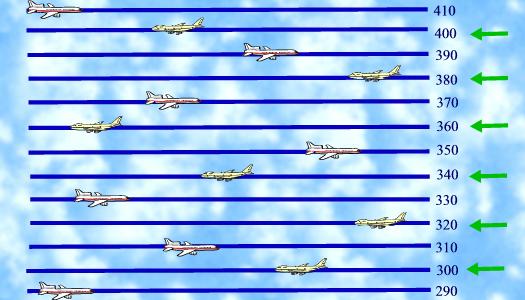
| Reduced Vertical Separation Minimum in the
EUR-RVSM Airspace will permit the application of a 1000
ft vertical separation minimum between suitably equipped
aircraft in the level band FL290-FL410 (incl) on
24/01/2002. |
| The purpose of RVSM is to increase airspace
capacity and provide airspace users with more flight
levels and thus optimized flight profiles. |
APPROVAL
FOR RVSM OPS
|
| Only RVSM approved aircraft will be permitted to
operate within the EUR RVSM Airspace. The approval is
issued to aircraft operators by the responsible authority
once an operator has achieved the following: |
- each aircraft type has received
airworthiness approval demonstrating compliance
with the RVSM Minimum Aircraft System Performance
Specification (MASPS),
- the State's approval of both the
operations manual and the maintenance- procedures
specific to RVSM ops.
|
| |
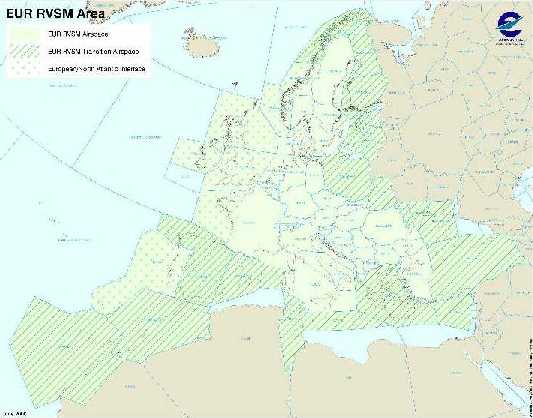
RVSM
AREA
|
|
HEIGHT
MONITORING PRINCIPLES
|
A comprehensive means of monitoring the
height-keeping performance of aircraft in the EUR RVSM
Airspace has been developed utilising two types of
monitoring equipment:
- Height Monitoring Units (HMUs)-
Fixed ground based height-monitoring facilities
at Linz, Nattenheim & Geneva which monitor
passing aircraft normally without action from
aircraft operators;
- GPS Monitoring Units (GMUs)-
portable monitoring units carried on board
aircraft to supplement HMUs & monitor
aircraft which are not normally flying over HMUs
|
| RVSM compliant aircraft are required to
participate in the monitoring program, which will
commence in Spring 2000. In some cases, aircraft may
request a re-routing so that they may be height
monitored. |
RVSM
PROCEDURES IN TRANSITION AREAS
|
| A number of FIR/UIRs in the EUR RVSM Airspace
have been designated to handle the transition of aircraft
from an RVSM to a non RVSM environment and vice-versa.
Within this "EUR RVSM Transition Airspace",
special procedures will allow ATC to transition both RVSM
and non-RVSM Civil and State aircraft. Flight crews may
expect to change from Conventional Flight Levels to RVSM
Flight Levels and vice-versa ATC will continue to provide
a 2,000 feet VSM between a non-RVSM approved aircraft and
any other aircraft. |
AIRCRAFT
EQUIPMENT
|
| The minimum equipment list (MEL) fulfilling the
MASPS consists of : |
- Two independent altitude
measurement systems each equipped with:
|
- cross-coupled static source system
with ice protection if located in areas subject
to ice accretion,
- display of the computed pressure
altitude to the flight crew,
- digital encoding of the displayed
altitude
- signals referenced to a pilot
selected altitude for automatic altitude control
and alerting,
- Static source error correction.
|
- One SSR transponder with an
altitude reporting system in use for altitude
keeping.
- An altitude alerting system.
- An automatic altitude control
system.
|
| |
| ACAS |
| TCAS Version 6.04A is designed for a non-RVSM
environment. ACAS II (TCAS Version 7.0) has improved
compatibility with RVSM. The Mandatory Carriage and
operation of ACAS II for aircraft above 15000 kg and more
than 30 passengers started on 1 January 2000 with a
transition period ending in March 2001. |
| FLIGHTPLANNING |
| The flight crew shall pay particular attention
to conditions that may affect operation in RVSM airspace:
|
- verifying that the aircraft is
RVSM approved, ie compliant with the MEL
- analysing the reported and
forecast weather that may affect RVSM
requirements (turbulence, icing ... ),
- reviewing the manufacturers and
the operator's restrictions concerning RVSM
operations.
- ICAO FPL: the letter W shall be
inserted in field 10 if RVSM approved
- RPL : the letter W shall be
inserted in Item EQPTI if RVSM approved,
regardless of the requested FL
|
| |
| PRE-FLIGHT PROCEDURES |
| Flight crew shall verify: |
- the condition of the equipment
required for RVSM operations and that maintenance
actions have been taken to correct defects,
- the condition of static sources,
- the altimetry accuracy by setting
the QNH or the QFE. The reading should then agree
with the altitude of the apron or the zero height
indication within a 75ft (23m) tolerance.
|
| |
| IN-FLIGHT PROCEDURES |
- all the required equipment shall
be monitored to ensure satisfactory operation
before and within RVSM airspace.
- when changing level, the aircraft
should not overshoot or undershoot the cleared
flight level by more than 150ft (45 m).
- the automatic altitude control
system shall be engaged during level cruise by
reference to one of the two altimeters. If
fitted, the altitude capture feature shall be
used whenever possible for the level off
- cross checks of the primary
altimeters shall be made at intervals of
approximately one hour. These primary altimeters
shall agree within 200ft(60m).
|
| Failure to meet that condition will require the
altimetry system to be reported as defective and
immediately notified to ATC. An initial check shall be
recorded just before entering the EUR-RVSM Airspace. |
| |
| CONTINGENCY PROCEDURES |
- the pilot shall notify ATC of any
contingency (equipment failure, weather hazards
such as severe turbulence etc... ) which affect
the ability to maintain the declared level or the
RVSM requirements (eg. MEL).
- ATC may take appropriate tactical
actions to ensure that safe separation is
maintained, including reversion to a 2000ft
separation minimum
- when notified by ATC of an
assigned altitude deviation of more than 300ft
(90m), the pilot shall take action to return to
the cleared level as quickly as possible.
- If unable to notify ATC, the pilot
shall follow established contingency procedures
and obtain ATC clearance asap.
|
| |