 |
| Home on the Range... |
|
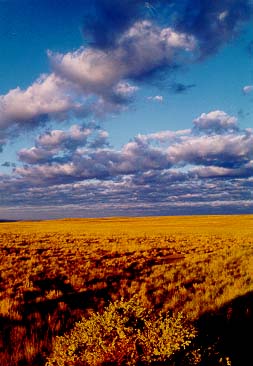
| While bison don't roam here, both deer and pronghorn ("antelope") certainly play amidst the silver, gray, and pale green sage and saltbush. A surprisingly diverse region, grasslands support hundreds of plant and animal species. The low, rolling hills are Tertiary deposits of sediment, including sand dunes stabilized by grasses and shrubs. Ephemeral washes bisect the landscape, guiding the often-torrential summer thunderstorm rainfall into the Puerco and Little Colorado Rivers. Seemingly tough and durable, grasslands are actually one of the most endangered habitats in North America. Petrified Forest National Park protects and preserves some of the most complete remnants of shortgrass prairie in the region. |
| 1. pronghorn 2. collared lizard 3. saltbush 4. globe mallow 5. kit fox 6. coyote 7. raven 8. red-tail hawk 9. mule deer 10. prairie dog 11. bobcat 12. Western rattlesnake 13. evening primrose 14. grama grass |
| Love grass Blue sage one-seed juniper Greasewood Prairie coneflowers Small-leaf Desert paintbrush Wooly paperflowers Prairie sunflowers |
| Turkey vulture Northern harrier American kestral prairie falcon Common nighthawk Western meadowlark Western wood pee-wee Scaled quail Rufous hummingbird Rock wren Raven |
| Bullsnake Arizona milksnake Arizona kingsnake Glossy snakes Plateau whiptail Western fence lizard Sage lizard Side-blotched lizard Red-spotted toad |
 |
 |
 |
 |
 |
 |
 |
 |
| Imagine returning from a trip to discover your home destroyed. Hundreds of plants and animal species are losing their home through the encroachment of development, pollution, agricultural use, and invasive exotic species. Non-native grasses such as brome take over a large area, preventing the growth of native species to which the local animals are adapted. Overgrazing by domestic stock encourage ground cover such as cacti and broom snakeweed which don't provide the same nutrition as native grasses. It would be like finding a stranger had moved into your house and wouldn't let you in the door. |
 |
 |
 |
 |
 |
 |
| When settlers came to this area more than a century ago, the shortgrass prairie was as vast as the sea, a rich resource. One of the largest ranches in American history (third largest in North America), the Aztec Land and Cattle Company took advantage of this natural opulence, eventually running more than a million head of cattle. Like the mixed and tallgrass prairie, the shortgrass prairie of northern Arizona was soon an environment of the past. Even within the boundaries of protected lands, the full magnificence of the grassland has never reached its full potential again. |
| Remember that the prairie is home to many plants and animals. Just as we would be devastated by the loss of our home, species of the grassland are endangered by their loss of habitat. In some cases, loss of habitat can mean the disappearance of an entire species. |
 |
 |
| In some areas, landowners, including farmers and ranchers, are aiding in the fight to protect our dwindling grasslands. Through wise management and education, grasslands throughout North America are making a comeback. |
| Do you recognize these grassland inhabitants? |

|
| Just a few of the species that can be seen in this region include: |
 |
 |
 |
| 1. |
| 2. |
| 3. |
| 4. |
| 5. |
| 6. |
| 7. |
| 8. |
| 9. |
| 10. |
| 11. |
| 12. |
| 13. |
| 14. |
| white-tailed antelope ground squirrel silky pocket mouse pallid bat |