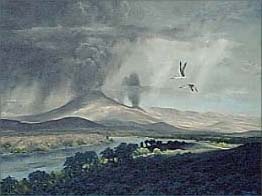
| The Bidahochi Formation, located on the southern Colorado Plateau, covers an area of about 16,000 km2 (~6,200 mi2). This very eroded formation represents sedimentation and volcanism of the Miocene and the Pliocene of the Cenozoic. The Hopi Butte volcanic field has the largest concentration of maar landforms in the world. Many of the volcanoes were phreatomagmatic, when ground- or lakewater mingled with eruptive material to cause an explosive eruption. The resulting ash formed fine-grained deposits that interbedded with the lake sediments. The volcanoes were also relatively short-lived. |
 |
 |
 |
| 5-16 million years ago: Lake and Lava |
 |
 |
 |
 |

|
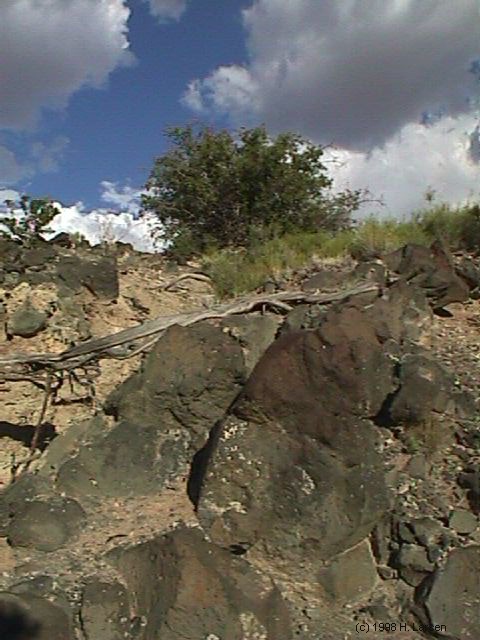
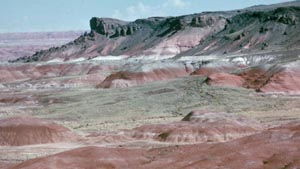
| The region continued to experience tectonic activity, mostly from the Basin and Range Tectonics (central Arizona and along the western edge of the Colorado Plateau) and during the opening of the Rio Grande Rift in New Mexico (~16 million years ago.) During the Pliocene, a shallow lake as large as Lake Erie or many shallow lakes covered much of Northeastern Arizona, depositing fine-grained sediment such as silt, clay, and sand, now part of the lower member of the Bidahochi Formation. Nearby, volcanoes spewed ash and lava over the land and into the lake. After millions of years of erosion, most of the Bidahochi Formation has been removed, exposing the volcanic landforms known as maars and scoria cones. The portions of the Bidahochi Formation that remain exist because the lava flows are resistant to erosion and protect the softer lake bed sediments beneath. Lava capstone tops buttes and mesas seen in the park and the Hopi Buttes area. |
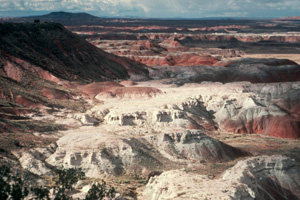
| In Petrified Forest National Park, the first five miles of the scenic drive displays the basalt of the Rim and overlooks the pale ash tuff of the Painted Desert Below. From several view points, the Hopi Buttes may be seen, remnants of the ancient Hopi Buttes volcanic field. Recent research dates the Bidahochi Formation between about 16 million years ago to about 4 million years ago. It appears that Hopi Lake drained about 5 million years ago. |
 |
 |
 |